• TalkBass has been independent since 1998. Add your voice.
    Create a free account to reply to discussions, view embedded media, and browse with fewer display ads.
    Join freeLog in
    Want zero display ads or expanded classifieds tools? Compare plans.

New bass or New neck- what would you do?

Great discussion! I really appreciate all your inputs.

Here’s what I’ll do.

- I’ll buy the squier to give it a serious try in band situations.

- I have access to an MIM precision neck at least to try. I’ll try and see if that fits the ESP. Plus measure it. But keep in mind: the 22nd fret on the original neck is on an overhang so that’s not an issue- under the fingerboard it’s just a normal neck. If the pocket fits, then I’ll see if I get a replacement neck. And I’ll contact my go-to luthier dude to see what he says.

But, if the Squier feels right in the long run, I’ll keep it. If not for anything else, the matching headstock is very cool.

But, alas, no SVT for me. And no 8x10.

best
Sidecar
 
Smart move.
One thing people forgot to mention...matching headstocks definitely make basses sound better!
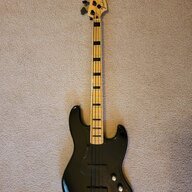
Pics-Art-09-08-03-31-16.jpg
 
Last edited:
Cheapest - probably get an ESP replacement neck, but that might be hard to find. Otherwise, buy a Fender or Squier neck as others have said, but ONLY if it will fit the ESP neck pocket.
 
  • Like
Reactions: MrSidecar
Ok,

the question is: I’m playing an 80s ESP 400 precision, a true beauty, great sound, but with a neck twist.

With the equivalent of USD 580 at your disposal, what would you do? Replace the neck with a genuine Fender P neck, or spend the money on a new squier fsr 50s precision (sonic Blue, a beautiful and very tempting bass I’ve already tried and do like quite a bit)?

Hit me, talkbass.

Best
Sidecar

In my opinion, if you played the bass and liked it, go with that.
 
  • Like
Reactions: MrSidecar
How bad is the twist? I'd take the bass to a luthier to see if it can be fixed. Probably something like 350-400 for the job since your bass has a rosewood fretboard (no need to refinish after planing the board). On the upside, the bass is going to play like butter after the operation, and you would've needed a refret down the line anyway.
 
Last edited:
I’ll definitely check with my luthier as well, if the twist can be cured maybe. But, as the bass has been through a rough time in a public school, the fretboard has seen better days. Maybe a refret would be in order as well.

But in general, I don’t like hoarding and, and I normally avoid new things. So, if I’d keep the Squier, the ESP would have to go. No need for more than one P and the ‘51 style single coil p I have.

I’ll post the process in any case.

Best
Sidecar
 
I’ll definitely check with my luthier as well, if the twist can be cured maybe. But, as the bass has been through a rough time in a public school, the fretboard has seen better days. Maybe a refret would be in order as well.

A twist isn't even necessarily a bad thing if each string can see a straight plane from the bridge to the nut. A good luthier will properly assess the situation and give you options.

A minor twist can be fixed with a simple fret level (if there's enough fret material to remove). The next step would be pulling the frets, planing the fretboard, and then re-installing frets (meaning you get a refret for "free").

There are even companies making basses with twisted necks to improve ergonomics: Torzal Guitars
 
Last edited:
  • Like
Reactions: TrustRod
A lot of twisted necks are playable - if it twists the right way (a la Torzal), a twisted neck can be more playable than a straight one. I’d play the thing, maybe dress the frets if it needed it due to the nature of the twist.
 
  • Like
Reactions: Windreaper
A lot of twisted necks are playable - if it twists the right way (a la Torzal), a twisted neck can be more playable than a straight one. I’d play the thing, maybe dress the frets if it needed it due to the nature of the twist.

Yeah, the important factor is determining if the twist causes playability problems, at which point you can either level the frets or get the board planed and refretted, if it's more severe. Had one of my necks fixed this way, and it hasn't moved since.

I've got an ESP jazz bass with a slight counter-clockwise twist looking from the nut (the desired direction), and it plays great, probably even better than if the neck was dead straight.