• TalkBass has been independent since 1998. Add your voice.
    Create a free account to reply to discussions, view embedded media, and browse with fewer display ads.
    Join freeLog in
    Want zero display ads or expanded classifieds tools? Compare plans.

New Design In Development-Completely Reimagined Sitting Posture

Hey there, so I'm writing my comment BEFORE I read any other comment posted because I want to focus on my initial thoughts without any influence from naysayers that may pop up (it's social media, right?)

That being said, I think the idea you have is pretty freaking cool! You're đź’Ż right when you said you want to focus on playing your instrument rather than fighting it while you play it, which is a total waste of energy.

Additionally I agree that folks may look at what you've proposed and because of asthetics and/or tradition will write this off. Poppycock, I say! At the end of the day we are trying to make music and because something looks different or is really far outside the box of what has been accepted is no reason to deride alrernative designs. The mindset of "this is how we've always done it" does nothing but keep you where you've always been. I applaude you for putting the work in both mentally and mechanically to try something new.

I do hope someone out there reaches out to develop this with you, and I'd get in line to give it a shot if that happens. Heck, even before that, if you need testers. Glad to see innovation and forward thinking that could help people keep make music with less strain as they progress deeper into their lives. I'm impressed!
Thank you!!
 
  • Like
Reactions: Fierzzaga
Whatever the solution, it needs to be scalable for production. Each incremental step in production will be a point of cost and failure (future warranty and/or bad PR).

I think the leg position is a bigger issue than the right arm position. I wonder if you could build a traditional shape, but the lower third (between the G and and leg rest could slide on/off and lock into place. You could have a "normal" look for standing and then swap that lower portion out for a section that achieves the leg rest placement you want. You'd need a way to keep the knobs and jack in the same spot.

These guys had this idea several years ago.
 
  • Like
Reactions: UNICORN BASS
Whatever the solution, it needs to be scalable for production. Each incremental step in production will be a point of cost and failure (future warranty and/or bad PR).

I think the leg position is a bigger issue than the right arm position. I wonder if you could build a traditional shape, but the lower third (between the G and and leg rest could slide on/off and lock into place. You could have a "normal" look for standing and then swap that lower portion out for a section that achieves the leg rest placement you want. You'd need a way to keep the knobs and jack in the same spot.

These guys had this idea several years ago.

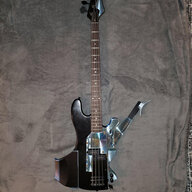
Love the idea overall of being able to swap out pieces. But these type of things always end up costing a lot and I'm guessing with that guitar that most people would find a favorite setup and probably just leave it there. I wonder if I managed to hide the foldout more, like more into the bass body when it is folded, if I could get it to look more normal and cool
 
  • Like
Reactions: monsterthompson
I wonder if I managed to hide the foldout more, like more into the bass body when it is folded, if I could get it to look more normal and cool

I think it would look more normal. You could probably put a mounting bracket on the back of a "standard" design so that the foldout can be attached and removed with a screw or three. I think the advantage of the design you have now is that it cuts away some of the body material and lets the instrument rest lower with strings closer to the leg.
 
  • Like
Reactions: scolaney91
I think it would look more normal. You could probably put a mounting bracket on the back of a "standard" design so that the foldout can be attached and removed with a screw or three. I think the advantage of the design you have now is that it cuts away some of the body material and lets the instrument rest lower with strings closer to the leg.
So right now the electronics are mounted in the right leg piece, there's barely enough room. I was already thinking I should move them, but I guess the only spot is going to be on the upper horn like where the strap connects. Would that be annoying? I have some extra wire and parts coming in the mail currently so I can experiment with that. Then I'll have move room to put the foldout deeper into the body when it's folded.
 
  • Like
Reactions: monsterthompson
You address several important issues and - generally speaking - your train of thoughts is valid...however...

If people don't like the look of something - and my best guess (based on 45+ years of playing, buying and selling stringed instruments) - is that they won't in this particular case then any further discussion of the subject matter is moot.

To put it bluntly: the current design is not going to fly with the vast majority of players, whatsoever. IMO.

I like the way you think, and could see myself buying the "armrest extension" - as I'd call it - if it were available as a separate detachable item, well-made, comfortable and good looking.

Wishing you the very best of luck.
 
  • Like
Reactions: scolaney91
So right now the electronics are mounted in the right leg piece, there's barely enough room. I was already thinking I should move them, but I guess the only spot is going to be on the upper horn like where the strap connects. Would that be annoying? I have some extra wire and parts coming in the mail currently so I can experiment with that. Then I'll have move room to put the foldout deeper into the body when it's folded.

I initially had a thought about moving the electronics to the upper horn. I'm not sure how I'd like that. I somewhat think that would make it faster/easier to adjust volume/tone/etc, but I think I like the existing position. I'd need to play each to be sure. Good luck with the development. I'd love to see this become more than a prototype.
 
  • Like
Reactions: scolaney91
Kudos for trying to address a very real problem. There are so many threads with people complaining about RSI/tendinitis, shoulder problems, etc, that it's good to revisit some fundamental assumptions and see if there's a better way.

I liked your thought that Ibanez might be interested given some of their experimental bases. Sandberg has created some basses-as-art (two strings with exposed wood on part of the body), maybe they would be interested in taking a stab at addressing the aesthetic side of your design.
 
  • Like
Reactions: scolaney91
You address several important issues and - generally speaking - your train of thoughts is valid...however...

If people don't like the look of something - and my best guess (based on 45+ years of playing, buying and selling stringed instruments) - is that they won't in this particular case then any further discussion of the subject matter is moot.

To put it bluntly: the current design is not going to fly with the vast majority of players, whatsoever. IMO.

I like the way you think, and could see myself buying the "armrest extension" - as I'd call it - if it were available as a separate detachable item, well-made, comfortable and good looking.

Wishing you the very best of luck.
Thank you for your input. I have a question for you and others regarding the aesthetics - Does it matter that the sitting position aesthetic is weird? Like if I could get the folded position to look more normal for standing, it would be all good?
 
Kudos for trying to address a very real problem. There are so many threads with people complaining about RSI/tendinitis, shoulder problems, etc, that it's good to revisit some fundamental assumptions and see if there's a better way.

I liked your thought that Ibanez might be interested given some of their experimental bases. Sandberg has created some basses-as-art (two strings with exposed wood on part of the body), maybe they would be interested in taking a stab at addressing the aesthetic side of your design.
Thanks for the Sandberg idea, and also for watching my entire video to the end haha. I have yet to contact any companies directly at this point. It feels very bold. Guess it wouldn't hurt to give it a shot. Getting more confidence with this thread. My students and other teachers/friends that I've shown my design liked it but I couldn't be sure if they were just being nice lol
 
Thank you for your input. I have a question for you and others regarding the aesthetics - Does it matter that the sitting position aesthetic is weird? Like if I could get the folded position to look more normal for standing, it would be all good?

You're very welcome.

I can't really answer your question without seeing at least a picture of what the revised design would look like, my imagination is not all that great in that respect.
 
You're very welcome.

I can't really answer your question without seeing at least a picture of what the revised design would look like, my imagination is not all that great in that respect.
I'm not sure at this point either, but just as a general thought experiment - pretend when folded, it looks exactly like a normal bass, like nothing is different. Would the fact that it still looks weird while sitting matter? Pretend that is exactly how it is now.
 
Had another thought: there are companies that specialize in providing adaptive technology to support people with physical limitations (for example, enabling cars to be driven with only your hands). That could be another avenue for you, and make it more viable to implement as an aftermarket modification.

Making it an aftermarket modification would enable musicians to choose their instrument from most manufacturers, as long as the instrument meets the parameters that your device requires (e.g. body material / ability to attach your stabilizing device, etc). It would open up the used market, and enable someone to have their own instrument customized so that they could continue playing it if they had become disabled, or if they had been ordered by their doctor to stop playing entirely because they otherwise faced irreparable damage to their body (assuming, of course, that they had already gone through the possible technique modifications, stretching & exercise, and other approaches to the problem without success).

I believe that a lot of the funding for adaptive technology comes through grants that recognize the high cost of providing these customizations. It may also provide a longer runway for you to be able to refine your device and develop a version that is more affordable for a broader market.
 
I’m all for innovation but I’ve been doing this for ever. Just sit in the classical position with a good strap.

But I’ll admit that solution isn’t 100% the same sitting and standing. And design can be about incremental gain, so full credit to you.
 
I mean if you ditch the mechanism and just leave the lower bout deployed, the body shape is super close to an Iceman. I know a body shape is a pretty hard thing to actually patent and successfully make money off of, but maybe some company would buy it off you for some small one time fee.
 
Had another thought: there are companies that specialize in providing adaptive technology to support people with physical limitations (for example, enabling cars to be driven with only your hands). That could be another avenue for you, and make it more viable to implement as an aftermarket modification.

Making it an aftermarket modification would enable musicians to choose their instrument from most manufacturers, as long as the instrument meets the parameters that your device requires (e.g. body material / ability to attach your stabilizing device, etc). It would open up the used market, and enable someone to have their own instrument customized so that they could continue playing it if they had become disabled, or if they had been ordered by their doctor to stop playing entirely because they otherwise faced irreparable damage to their body (assuming, of course, that they had already gone through the possible technique modifications, stretching & exercise, and other approaches to the problem without success).

I believe that a lot of the funding for adaptive technology comes through grants that recognize the high cost of providing these customizations. It may also provide a longer runway for you to be able to refine your device and develop a version that is more affordable for a broader market.
I like this idea and will certainly be considering as I move forward. Making it an aftermarket addition would make it infinitely more marketable. Unfortunately I can't figure out how to make it work without moving the right leg piece much closer to the strings. I suppose the foldout could still be useful for handicap people, but by itself it kinda misses the original point of the design. I also find the design to be a generally good thing for anyone with or without limitations so i'm not sure I want to limit myself to that. I am currently considering an idea where the left leg foldout detaches completely, thus making the bass at least look a little more normal when standing. I am also floating some other aesthetic improvements in my mind, will keep updating this thread and asking for advice. I appreciate you and everyone else here, this is tremendously helpful and this forum is my main outlet for this design currently.
 
  • Like
Reactions: Daniel B5
I mean if you ditch the mechanism and just leave the lower bout deployed, the body shape is super close to an Iceman. I know a body shape is a pretty hard thing to actually patent and successfully make money off of, but maybe some company would buy it off you for some small one time fee.
This post is actually very interesting to me because perhaps I could use an iceman shape as my foundation, and truly create just an add-on without cutting material away. Something I will be considering.