
• TalkBass has been independent since 1998. Add your voice.
    Create a free account to reply to discussions, view embedded media, and browse with fewer display ads.
    Join freeLog in
    Want zero display ads or expanded classifieds tools? Compare plans.

New Fender Rumble Stage 800 Impedance Switch?

G-Dog

What a fun place!
Feb 12, 2016
10,306
35,044
U.S.A. - A musical State of Mind ...
Anyone seen the new Fender Rumble Stage 800 combo bass amp introduced at NAMM recently? There's not much info available to the public yet, and some of what is brings questions, like this. The switch, shown below, on this new model is new to the Fender Rumble line and is perplexing to me.

I'm familiar with internal auto-switching from 8 to 4 ohm operation without any manual, or external, switch. In combos the amp operates the internal 8 ohm speaker load alone at some fraction of the nameplate wattage (140 for the Rumble 200 and 350 for the Rumble 500) and automatically goes to full nameplate wattage when another 8 ohm load is connected, giving a 4 ohm total load. And I assume that is what happens with this new switch in the 8 ohm setting.

But this new switch in the 4 ohm setting seems to allow connection of a 4 ohm external speaker load along with the internal (assumed) 8 ohm speaker load?! I assume the internal load stays connected because this setting only requires a 500W rated external cab. So, this would have the amp running a 2.67 ohm total load!? Does that seem correct?

Can anyone who's seen something like this before, please, confirm or correct my assumptions on this?
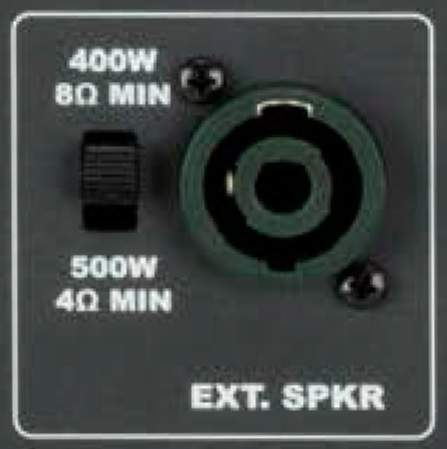
Stage 800 Ext Spkr.jpg


:jawdrop:
 
Last edited:
Likely similar to the 2 ohm setting on the darkglass and Mesa D800 amps.

See some comments here on the Mesa protection circuit Mesa D800 - 2ohm stack with switch to 4/8ohm. Bad?

Yes, I believe this is actually a "2 ohm or 4/8 ohm switch", as far as the amp operation is concerned, and it's "4 ohm & 8 ohm" labeling (including the wattage ratings) is more like the user-added reminder notes & labels mentioned in your link's comments. Although a "2 ohm or 4/8 ohm" labeling would be more technically correct, it requires more technical knowledge by the user to understand and correctly implement, as we see quite often here on TB. However, this "4 ohm & 8 ohm" labeling, tells you, right there on the switch, exactly what you can connect for each switch position, which should be more straightforward for the less technical user. What does everyone think of this approach?

Also, is there such thing as a safe 2.67 ohm amp operating mode that is unsafe for a 2.0 ohm load? That's what this "4 ohm & 8 ohm" labeling seems to indicate to me. I mean, I've only ever heard of 2, 4, 8, 16, etc, operating modes, but my experience is very limited.

Thanks for any assistance here.
 
Yes, if the minimum rated impedance is 2.67 ohms, it is not safe to operate at 2 ohms.

Thank you, @agedhorse. I appreciate your confirmation that such ratings exist.

And, being aware of your venerable background, I take your silence on my other assumptions as tacit confirmation that they, too, are reasonable.

Still looking for comments on, and/or experience with, the labeling "400W, 8 ohm minimum" & "500W, 4 ohm minimum" versus the simpler "2.67 ohm" & "4/8 ohm".

:whistle:
 
Still looking for comments on, and/or experience with, the labeling "400W, 8 ohm minimum" & "500W, 4 ohm minimum" versus the simpler "2.67 ohm" & "4/8 ohm".

I think it’s an issue of being a combo.

With a head you’re connecting to whichever set of cabs directly. With the combo half of your speakers are going to be fixed so the external speaker jack is labeled in such a way that the end user doesn’t have to do any math or guess work. In one position it can be connected to 8 ohm minimum, in the other 4 ohms. If the jack was labeled 4/8 and 2.6 I can almost guarantee they’d have issues with people plugging in too low of a speaker load because they misunderstood the label.
 
  • Like
Reactions: Passinwind
I think it’s an issue of being a combo.

With a head you’re connecting to whichever set of cabs directly. With the combo half of your speakers are going to be fixed so the external speaker jack is labeled in such a way that the end user doesn’t have to do any math or guess work. In one position it can be connected to 8 ohm minimum, in the other 4 ohms. If the jack was labeled 4/8 and 2.6 I can almost guarantee they’d have issues with people plugging in too low of a speaker load because they misunderstood the label.

Good point, @coreyfyfe. That makes sense and,, hopefully, reduces the chances for error.

So, does anyone know of any other combos with an impedance switch? And, if so, how are they labeled?
 
Thank you, @agedhorse. I appreciate your confirmation that such ratings exist.

And, being aware of your venerable background, I take your silence on my other assumptions as tacit confirmation that they, too, are reasonable.

Still looking for comments on, and/or experience with, the labeling "400W, 8 ohm minimum" & "500W, 4 ohm minimum" versus the simpler "2.67 ohm" & "4/8 ohm".

:whistle:
I am not putting any words in any ones mouth, but sometimes silence means I am taking time to think about it, or I do not have enough information to further comment, and a third and possible answer " I choose not to provide an answer

Plus one to @ aged horse on his 2.7 ohm answer.
 
I asked for clarity from Fender on this topic, and this is what I was told:

"The power rating is 400W/8ohms (internal speakers) or 800W with an extension cabinet. The impedance switch allows for some flexibility to pair different cabinets with the combo other than a single 8ohm cabinet. Now a single 4ohm cabinet is another option, or 2-8ohm cabinets daisy chained since there is only 1 extension jack present.

Adding an 8ohm extension cabinet creates a 4ohm total load, with 800W delivered evenly to each cabinet (400W ea).

Adding a 4ohm (total) extension cabinet creates a 2.67ohm total load to the amplifier, and the power would divide unevenly between the cabinets - roughly 300W to the internal speakers, and 500W to the external 4ohm cabinet(s). To keep things simple for the customer, we avoided referring to the 2.67ohms total load on the product and only focused on the rating/impedance of the external cabinet connected.

There are no power resistors or anything complicated involved. The switch simply reduces the output to match the lower impedance for ‘constant’ power. The amp won’t be damaged if the switch is set in the wrong position, but there is risk of activating thermal protection circuits particularly if a 4ohm cabinet is used with the switch set to 8ohm. The amp produces less power in the reverse situation (ext cabinet = 8ohm, switch = 4ohm). The minimum load impedance for this product is 2.67ohm, so connection of external cabinets below 4ohms (total) is not recommended."​

That makes sense to me.
 
I asked for clarity from Fender on this topic, and this is what I was told:

"The power rating is 400W/8ohms (internal speakers) or 800W with an extension cabinet. The impedance switch allows for some flexibility to pair different cabinets with the combo other than a single 8ohm cabinet. Now a single 4ohm cabinet is another option, or 2-8ohm cabinets daisy chained since there is only 1 extension jack present.

Adding an 8ohm extension cabinet creates a 4ohm total load, with 800W delivered evenly to each cabinet (400W ea).

Adding a 4ohm (total) extension cabinet creates a 2.67ohm total load to the amplifier, and the power would divide unevenly between the cabinets - roughly 300W to the internal speakers, and 500W to the external 4ohm cabinet(s). To keep things simple for the customer, we avoided referring to the 2.67ohms total load on the product and only focused on the rating/impedance of the external cabinet connected.

There are no power resistors or anything complicated involved. The switch simply reduces the output to match the lower impedance for ‘constant’ power. The amp won’t be damaged if the switch is set in the wrong position, but there is risk of activating thermal protection circuits particularly if a 4ohm cabinet is used with the switch set to 8ohm. The amp produces less power in the reverse situation (ext cabinet = 8ohm, switch = 4ohm). The minimum load impedance for this product is 2.67ohm, so connection of external cabinets below 4ohms (total) is not recommended."​

That makes sense to me.

Thanks, @tombowlus! Now, that quite authoritatively answers my questions to the max!

:hyper:
 
It's on the fender website now.

Yes, but with precious little about using external cab(s), even in the manual, which is located on the Studio 40 page under "Support".

Much better info in the post above by tombowlus. His interviews with Fender have answered many such questions. A great resource!

But I've still not heard of any other combos with an Impedance Switch, so maybe Fender is plowing new ground here!?!
 
Ok, here's a question I'm pretty sure I know the answer to but pretty sure is not good enough. I modified my Rumble 100 combo so that I can use it as a 1x12 ext cabinet with my Rumble 800 combo (2x10). Both are rated at 8 ohms. My question is should I be worried about running the cab at 8 ohms given that it is being fed 400 watts? I was a commercial/industrial electrician for years; I can calculate load for a robotics factory but this impedance stuff is over my head!
 
Ok, here's a question I'm pretty sure I know the answer to but pretty sure is not good enough. I modified my Rumble 100 combo so that I can use it as a 1x12 ext cabinet with my Rumble 800 combo (2x10). Both are rated at 8 ohms. My question is should I be worried about running the cab at 8 ohms given that it is being fed 400 watts? I was a commercial/industrial electrician for years; I can calculate load for a robotics factory but this impedance stuff is over my head!


Hey, Oldie! Well, this old guy thinks you're OK for impedance, but I'd be extremely careful with the volume not to overload that 100 watt cab with up to 400 watts! Does that 12" give a bit fuller sound to the 2x10" at such low volumes? I wouldn't expect it to be any help in a gig situation, though, is it? :smug:

By the way, Guy, why don't you come on over to the Fender Rumble Club and show us those Rumbles of yours? We'd love to see 'em. :)
.
 
Last edited:
This is an incredible coincidence, ‘Dog. I was just explaining this to a guy who may be interested in buying a Stage 800 and I mentioned this as a feature, but I didn’t think the wide ohm load was new. In fact, I thought my year-and-a-half old 800 had this feature. And if I’m wrong, how did I know about this to tell this guy?

Pandemics cause strange things to happen, don’t they? :meh:
 
  • Like
Reactions: G-Dog