• TalkBass has been independent since 1998. Add your voice.
    Create a free account to reply to discussions, view embedded media, and browse with fewer display ads.
    Join freeLog in
    Want zero display ads or expanded classifieds tools? Compare plans.

New Jazz setup

For a 10 minute setup on a new instrument:

1. 1/4 turn truss rod tightening, if needed (new necks usually have excessive relief IME).

2. Raise saddles one turn on saddle height screws (always 1–2 turns too low on a new instrument IME).

3. Quick-n-dirty intonation. Make things roughly in tune up to the 7th fret on the A string. Set the other saddles visually in relation to the A. Bass/guitar played into cel phone tuner without being plugged in.

4. Attach a strap, and Grolsch washers or shoelaces.

5. Throw the thing into your normal gig case or bag (which always has your tuner, instrument cable, spare 9V battery, and screwdriver in it).

6. Head out the door to the gig! You're already late...which is why the setup needed to be only 10 minutes.

7. Cuss and turn back. You forgot to load your SVT and Fridge, because you were distracted by rushing to set up a new bass right before a gig.

In my case its a 1970's 8 track cassette pickup truck radio converted into a bass amp.
 
  • Like
Reactions: StayLow
Hi all,

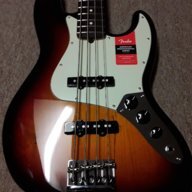
So I took a chance and bought a floor model Jazz Pro over the internet. It arrived today. First, it often surprises me how poorly these things are set up in the store. For a "professional" instrument the set up should professional out of the box... But sadly that's rarely the case.

I did a quick neck adjust by the seat of my pants which was an immediate improvement but it could still be better.

Just wondering if anybody has any hard and fast rules for a quick set up.

Thanks!
I start by adjusting the truss rod. When there's no buzz on the first 5 frets, I drop the saddles. I then raise them slightly one by one til buzzing stops on each string. I then set intonation. I then repeat if necessary. Then I move to pickups.
 
Fast set-up. (No such thing.)

Tune it up.

Check relief at fret #8 when fret #1 and fret #20 (21 or 22) are depressed at the same time. About a business card space/relief from bottom of E string to top of #8 fret.

Next, string height adjustment. (To your liking. Approx 2/32 to 3/32 G string. 1/8 to 3/32 E string.) From bottom of string to top of fret @ 12th fret, strings open.

Next intonation. Use your tuning meter. Tune string to proper pitch, check at fret #12 for note tuning. Move bridge saddle up or down so that open string and 12th fret both have exact same note tuning.

Adjust pickups. Fret string out at 20, 21 or 22 fret. Neck and/or bridge pickup should be about 1/8 inch or wee bit less @ E string from top of the magnet pole to bottom of the string. And about 1/32 closer at the G string, magnet pole to bottom of the string.

This should be about it.

Oh, did I mention trying to adjust the E and G string on the saddles so that their edge is the same distance from the edge of the string to the edge of the fret board? (Buy the treaded saddle bridge for this accurate adjustment!!!!!) And than the rest of the strings should be equal distance from dead center of the string to the next string............about 19 to 19.5 mm from center of each string to the next. Get 'em equal distance dead center to dead center.

Phew! Not easy but not too hard for a so called quick set-up. Good luck!
 
  • Like
Reactions: 31HZ and Ash Jazz
Fast set-up. (No such thing.)

Tune it up.

Check relief at fret #8 when fret #1 and fret #20 (21 or 22) are depressed at the same time. About a business card space/relief from bottom of E string to top of #8 fret.

Next, string height adjustment. (To your liking. Approx 2/32 to 3/32 G string. 1/8 to 3/32 E string.) From bottom of string to top of fret @ 12th fret, strings open.

Next intonation. Use your tuning meter. Tune string to proper pitch, check at fret #12 for note tuning. Move bridge saddle up or down so that open string and 12th fret both have exact same note tuning.

Adjust pickups. Fret string out at 20, 21 or 22 fret. Neck and/or bridge pickup should be about 1/8 inch or wee bit less @ E string from top of the magnet pole to bottom of the string. And about 1/32 closer at the G string, magnet pole to bottom of the string.

This should be about it.

Oh, did I mention trying to adjust the E and G string on the saddles so that their edge is the same distance from the edge of the string to the edge of the fret board? (Buy the treaded saddle bridge for this accurate adjustment!!!!!) And than the rest of the strings should be equal distance from dead center of the string to the next string............about 19 to 19.5 mm from center of each string to the next. Get 'em equal distance dead center to dead center.

Phew! Not easy but not too hard for a so called quick set-up. Good luck!


I guess there is some room for interpretation in the term "quick". This is exactly what I had in mind as it more accurate than; twist key and good luck, but doesn't really require special tools or skills to get the job done.

Thank you!
 
First I figured out how to raise and lower action at the bridge, then I saw how important it was to get the relief right.

Then I saw how very, very few basses make it out of shops and factories with any degree of care put towards nut slot height/fall (there are a few consistent exceptions).

If you've got a few instruments or more, and you've got any propensity towards working with hand tools, do yourself a favor and figure out how to do this stuff on your own. It isn't rocket science, or even much of a learned skill; rather, it simply requires careful observation and the patience to do work in small increments.
 
  • Like
Reactions: Ash Jazz
That is a good question, about three quarters (coins) fit under the string at the twelfth fret.

I will have to get a measuring device for a more accurate measure and get back to you.

Thanks

That's not relief, that's string height. Relief is when you hold down the string at the 1st and ~17th fret (...where the neck meets the pocket) and measure the gap between the string and ~8th fret. A set of $5 feel gauges comes in handy as does an extra set of hands. I usually aim for .012-.014". If no gauges, you can do a qualitative analysis: is there a gap, yes or no?

Riis
 
  • Like
Reactions: Ash Jazz
Finding a good competent luthier was the best thing I ever did for my basses. Sure you can DIY setup and you might even be good but having a master set up your bass is worth the expense IMHO.
I agree with your thinking. 100%. BUT . . . if one can afford it, buying a cheap bass and "learning" to make it playable will teach you a LOT about setup (even if that means leaving it to a Luthier ! ). I learned a lot from just dinkin' around with a cheap project bass. I actually enjoy setting up my own hardware!
 
As an aside, I've bought (second-hand) some very expensive basses that weren't set up very well -- especially at the nut. These days, my expectations are calibrated such that I simply expect that any bass I buy will need work, and I'm rarely disappointed.
 
  • Like
Reactions: Ash Jazz
"Oh, S-u-u-u-s-a-a-a-n....." Have to agree: as bassists, we don't have many friends and the chances of having a S.O. is slim-to-none.

Riis


I'm married, but it often goes like this...

"Put your finger there"
"Not like that, like this"

"You don't have to say it like that!"
"Like what?"
"I'm not helping if you have an attitude"

:roflmao:;):roflmao: