- Jan 12, 2004
- 1,493
- 1,270
- Disclosures
- Owner, Stand Up Guy Basses (Repair/Sell/Buy upright basses)
Hi all,
Ive purchased another fixer-upper bass. Heres a description, a few pics, and a couple of broad, get-started questions. Note, a longer than usual thread.
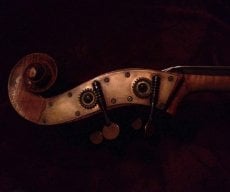
Its a smaller, flatback bass, with hatpeg tuners. The seller described it as Czech, although it has no markings anywhere The scale length is 39, meaning perhaps a half-size? It has unfortunately, been stripped to a blonde-ish finish. Ive taken the top off, and found:
1) Good stuff about the bass:
The top has few cracks, and no deformations.
The back is mostly solid, with only a couple of filled cracks. It has some slight warping on the lower bout
The neck body join is secure
The bottom and top blocks are unbroken
2) Not-good stuff about the bass:
The neck is somewhat bowed. It is probably fixable using a carbon fibre insert.
The fingerboard is painted maple, which I will likely replace with ebony.
The cracks have all been repaired in a horrible way (see pics). At each bout, there pieces of the top have cracked and been glued back on imprecisely. These repairs were then bolstered with cleats that are just big pine rectangles. Arrgh!
The ribs also have a few cracks, again glued together imprecisely, and shored up with odd bits of wood.
The back braces have come away in spots. In some cases they have had shims glued in to fix things.
In general, way too much glue was used when the bass was last put back together. Between the middle braces on the back, it almost seems like the strategy was to flood the area with glue (like when youre making a backyard skating rink!). The glue seems to be clear amber, and it is dry and brittle. I might be able to scrape or chip it off (!?). Any other ideas re. glue removal?
The bass bar is integral. Not sure I want to deal with this. As mentioned, the top is stable.
Repair strategy:
My sense is to take out all the improper old repairs, remove as much glue as possible, and re-do all of the cracks to the best of my ability. Id like to refinish it to a darker colour when done. Also, Im thinking of fluting the replacement fingerboard to give it a little more width (ie., more like an adult size). I have very small hands, and a 39 scale length might be a good fit.
Id be happy to hear some thoughts on any of the above.
Cheers,
Paul
Ive purchased another fixer-upper bass. Heres a description, a few pics, and a couple of broad, get-started questions. Note, a longer than usual thread.
Its a smaller, flatback bass, with hatpeg tuners. The seller described it as Czech, although it has no markings anywhere The scale length is 39, meaning perhaps a half-size? It has unfortunately, been stripped to a blonde-ish finish. Ive taken the top off, and found:
1) Good stuff about the bass:
The top has few cracks, and no deformations.
The back is mostly solid, with only a couple of filled cracks. It has some slight warping on the lower bout
The neck body join is secure
The bottom and top blocks are unbroken
2) Not-good stuff about the bass:
The neck is somewhat bowed. It is probably fixable using a carbon fibre insert.
The fingerboard is painted maple, which I will likely replace with ebony.
The cracks have all been repaired in a horrible way (see pics). At each bout, there pieces of the top have cracked and been glued back on imprecisely. These repairs were then bolstered with cleats that are just big pine rectangles. Arrgh!
The ribs also have a few cracks, again glued together imprecisely, and shored up with odd bits of wood.
The back braces have come away in spots. In some cases they have had shims glued in to fix things.
In general, way too much glue was used when the bass was last put back together. Between the middle braces on the back, it almost seems like the strategy was to flood the area with glue (like when youre making a backyard skating rink!). The glue seems to be clear amber, and it is dry and brittle. I might be able to scrape or chip it off (!?). Any other ideas re. glue removal?
The bass bar is integral. Not sure I want to deal with this. As mentioned, the top is stable.
Repair strategy:
My sense is to take out all the improper old repairs, remove as much glue as possible, and re-do all of the cracks to the best of my ability. Id like to refinish it to a darker colour when done. Also, Im thinking of fluting the replacement fingerboard to give it a little more width (ie., more like an adult size). I have very small hands, and a 39 scale length might be a good fit.
Id be happy to hear some thoughts on any of the above.
Cheers,
Paul