Yeah I’ve seen a couple of comments so could be worth a revisit. Again it might just not be for you but I really like the character it delivers but it’s serving a purpose in the whole signal chain. Mine could be the quirky one but it works for my needs.

Enjoy the benefits of a premium membership!
Upgrade Account
-
TalkBass has been independent since 1998. Add your voice.
Create a free account to reply to discussions, view embedded media, and browse with fewer display ads.
Join free Log in
Want zero display ads or expanded classifieds tools? Compare plans.
You are using an out of date browser. It may not display this or other websites correctly.
You should upgrade or use an alternative browser.
You should upgrade or use an alternative browser.
New SolidGoldFX Beta V Bass Preamp Pedal
- Thread starter TwototheValley
- Start date
More options
Who Replied?
Finally got one of these. Nice! Been using with flatwounds. Good old school bassy puffy sounds to an amp fuzz like Cream or Mountain. I was very confused about the LPF settings though. The LPF is pretty subtle too so hard to figure what exactly it’s doing. How can a LPF create a mid bump or scoop anyways, as they just roll off the treble normally?
I emailed the company and they said it’s really just a subtle passive tone LPF, roll off like the tone knob on your old bass. The position 1 only rolls off down to 2-3 kHz, and so creates a perceived mid bump. The position 2 rolls off deeper, so creates a perceived mid scoop. Depends on the size of the capacitor connected.
I hope that helps anyone also confused! I’ll have to mess with it more to really grok the tone shaping. It’s less confusing to leave it off and just use the active bass and treble of course.
I emailed the company and they said it’s really just a subtle passive tone LPF, roll off like the tone knob on your old bass. The position 1 only rolls off down to 2-3 kHz, and so creates a perceived mid bump. The position 2 rolls off deeper, so creates a perceived mid scoop. Depends on the size of the capacitor connected.
I hope that helps anyone also confused! I’ll have to mess with it more to really grok the tone shaping. It’s less confusing to leave it off and just use the active bass and treble of course.

I’m still confused about what the LPF dial does. I hear the effect, from darker to brighter, but not sure if it’s changing the frequency of the LPF, or attenuating its effect/slope.
I’ve also been comparing it to the Xotic Bass BB. The BB has no LPF function, but it is inherently darker, never transparent.
I’ve also been comparing it to the Xotic Bass BB. The BB has no LPF function, but it is inherently darker, never transparent.
Here’s exactly what SolidGoldFX said: “The LPF circuit is a passive circuit on the output that is attenuating a portion of the high frequencies and it is designed to be a more subtle enhancer rather than a heavy handed active filter. Depending on the size of the capacitor we use, the ear will perceive a slight mid bump if we're only cutting down to 2-3kHz or scoop if we dip down lower. The LPF circuit is bypassed with the toggle in the center position.”
So, I think perceived is the key word here and focusing on the mid bump or scoop is a bit of a red herring.
Position 0 disconnects the LPF, and the sound is louder and brighter. Also more clipping (overdrive).
Position 1 softens the sound, takes out some treble. Like a bass’s passive tone knob it darkens more counterclockwise. However I don’t hear a mid bump, really.
Position 2 has a stronger effect, softens the sound even more, and more as the knob goes CCW. It takes out more into the mids, so it really does sound quite similar to a mid scoop, similar to the contour switch on a Rumble. It’s not quite the same sound though, leaving a little more mid and less treble.
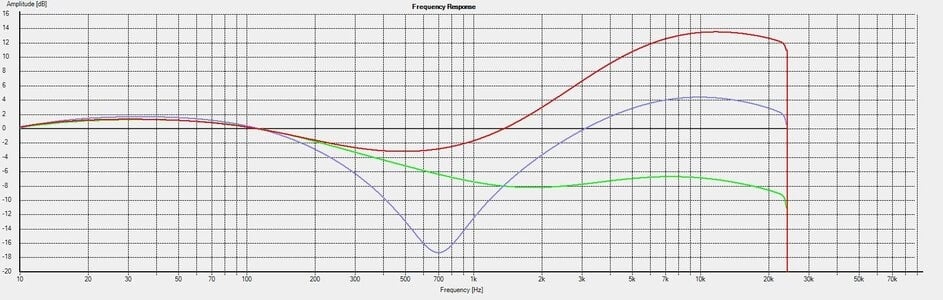
What the contour on a Rumble does, a big notch at 700 Hz (blue line):
So, I think perceived is the key word here and focusing on the mid bump or scoop is a bit of a red herring.
Position 0 disconnects the LPF, and the sound is louder and brighter. Also more clipping (overdrive).
Position 1 softens the sound, takes out some treble. Like a bass’s passive tone knob it darkens more counterclockwise. However I don’t hear a mid bump, really.
Position 2 has a stronger effect, softens the sound even more, and more as the knob goes CCW. It takes out more into the mids, so it really does sound quite similar to a mid scoop, similar to the contour switch on a Rumble. It’s not quite the same sound though, leaving a little more mid and less treble.
What the contour on a Rumble does, a big notch at 700 Hz (blue line):
So what are the differences between the Broughton Audio Fliptop and the SGFX Beta-V? They are both B15 style preamp pedals with JFET drive options, master volume, and a 2-band EQ.
EQ: BA advertises the Fliptop as having a "James" stack, which I believe is passive - while the Beta-V EQ is advertised as "active", which would be the Baxandall stack if I'm not mistaken. Not sure if there's really much difference in this format or application. If so, I would love to know more.
Cabsim vs. LPF: Fliptop has a Cabsim ("...dialing in more of the cab response tightens the low end and cuts the high frequencies for a warm, vintage tone. The frequency response is modelled after the 15" cab). Beta-V has the Low Pass Filter. Could they be used to acheive similar results? If you bypass these options completely are they essentially the same pedal?
EQ: BA advertises the Fliptop as having a "James" stack, which I believe is passive - while the Beta-V EQ is advertised as "active", which would be the Baxandall stack if I'm not mistaken. Not sure if there's really much difference in this format or application. If so, I would love to know more.
Cabsim vs. LPF: Fliptop has a Cabsim ("...dialing in more of the cab response tightens the low end and cuts the high frequencies for a warm, vintage tone. The frequency response is modelled after the 15" cab). Beta-V has the Low Pass Filter. Could they be used to acheive similar results? If you bypass these options completely are they essentially the same pedal?
Great question. I have the BetaV, Xotic Bass BB, and have been looking at the Fliptop for some time.
I have the impression the Cabsim dial is some sort of HPF/LPF that narrows the bandwidth, with possibly a resonance at the cutoff frequency like the Broughton Resonant Filter Equalizer.
The BetaV in neutral is clean and transparent with a bright sheen to it. The Xotic BB is inherently dark and middy (strong middle frequencies in neutral setting).
I have the impression the Cabsim dial is some sort of HPF/LPF that narrows the bandwidth, with possibly a resonance at the cutoff frequency like the Broughton Resonant Filter Equalizer.
The BetaV in neutral is clean and transparent with a bright sheen to it. The Xotic BB is inherently dark and middy (strong middle frequencies in neutral setting).
Last edited:

I'll take the Xotic BB over the Beta V every time. I found the BB far more natural sounding ODGreat question. I have the BetaV, Xotic Bass BB, and have been looking at the Fliptop for some time.
I have the impression the Cabsim dial is some sort of HPF/LPF that narrows the bandwidth, with possibly a resonance at the cutoff frequency like the Broughton Resonant Filter Equalizer.
The BetaV in neutral is clean and transparent with a bright sheen to it. The Xotic BB is inherently dark and middy (strong middle frequencies in neutral setting).
I must admit, the BB’s dark dirty middle frequency emphasis works very well.
The BetaV smooth articulate LPF is its own thing. I wish I could prefer one over the other and simplify things.
The BetaV smooth articulate LPF is its own thing. I wish I could prefer one over the other and simplify things.
Got the Fliptop this winter. Much lower gain drive than the Bass BB, not nearly as mid-forward, but has a comparable softening haze-y tone. The BetaV drive sounds better to me, and replaces the haziness with the LPF control (which seems to do a little more than a simple low pass filter, it makes the tone rounder and softer).
The Fliptop sounds very very good overall, a subtle tone enhancer that makes everything sound better to me.
The Bass BB is (much) less subtle but similar otherwise. More distortion, more haze, more mids.
BetaV is more versatile, from completely clean to heavy distortion, transparent to round and increasingly dark.
The Fliptop sounds very very good overall, a subtle tone enhancer that makes everything sound better to me.
The Bass BB is (much) less subtle but similar otherwise. More distortion, more haze, more mids.
BetaV is more versatile, from completely clean to heavy distortion, transparent to round and increasingly dark.

I’m still on the fence with this pedal, love my mk1 but also the v has beat out most other things I’ve put it against.
I did a video of mine here
I did a video of mine here
very interesting thread, thanks
If this can help, with a 62’ Precision and TI jazz flats ( which are different in sound from Labella’s) :
I use these settings
switch now 0 , was 2 initially
Note that I use a nordymute when I play with fingers , without when I use a pick
I switch body between 11h and 2h , especially if I have the nordymute (already many bass)
Switch position 2 is very drastic , I find I have to higher the level around 2pm to exist in the band.
Hope it helps
If this can help, with a 62’ Precision and TI jazz flats ( which are different in sound from Labella’s) :
I use these settings
switch now 0 , was 2 initially
Note that I use a nordymute when I play with fingers , without when I use a pick
I switch body between 11h and 2h , especially if I have the nordymute (already many bass)
Switch position 2 is very drastic , I find I have to higher the level around 2pm to exist in the band.
Hope it helps
Attachments

Remember that the LPF control dial has no effect with LPF switch at 0 (off). With the LPF off, the BetaV is just a (rather harsh) transparent pedal, with Drive distortion that can be dialed in and basic Bass and Treble EQ.
Where the BetaV stands out is with the dark vintage tone of the LPF. It sounds much better, fuller than the tone knob on my passive Fender precisions, and the Broughton HPF/LPF. The BetaV LPF is doing more than simple low-pass filtering.
I can compare the BetaV to similar vintage Ampeg tone pedals like the Xotic Bass BB and the Broughton Fliptop.
The Xotic has the dark tone baked in, and is never completely clean. The Gain is wide-range and sounds better (to me) than the BetaV drive. Its Bass eq needs to always be turned up (to 3 o’clock for me) otherwise it lacks body.
The Fliptop is also always darkish and hazy. The Gain is very subtle low gain no matter the setting. I find it lacks body even with its Bass control turned up. The Cabsim dial narrows the bandwidth (decreases bass and treble) but introduces punch.
I prefer the BetaV overall. Fuller sound and more versatile as it can be completely transparent and clean.
The Damnation Audio MBD3 has a much better sounding overdrive, from low-gain to heavy distortion. But even run clean it imparts a fullness to the tone that I don’t know how else to get. The highs can be dialed out in various ways to sound close enough to the BetaV, but I still prefer the BetaV for that particular dark tone.
Where the BetaV stands out is with the dark vintage tone of the LPF. It sounds much better, fuller than the tone knob on my passive Fender precisions, and the Broughton HPF/LPF. The BetaV LPF is doing more than simple low-pass filtering.
I can compare the BetaV to similar vintage Ampeg tone pedals like the Xotic Bass BB and the Broughton Fliptop.
The Xotic has the dark tone baked in, and is never completely clean. The Gain is wide-range and sounds better (to me) than the BetaV drive. Its Bass eq needs to always be turned up (to 3 o’clock for me) otherwise it lacks body.
The Fliptop is also always darkish and hazy. The Gain is very subtle low gain no matter the setting. I find it lacks body even with its Bass control turned up. The Cabsim dial narrows the bandwidth (decreases bass and treble) but introduces punch.
I prefer the BetaV overall. Fuller sound and more versatile as it can be completely transparent and clean.
The Damnation Audio MBD3 has a much better sounding overdrive, from low-gain to heavy distortion. But even run clean it imparts a fullness to the tone that I don’t know how else to get. The highs can be dialed out in various ways to sound close enough to the BetaV, but I still prefer the BetaV for that particular dark tone.
Last edited:
yes I do agreeRemember that the LPF control dial has no effect with LPF switch at 0 (off). With the LPF off, the BetaV is just a (rather harsh) transparent pedal, with Drive distortion that can be dialed in and basic Bass and Treble EQ.
Where the BetaV stands out is with the dark vintage tone of the LPF. It sounds much better, fuller than the tone knob on my passive Fender precisions, and the Broughton HPF/LPF. The BetaV LPF is doing more than simple low-pass filtering.
But since I have flats and Nordymute I do not tend to have the « harsh thing » happening on position 0 ; whereas it is to dark for me on position 2 , even with LPF at full open position ( or I would have to dime the level at 2 pm minimum)
IME It depends also very much on which cabinets configuration you have
I am on Barefaced 2x10 no tweeter, for instance
Hope it helps
I have LaBella flatwounds too. I find LPF switch 0 way too bright and harsh. Switch 2 sounds good, smooth and full, especially at high volumes.
I would be very interested in trying your settings on my place !I have LaBella flatwounds too. I find LPF switch 0 way too bright and harsh. Switch 2 sounds good, smooth and full, especially at high volumes.
To hear the difference with my Tomastik Jazz Flats
Thanks
Hi folks,
I'm interested in trying the Beta V as my Tech 21 YYZ replacement (space saving / top jacks). I have the YYZ essentially set up with a slight mid boost and some light dirt. Do you folks think the Beta V is a good replacement for that?
I'm interested in trying the Beta V as my Tech 21 YYZ replacement (space saving / top jacks). I have the YYZ essentially set up with a slight mid boost and some light dirt. Do you folks think the Beta V is a good replacement for that?
Never tried the YYZ but I think the BetaV can do what you describe, although that may not be its intended strength, which is the LPF.Hi folks,
I'm interested in trying the Beta V as my Tech 21 YYZ replacement (space saving / top jacks). I have the YYZ essentially set up with a slight mid boost and some light dirt. Do you folks think the Beta V is a good replacement for that?
What would be the intended use case of the LPF?Never tried the YYZ but I think the BetaV can do what you describe, although that may not be its intended strength, which is the LPF.
The BetaV is intended to give what is considered the vintage Ampeg B15 tone, dark punchy dirty. This apparently had tight (ie high pass filtered) lows and subdued low-pass filtering of the higher frequencies, which has the effect of accentuating the middle frequencies.What would be the intended use case of the LPF?
The LPF switch and dial do exactly that, the drive dials in dirt (and high mids) to taste.
With the LPF off it’s just another clear drive pedal with useful two-band bass and treble dials.
I've been reading all your posts on the SGFX Beta V and walking through your journey as you learn more about how it's used. Thank you for sharing everything you've discovered!The BetaV is intended to give what is considered the vintage Ampeg B15 tone, dark punchy dirty. This apparently had tight (ie high pass filtered) lows and subdued low-pass filtering of the higher frequencies, which has the effect of accentuating the middle frequencies.
The LPF switch and dial do exactly that, the drive dials in dirt (and high mids) to taste.
With the LPF off it’s just another clear drive pedal with useful two-band bass and treble dials.
I feel like this is a very misunderstood pedal, for very good reason. SGFX was maybe too clever when they created it. It's very how to explain how it works, and from what I've read in the forum a bit more information would have helped a lot of people.
We know they intended the Beta V to recreate B15 tones (though not limited to B15 tones...). Based on what you've figured out to date, could you share what settings you have found that come closest to recreating the basic B15 tone?


