I'm currently taking online lines, and we're just focusing on holding the bass and plucking. When I try to hold the the strings, they seem pretty stiff and I have to use the all four fingers to press them down. Is it possible to use lower tension strings to make things easier, or is it pointless due to having to raise the bridge to accomadate the lower tension?

Enjoy the benefits of a premium membership!
Upgrade Account
-
TalkBass has been independent since 1998. Add your voice.
Create a free account to reply to discussions, view embedded media, and browse with fewer display ads.
Join free Log in
Want zero display ads or expanded classifieds tools? Compare plans.
You are using an out of date browser. It may not display this or other websites correctly.
You should upgrade or use an alternative browser.
You should upgrade or use an alternative browser.
Double Bass New to Double Bass, Are lower tension Strings Pointless?
- Thread starter Donald Thompson
- Start date
More options
Who Replied?
Strings labelled "Weich" are low tension ones, and seem pretty popular.
I use Evan Pirazzi Weich strings on my bass, and they are a joy to play.
That being said, you should try to find someone in person to diagnose why you're having to use a death grip.
I use Evan Pirazzi Weich strings on my bass, and they are a joy to play.
That being said, you should try to find someone in person to diagnose why you're having to use a death grip.

Strings should be pulled down with power from body/shoulders, not pressed just with the fingers. Try pulling down the strings without having the thumb touching the neck. If you have the correct technique, higher tension strings will be playable. Some basses sound better and louder with higher tension strings, others with lower tension strings. A thicker string will feel lighter on the fingers then a thin string with identical tension. A string that is more flexible will feel lighter then a stiffer string with identical tension. In many cases the difference in tension does not require raising the string hight. Beware of the naming: a light / weich metal core string often has more tension then a medium synthetic core string. A strong string of one company (for example Corelli) can have less tension then the medium or even light string of another company (for example Thomastik).
Slappers usually prefere low tension strings (gut/synthetic core) raised high or medium high.
Pizzicato players often prefere medium tension with low string height.
Arco players often prefere medium tension strings with medium string height.
Very low tension strings (mostly gut and nylon) require raising the hight of the strings.
For a beginner: start with Thomastik Spirocore weich (light), to have a basis for comparison.
Slappers usually prefere low tension strings (gut/synthetic core) raised high or medium high.
Pizzicato players often prefere medium tension with low string height.
Arco players often prefere medium tension strings with medium string height.
Very low tension strings (mostly gut and nylon) require raising the hight of the strings.
For a beginner: start with Thomastik Spirocore weich (light), to have a basis for comparison.

Ok, I'll wait till my next lesson before attending playing upright bass with my left hand.Strings should be pulled down with power from body/shoulders, not pressed just with the fingers. Try pulling down the strings without having the thumb touching the neck. If you have the correct technique, higher tension strings will be playable. Some basses sound better and louder with higher tension strings, others with lower tension strings. A thicker string will feel lighter on the fingers then a thin string with identical tension. A string that is more flexible will feel lighter then a stiffer string with identical tension. In many cases the difference in tension does not require raising the string hight. Beware of the naming: a light / weich metal core string often has more tension then a medium synthetic core string. A strong string of one company (for example Corelli) can have less tension then the medium or even light string of another company (for example Thomastik).
Slappers usually prefere low tension strings (gut/synthetic core) raised high or medium high.
Pizzicato players often prefere medium tension with low string height.
Arco players often prefere medium tension strings with medium string height.
Very low tension strings (mostly gut and nylon) require raising the hight of the strings.
For a beginner: start with Thomastik Spirocore weich (light), to have a basis for comparison.

The setup can be a significant a factor. Many basses have a much higher nut height than I like. This causes the tension to increase as I play closer to the nut. Also it emphasizes the difference in tension across the strings.
It's going to take some time for you to develop the necessary muscles and finesse. I would confirm the setup is reasonable, but I wouldn't necessarily rush to install lower tension strings.
It's going to take some time for you to develop the necessary muscles and finesse. I would confirm the setup is reasonable, but I wouldn't necessarily rush to install lower tension strings.
Last edited:
+1 For letting someone who knows double basses check out the overall setup of your instrument. That said, if you are a beginner, it will take some time to learn the basic left hand technique, and also to build up the muscles you need for playing the bass. Be patient and be careful if you feel pain, it`s a marathon rather than a sprint.

Lower tension strings are not pointless. Many of us use them, and there are many manufacturers who produce them in many varieties for a reason. Not everyone is comfortable pulling bridge cables. Raising the bridge height does not turn low tension strings back into high tension strings. It's more about setup, and optimal response of the bass given the type of string. My string height is relatively high because I play gut strings. I've had guys look wide-eyed at my string height who have never touched gut thinking my bass must be unplayable, or that I have some super human hand strength. It's quite the opposite.
If your bass is set up well, and the high tension stuff is still bothering you - try something with lower tension. If your bass is not comfortable, you will never enjoy playing it. There's no good reason to struggle through a string that doesn't work for you.
Also in general, if you are using your 4 (pinky) to play a note, then the other 3 fingers should be closed above it for support. Not sure if this is what you meant though.
If your bass is set up well, and the high tension stuff is still bothering you - try something with lower tension. If your bass is not comfortable, you will never enjoy playing it. There's no good reason to struggle through a string that doesn't work for you.
Also in general, if you are using your 4 (pinky) to play a note, then the other 3 fingers should be closed above it for support. Not sure if this is what you meant though.
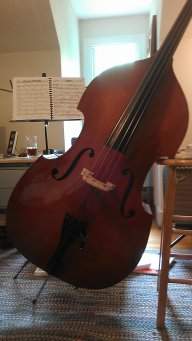
They are not pointless and can make it feel easier to play. Some basses even require them to resonate at their best capacity.
Extremely key is string height AT THE NUT. It's more important, in my opinion, than bridge height. It's those half position notes that'll wear you out. (Play three sets of bluegrass tunes in F...)

A few things that have helped me as a fellow "mature" learner:
1. Research the concept of "arm weight" for left hand technique--this is the key to tension-free playing, as Ludwig suggests above.
2. The easiest way to get comfortable with this is first to play seated on a stool, so you can focus on using the arm weight without having to worry about balancing the bass while standing.
3. Research use of "solo" strings. As name suggests, they are designed to be used for solo playing, tuned a step higher than standard (i.e., A, E, B, F#). But they can also be downtuned to play at standard pitch, the result being a lower tension set. Many varieties of strings come in solo versions.
4. At least in my experience, "synthetic" strings with nylon/perlon cores tend to feel less stiff than strings with steel/metal cores.
5. For general inspiration, listen to anything by your namesake, a widely admired Canadian bassist, if you are not already aware of him. Many wonderful recordings in his catalogue.
1. Research the concept of "arm weight" for left hand technique--this is the key to tension-free playing, as Ludwig suggests above.
2. The easiest way to get comfortable with this is first to play seated on a stool, so you can focus on using the arm weight without having to worry about balancing the bass while standing.
3. Research use of "solo" strings. As name suggests, they are designed to be used for solo playing, tuned a step higher than standard (i.e., A, E, B, F#). But they can also be downtuned to play at standard pitch, the result being a lower tension set. Many varieties of strings come in solo versions.
4. At least in my experience, "synthetic" strings with nylon/perlon cores tend to feel less stiff than strings with steel/metal cores.
5. For general inspiration, listen to anything by your namesake, a widely admired Canadian bassist, if you are not already aware of him. Many wonderful recordings in his catalogue.
Last edited:

If your left hand is struggling a set of Corelli 370Ms will probably be easy on them. They’re a bit bright arco and I have no idea how they’ll do pizz but as strings go they won’t break the bank. And they’re pretty flexible and shouldn’t kill your hands.
As other folks have said, low tension is a real thing but it depends on you, your bass, and the settings you’re playing in so it’s hard to precisely the right balance.
As other folks have said, low tension is a real thing but it depends on you, your bass, and the settings you’re playing in so it’s hard to precisely the right balance.

I find that Weichs require a different technique (and a bit of practice) to pull a nice full sound, but they will keep you out of the hospital if you plan to play the double bass for the rest of your life. I love playing weichs.
Only drawback to playing weichs all the time is if you go to a jam session and the house bass is strung with mittels. You'll only last one or two tunes, (which is proper jam session etiquette anyhow).
Only drawback to playing weichs all the time is if you go to a jam session and the house bass is strung with mittels. You'll only last one or two tunes, (which is proper jam session etiquette anyhow).
I find that Weichs require a different technique (and a bit of practice) to pull a nice full sound, but they will keep you out of the hospital if you plan to play the double bass for the rest of your life. I love playing weichs.
Only drawback to playing weichs all the time is if you go to a jam session and the house bass is strung with mittels. You'll only last one or two tunes, (which is proper jam session etiquette anyhow).
At that point I'll just save up for my personal Yamaha Slient Bass and start bringing that to jam sessions.
A few things that have helped me as a fellow "mature" learner:
1. Research the concept of "arm weight" for left hand technique--this is the key to tension-free playing, as Ludwig suggests above.
2. The easiest way to get comfortable with this is first to play seated on a stool, so you can focus on using the arm weight without having to worry about balancing the bass while standing.
3. Research use of "solo" strings. As name suggests, they are designed to be used for solo playing, tuned a step higher than standard (i.e., A, E, B, F#). But they can also be downtuned to play at standard pitch, the result being a lower tension set. Many varieties of strings come in solo versions.
4. At least in my experience, "synthetic" strings with nylon/perlon cores tend to feel less stiff than strings with steel/metal cores.
5. For general inspiration, listen to anything by your namesake, a widely admired Canadian bassist, if you are not already aware of him. Many wonderful recordings in his catalogue.
His name is namesake? May I get a link for that?

Thanks for the reminder to check out Don Thompson again..
I was confused when you said by my namesake, lol.
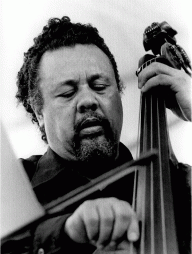
+1 on making sure your bass is set up to make it as easy to play as possible. Be patient with yourself. I have all my beginning students use light gauge strings so that they learn good left hand technique and learn to get a quality (not loud) sound. (I also start them in 3rd position). The transition to regular gauge strings and lower positions will then be much easier and you will be much happier.
I studied/worked with Don Thompson about 30 years ago at the banff center. I was a guitarist (still am) but at that time I hadn’t started playing bass yet. I asked him about starting bass and he said “the hardest thing about playing bass is finding a good bass”. It’s not an entirely untrue statement!
When I started on double bass I went with Corellis as they were about the lightest string available. Then as i got stronger I tried some new strings but I seem to have settled on EP lights, mostly for jazz but I do play some chamber music with the bow. I would love to play jazz on guts but I can’t stand trying to bow them. They have a nice soft feel.
Point is, I think light strings are great when you’re starting, and maybe over time you can switch to higher tension strings, maybe not. It depends on what you’re playing, what’s most important to you and the music you play. If your hands hurt, it’s never fun.
When I started on double bass I went with Corellis as they were about the lightest string available. Then as i got stronger I tried some new strings but I seem to have settled on EP lights, mostly for jazz but I do play some chamber music with the bow. I would love to play jazz on guts but I can’t stand trying to bow them. They have a nice soft feel.
Point is, I think light strings are great when you’re starting, and maybe over time you can switch to higher tension strings, maybe not. It depends on what you’re playing, what’s most important to you and the music you play. If your hands hurt, it’s never fun.
I studied/worked with Don Thompson about 30 years ago at the banff center. I was a guitarist (still am) but at that time I hadn’t started playing bass yet. I asked him about starting bass and he said “the hardest thing about playing bass is finding a good bass”. It’s not an entirely untrue statement!
When I started on double bass I went with Corellis as they were about the lightest string available. Then as i got stronger I tried some new strings but I seem to have settled on EP lights, mostly for jazz but I do play some chamber music with the bow. I would love to play jazz on guts but I can’t stand trying to bow them. They have a nice soft feel.
Point is, I think light strings are great when you’re starting, and maybe over time you can switch to higher tension strings, maybe not. It depends on what you’re playing, what’s most important to you and the music you play. If your hands hurt, it’s never fun.
Those strings were light or medium gauge?
Latest posts
-

-
What Frequency Response is Actually Needed for Low Tuning?
- Latest: bass player 53
-

-
-
