• TalkBass has been independent since 1998. Add your voice.
    Create a free account to reply to discussions, view embedded media, and browse with fewer display ads.
    Join freeLog in
    Want zero display ads or expanded classifieds tools? Compare plans.

Double Bass Nicolai Merry Wives

Hi all

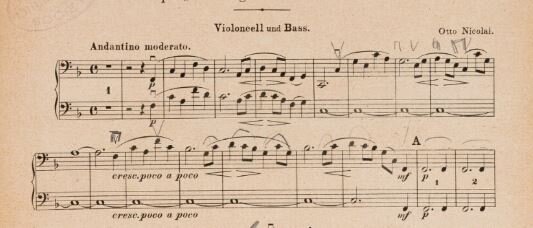
I found this extract from an old method book, and co-incidentlaly an upcoming piece.
Does it look right to you? Specifically, the fingering.
Is the starting F suggested be played on the A string (given the fingering indicated). I was playing on D string, with second finger.
The other 2 bars indicated by the red arrows, should the fingering be 1 2 ? Or how is the 1 4 played??
The 7th bar (before the arrows) with the fingering indicated also looks odd.

Thanks everyone, and hope the "old guard" is well.

PS - NY Phil Arch wasn't much help!
 

Attachments

  • MVW.JPG
    MVW.JPG
    219.6 KB · Views: 11
  • Like
Reactions: AndersLasson
"Does it look right to you?" in the world of fingering selection, "right" and "wrong" are generally matters of opinion for each individual player, or sometimes determined by the principal player of the section.

Having said that, I agree that the fingering suggestions in your example make very little sense, at least to me. The three fourth fingers in a row between two different positions and strings in the third measure of the piece don't make much sense either, and the sixteenth note run in the sixth bar of the third line has the half step between A and G# marked 4th to 1st finger...like the quarter note half steps about which you've already remarked.

Typically, when confronted with a new-to-me edition of a piece, I'll learn it as best I can with the suggested fingerings, just to stretch my "fingering vocabulary," then tweak the fingerings as needed to further improve my ability to communicate the intended music. I do think, however, that there are simply blatant errors in the posted example.
 
I just checked an old part:
Starting UPBOW: F is 1 on the D string;
the next 4 notes ( CAFD) are all part of the same UPBOW on the G string (be careful with the jump to the high F)*
(shift 4-4 high F back to D on the G string);
then DOWN BOW on the dotted 1/2 C and
(in one position on D & G strings) the next phrase UPBOW,
then shift back on the D string for the quarter note F-G (play it DOWNBOW) and start the sustained C UPBOW

* if it's too challenging, you could start the downbow on the high F and play the F-D-C tied (but I think it's better the other way)

the red bars are 1-2 in half position

I think we played all the "Rf" quarter notes all down bow
Hope it helps
 
Thanks both.
MuscleChaser - you are correct in your comments, about the fingering, however this forum is always an invaluable resource to double check and validate.
LouisF - reviewing the NYPhil Archives, it lools like downbow to start with - I guess it's one of those things we'll sort out once we start to play it. But what you've said makes sense to how I would approach. The red bars just look like an error in the numbers used.
 

Attachments

  • Capture.JPG
    Capture.JPG
    51.3 KB · Views: 7
Andy,
Note the penciled cello bowings in bar 6 -- pretty much the way we did it. I'd say it's up for grabs. (Also note the bow change on the high F in bar 12). I'd say huddle with the principal cellist and others in your section. Good luck.
 
Hi all

I found this extract from an old method book, and co-incidentlaly an upcoming piece.
Does it look right to you? Specifically, the fingering.
Is the starting F suggested be played on the A string (given the fingering indicated). I was playing on D string, with second finger.
The other 2 bars indicated by the red arrows, should the fingering be 1 2 ? Or how is the 1 4 played??
The 7th bar (before the arrows) with the fingering indicated also looks odd.

Thanks everyone, and hope the "old guard" is well.

PS - NY Phil Arch wasn't much help!
At this dynamic I’d probably play F C A (1-shift-4-shift/pivot/extension-1) all on the D string and the F D C (4-shift-4 1 or 4-shift/pivot/extension-1-shift-1, whatever feels more comfortable/sounds better) on the G string. For me, I try to avoid shifting for every note as much as possible, although sometimes it’s unavoidable like in this passage: keeping the first C, A, high F, and maybe the D all within a half step of each other cuts out a lot of the sliding (which I’m not opposed to at all, but sliding into and out of every note can sound a little seasick to me) but still feels lyrical and vocal.

I’m assuming the idea behind starting with 4 is to eliminate needing to barre/hop/push and shift at the same time between the first two notes, but then the editor does that exact thing between the A and high F.
 
Last edited:
  • Like
Reactions: AndyMopley
Oh also: for the sixteenths leading to the G# A quarters I would probably play D C B on the G string (probably 4-shift/pivot-2 1) with the A on the D string and then both of the next two bars would be 2 4.

The sixteenths in the sixth bar of the third line (where the editor has marked another 1 4 half step) could be done 4 2-shift-2 1 on the G string, or if you shift 1-1 from A to B in the previous bar you could do 2 1-shift/pivot-4 2 with the A and G# on the D string.

3 bars before the key change I’d probably play the C B A D as 2 1-shift/pivot- 4 4 or 4 2-shift/pivot-1-shift-4.
 
  • Like
Reactions: AndyMopley