• TalkBass has been independent since 1998. Add your voice.
    Create a free account to reply to discussions, view embedded media, and browse with fewer display ads.
    Join freeLog in
    Want zero display ads or expanded classifieds tools? Compare plans.

Nordstrand Zen Blade

Personally, in the passive realm, I am a total devotee of pup to pup in series configuration. One objection to parallel configuration is the backward pot wiring required - as volume is lowered the pup sees increasing load, which IMO tends to suck away some of the response, especially top end. Another is that the pups fight each other rather than help each other. (Although some players may find this beneficial). A real world experience: Have a beautifully crafted Schecter (Korean made) bass, through neck with binding, passive pups with active EQ, master volume and blend control. Noticed that each end of the blend, sound was crisp, but getting toward the middle, sound became muddy. Changed to series - night and day - honks big time in mid position, much better control of blend throughout. Also added a phase switch, which provides another level of flexibility. My favorite, mostly neck, add a little bridge out of phase, very spicy with lots of harmonics. Planning to upgrade to Zen Blades from stock EMG. It seems that a lot of the imported basses suffer from bad raps due to poor wiring design. Wiring and pups are fixable, poor construction is forever.

I'm curious how you wired the pickups in series with each other while also having a blend control? I can't recall seeing any blend pots that operated with pickups in series with each other...

 
I'm curious how you wired the pickups in series with each other while also having a blend control? I can't recall seeing any blend pots that operated with pickups in series with each other...
Check out the Washburn VCC control. It is essentially this so a player can progressively cut one coil while keeping the other coil. No, it is not a balance control per se, but it is great to do everything in an application for a two-pickup application from both pickups full on series to slightly cutting one coil for clarity, to more progressive single pickup (choose which pickup to stay full on) tones. In the attached diagram, instead of looking at the two coils as two coils of the same pickup, look at them as separate pickups.
VCC.jpg
 
Last edited:
Check out the Washburn VCC control. It is essentially this so a player can progressively cut one coil while keeping the other coil. No, it is not a balance control per se, but it is great to do everything in an application for a two-pickup application from both pickups full on parallel to slightly cutting one coil for clarity, to more progressive single pickup (choose which pickup to stay full on) tones.

From the Washburn site: A unique coil tapping system that allows players to incrementally blend between a hum bucking sound and a single coil sound without the hum normally associated with single coils, similar to the concept of a dimmer switch but related to the tone of a guitar. Turn the VCC knob up for a traditional humbucker sound; turn it down for the character of a single coil. It does not require a pre-amp or batteries. It was available on select Original Idol models, and is available on the new Idol models.

That description sounds similar to what Peavey did back in the days of the T40 and T60, when the tone control cut highs on the pickup when turned down, but when turned up it did a (gradual) coil tap on the (series-wired) pickup.

It still doesn't quite explain exactly what the wiring would look like for a blend control with pickups in series would look like, though.
 
  • Like
Reactions: MovinTarget
From the Washburn site: A unique coil tapping system that allows players to incrementally blend between a hum bucking sound and a single coil sound without the hum normally associated with single coils, similar to the concept of a dimmer switch but related to the tone of a guitar. Turn the VCC knob up for a traditional humbucker sound; turn it down for the character of a single coil. It does not require a pre-amp or batteries. It was available on select Original Idol models, and is available on the new Idol models.

That description sounds similar to what Peavey did back in the days of the T40 and T60, when the tone control cut highs on the pickup when turned down, but when turned up it did a (gradual) coil tap on the (series-wired) pickup.

It still doesn't quite explain exactly what the wiring would look like for a blend control with pickups in series would look like, though.

I did find some wiring diagrams for a control that seems to be switching from one coil to another on a pickup with coils wired in series on this board (Spin-a-parallel control, VCC mods or alternatives? | GuitarNutz 2). And sorry, I didn't see @iiipopes wiring diagram the first time--it looks pretty similar!
 
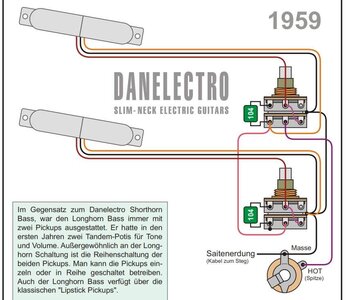
Being an electrical engineer, I started on the series wiring many moons ago (before the Internet!). Later found out that Danelectro also did this. (The nerve...)
You need a blend control with twin pots. Wire them like the drawing, obviously pot directions opposite. The output would then go to the master volume. If you have pups without an independent ground (shield) in the cable, you'll need to get a two conductor shielded cable and let the coil float independently from ground (only one needs the mod). Usually not fun but worth the trouble, IMHO. Have two other basses with two independent volumes and phase switch. Love the simplicity, for those that like all kinds of switches, have fun! For me, the desired tone is always some blend of the two pups. One other thing, for setups with dual tone controls, series is the only configuration that allows complete independence between the two.
 
From the Washburn site: A unique coil tapping system that allows players to incrementally blend between a hum bucking sound and a single coil sound without the hum normally associated with single coils, similar to the concept of a dimmer switch but related to the tone of a guitar. Turn the VCC knob up for a traditional humbucker sound; turn it down for the character of a single coil. It does not require a pre-amp or batteries. It was available on select Original Idol models, and is available on the new Idol models.

That description sounds similar to what Peavey did back in the days of the T40 and T60, when the tone control cut highs on the pickup when turned down, but when turned up it did a (gradual) coil tap on the (series-wired) pickup.

It still doesn't quite explain exactly what the wiring would look like for a blend control with pickups in series would look like, though.
Well, no. It is completely different from the Peavy wiring, having played that wiring when it was new decades ago. And yes, follow the signal path and the dual-ganged potentiometers. Fully one way, it is two pickups or coils in series. Fully the other way, it is the two coils/pickups in parallel. In the middle is a progressive balance between these two extremes. As I said, you need to choose which pickup would be essentially "on" all the time. And re-read my post. I did not say it was a balance control, per se, but is probably more useful.
 
Question: has anyone set up the Nordstrand Zen pickups in either N-parallel B-series or N-series B-parallel? I connected the pickups on a bass with no switches, so I have to move the cables around in the preamp to change the layout of the pickups. I just want to get the best punchy sound and with not so much electric sound. I connect them in parallel, I like the sound, but the output is too low, and when I connect them in series the output is good, but I get that electric noise that you have to touch the string to calm the noise. The cavity from the preamp and pick up are cover with copper foil. The bass is has mike pope flexcore preamp.
 
Last edited:
  • Like
Reactions: MovinTarget
Question: has anyone set up the Nordstrand Zen pickups in either N-parallel B-series or N-series B-parallel? I connected the pickups on a bass with no switches, so I have to move the cables around in the preamp to change the layout of the pickups. I just want to get the best punchy sound and with not so much electric sound. I connect them in parallel, I like the sound, but the output is too low, and when I connect them in series the output is good, but I get that electric noise that you have to touch the string to calm the noise. The cavity from the preamp and pick up are cover with copper foil. The bass is has mike pope flexcore preamp.
The Zen are designed to sound best with 250k volume and tone in series. If you want to really hear what these pups do, that is the way to go. Messing with the impedence is likely causing the noise. Lack of resistance in the circuit, between the pups and the jack are most likely why it sounds weird.
 
  • Like
Reactions: Memnochthebass
The Zen are designed to sound best with 250k volume and tone in series. If you want to really hear what these pups do, that is the way to go. Messing with the impedence is likely causing the noise. Lack of resistance in the circuit, between the pups and the jack are most likely why it sounds weird.
Thanks for the info. When I had them on series, It sounded better, but I can hear the electrical noise louder.