
Enjoy the benefits of a premium membership!
Upgrade Account
-
TalkBass has been independent since 1998. Add your voice.
Create a free account to reply to discussions, view embedded media, and browse with fewer display ads.
Join free Log in
Want zero display ads or expanded classifieds tools? Compare plans.
You are using an out of date browser. It may not display this or other websites correctly.
You should upgrade or use an alternative browser.
You should upgrade or use an alternative browser.
Not a bass but...
- Thread starter meandi
- Start date
More options
Who Replied?The Action looks pretty High. is it adjustable or is it just personal preference.
Though i do really like the look of it and it probably sounds great.
Though i do really like the look of it and it probably sounds great.
Hi.
WOW, that looks amazing, how's the unfinshed sound?
Regards
Sam
Nice & warm & rich.
Good note articulation.
Haven't really played it much yet, still intonating the saddle, etc.
The Action looks pretty High. is it adjustable or is it just personal preference.
Though i do really like the look of it and it probably sounds great.
When I took that pic, the action was way high as I'd just strung it up for the first time.
It's a one piece bridge with a bone insert saddle.
I'm in the process of doing the set-up on it now.
Nice. I like the f holes.
Thanks, I can't take credit for them the entire build is right out of Benedetto's book.
Looks REALLY good. Got any progress shots?
I appreciate the compliment.
I know this is a bass forum, but I read in here every day & really enjoy & appreciate watching builds take place on any type instrument...thought you all might feel the same.
I've done a complete write-up on it over on H.C. on the acoustic guitar page that contains not only the guitar, but all of the molds, jigs & fixtures used to build it.
Hi.
I'm pretty sure that it's ok to post a direct link to that said site.
That guitar of Yours looks absolutely amazing, I'm a big fan of deep archtops.
Regards
Sam
I'm pretty sure that it's ok to post a direct link to that said site.
That guitar of Yours looks absolutely amazing, I'm a big fan of deep archtops.
Regards
Sam
Hi.
I'm only at the page 21, but man You got some talent there. And the patience to match.
I guess a few decades with vintage wheels and their owners builds up both .
.
One particular item among Your impressive collection of tools gave me quite a scare though.
It was the chain-saw/angle grinder combo. I believe that they were banned here, at least they're pretty much dissapeared from the shops. The initial use I believe was to make adz like marks on machine sawn logs and planks, but a few nasty accidents pretty much led to safer methods. The chain seizing or breaking while spinning 11K revs does its damage. There's an angle grinder rasp wheel available, but I've always used the regular segment slip disks. 60 grit will eat through wood like it was butter.
Damn, that I must keep on doing more productive things now, just as Your build thread was speeding up again.
That's one great contribution You have done there, documenting it all, right from the start. Thank You.
Regards
Sam
I'm only at the page 21, but man You got some talent there. And the patience to match.
I guess a few decades with vintage wheels and their owners builds up both
.One particular item among Your impressive collection of tools gave me quite a scare though.
It was the chain-saw/angle grinder combo. I believe that they were banned here, at least they're pretty much dissapeared from the shops. The initial use I believe was to make adz like marks on machine sawn logs and planks, but a few nasty accidents pretty much led to safer methods. The chain seizing or breaking while spinning 11K revs does its damage. There's an angle grinder rasp wheel available, but I've always used the regular segment slip disks. 60 grit will eat through wood like it was butter.
Damn, that I must keep on doing more productive things now, just as Your build thread was speeding up again.
That's one great contribution You have done there, documenting it all, right from the start. Thank You.
Regards
Sam
Thaks for the compliment, I truly appreciate it.
Building one of these things isn't for everyone.
There is a precision involved in an archtop that I never encountered building a solid bodied instrument.
But, that's actually the thing that drew/draws me to this.
I love projects that allow me to become immersed in the process for a period of time...that require me to be looking to the next step, yet demand that I always be working in the moment.
I've got back plates glued up for two more & the neck blank already glued up for one of them.
I'm going to build them side by side, & will be getting started in the next few days while this one settles in & getting the intonation finalized.
Doing the car thing instilled a certain mind-set towards doing things thouroughly & systematically.
Actually I was pretty fortunate with the owners through the years, as they were for the most part easy to work with.
However, I always "educated" them before I took on a job as to what to expect...had to remind one or two of them about that conversation later in the game, but always managed to prevent any major blow-ups.
I'm very aware of the potential risks with the chain saw grinder.
The clamping discs that hold the chain are designed to allow the chain to slip under certain conditions.
By using it only for the first bit of rough-in on the plates, I never really put much of a load on it & due to the delicate nature of the work I'm using it for & I don't leave the machine running, rather I "feather" it on & off with the trigger switch there-by keeping the speed well below the 11k potential.
Do you have a link for the 60 grit slip disc that you mentioned?
I'm always looking for a better/ more precise way.
Building one of these things isn't for everyone.
There is a precision involved in an archtop that I never encountered building a solid bodied instrument.
But, that's actually the thing that drew/draws me to this.
I love projects that allow me to become immersed in the process for a period of time...that require me to be looking to the next step, yet demand that I always be working in the moment.
I've got back plates glued up for two more & the neck blank already glued up for one of them.
I'm going to build them side by side, & will be getting started in the next few days while this one settles in & getting the intonation finalized.
Doing the car thing instilled a certain mind-set towards doing things thouroughly & systematically.
Actually I was pretty fortunate with the owners through the years, as they were for the most part easy to work with.
However, I always "educated" them before I took on a job as to what to expect...had to remind one or two of them about that conversation later in the game, but always managed to prevent any major blow-ups.
I'm very aware of the potential risks with the chain saw grinder.
The clamping discs that hold the chain are designed to allow the chain to slip under certain conditions.
By using it only for the first bit of rough-in on the plates, I never really put much of a load on it & due to the delicate nature of the work I'm using it for & I don't leave the machine running, rather I "feather" it on & off with the trigger switch there-by keeping the speed well below the 11k potential.
Do you have a link for the 60 grit slip disc that you mentioned?
I'm always looking for a better/ more precise way.
Hi.
Just before I had to hurry to the rehearsal I finshed reading the thread, and I'm convinced that You should compile the whole thing as a tutorial as one of the active posters in your thread suggested.
I'm sure the feathering reduces the possibility of the breakage greatly, and I'm also sure that a person of Your experience can handle these tools with proper caution, it's just seeing those discs in use always makes me shiver.
Seeing that You already use Mirka products,
Invalid Link Removed
Seems that I got the description wrong, it's flap disc, You must have used them when doing bodywork. The link is for 40 grit, but I've had better success with a bit finer discs.
I haven't done any commercial restorations or modifications, but generally the HD-chopper folks and Street Rod enthusiasts are the easiest to work with, the strict restorers on the other hand..... "It costs THAT much?" is the usual response.
Regards
Sam
Just before I had to hurry to the rehearsal I finshed reading the thread, and I'm convinced that You should compile the whole thing as a tutorial as one of the active posters in your thread suggested.
I'm sure the feathering reduces the possibility of the breakage greatly, and I'm also sure that a person of Your experience can handle these tools with proper caution, it's just seeing those discs in use always makes me shiver.
Seeing that You already use Mirka products
, Invalid Link Removed
Seems that I got the description wrong, it's flap disc, You must have used them when doing bodywork. The link is for 40 grit, but I've had better success with a bit finer discs.
I haven't done any commercial restorations or modifications, but generally the HD-chopper folks and Street Rod enthusiasts are the easiest to work with, the strict restorers on the other hand....
. "It costs THAT much?" is the usual response.Regards
Sam
Hi.
Just before I had to hurry to the rehearsal I finshed reading the thread, and I'm convinced that You should compile the whole thing as a tutorial as one of the active posters in your thread suggested.
I'm sure the feathering reduces the possibility of the breakage greatly, and I'm also sure that a person of Your experience can handle these tools with proper caution, it's just seeing those discs in use always makes me shiver.
Seeing that You already use Mirka products
Invalid Link Removed
Seems that I got the description wrong, it's flap disc, You must have used them when doing bodywork. The link is for 40 grit, but I've had better success with a bit finer discs.
I haven't done any commercial restorations or modifications, but generally the HD-chopper folks and Street Rod enthusiasts are the easiest to work with, the strict restorers on the other hand....
Regards
Sam
I'm a shop rat, an eyeball engineer...not even sure how one would go about the tutorial thing on a formal basis.
You seem to have some customer relations experience, cause that's exactly what the strict restorers would say with feigned horror.
I'd just refer them down the street to the local slam dunk psudo custom shop, saying that perhaps that shop might be more in line with their ability to pay...just be sure you look some of their work over carefully before you committ.
Most of the time, they had already stopped in there & would respond with, "ya but their work is no where close to what you do".
My response was, "that's why their pricing is no where close to mine".
My closing remark was "it's not a hobby."
Sometimes I got the job, sometimes I didn't...
I'm glad I'm out of it.
Nice being retired with a great hobby!!

Hi.
I was going to suggest the above method for the intonation, but had a hunch that You'd already be familiar with it, seeing how wide the saddle is.
I first thought about it when trying to intonate an old Landola 12 string back in late 80's. Obviously it couldn't be done with the ordinary saddle even if the quality of that instrument would've been better, so I carved the groove for two bone nuts, 6+6 placed on their side. That gave me generous 9mm to intonate the normal and the octave strings separately. I used MIG/MAG 0.6mm welding wire, but any hard wire will work.
Regards
Sam
I was going to suggest the above method for the intonation, but had a hunch that You'd already be familiar with it, seeing how wide the saddle is.
I first thought about it when trying to intonate an old Landola 12 string back in late 80's. Obviously it couldn't be done with the ordinary saddle even if the quality of that instrument would've been better, so I carved the groove for two bone nuts, 6+6 placed on their side. That gave me generous 9mm to intonate the normal and the octave strings separately. I used MIG/MAG 0.6mm welding wire, but any hard wire will work.
Regards
Sam
I purposly built the bridge to take a wide saddle so I would have room for individual intonation points.
I've got one flat-top that I like a lot other than it doesn't intonate well enough to suit me...& it's fitted with a skinny little 1/8" saddle...not much wiggle room there.
I just cut a used guitar string into lengths to use.
I learned it on frets dot com.
I chat with a guy who builds in the U.K. who apprenticed as a luthier with his grandfather & he learned it from him, so it's not a new trick.
By the way, I've been meaning to ask, do you build?
I've got one flat-top that I like a lot other than it doesn't intonate well enough to suit me...& it's fitted with a skinny little 1/8" saddle...not much wiggle room there.
I just cut a used guitar string into lengths to use.
I learned it on frets dot com.
I chat with a guy who builds in the U.K. who apprenticed as a luthier with his grandfather & he learned it from him, so it's not a new trick.
By the way, I've been meaning to ask, do you build?
Hi.
I believe that there's not too many recent inventions when it comes to the traditional wood- and metal working. I have bought and I collect old books about metal working in particular and it sometimes surprises me how old some methods are.
I used to build back in the eighties, about total of 15 or so instruments for my own use mostly, parts almost always used in the next, the "better" one, so only a few remain. In the 90's and in the new millenium I've just done repair work on instruments I have bought from an insurance company. Quite a few Gibson and Tokai guitars with broken necks. No surprise there, I believe.
I've been planning to do a Thunderbird and an Explorer basses and one damn TB.er put up a link where I saw Dusty Hills white Crazy Cowboy Bass. I had completely forgotten about it, but now it seems that that'll be on the "list" as well, perhaps on the top. My main hobby is metal machining (or collecting old machinery it seems) though so not too much time for wood  .
.
Regards
Sam
I believe that there's not too many recent inventions when it comes to the traditional wood- and metal working. I have bought and I collect old books about metal working in particular and it sometimes surprises me how old some methods are.
I used to build back in the eighties, about total of 15 or so instruments for my own use mostly, parts almost always used in the next, the "better" one, so only a few remain. In the 90's and in the new millenium I've just done repair work on instruments I have bought from an insurance company. Quite a few Gibson and Tokai guitars with broken necks. No surprise there, I believe
.I've been planning to do a Thunderbird and an Explorer basses and one damn TB.er put up a link where I saw Dusty Hills white Crazy Cowboy Bass. I had completely forgotten about it, but now it seems that that'll be on the "list" as well, perhaps on the top. My main hobby is metal machining (or collecting old machinery it seems
) though so not too much time for wood .Regards
Sam
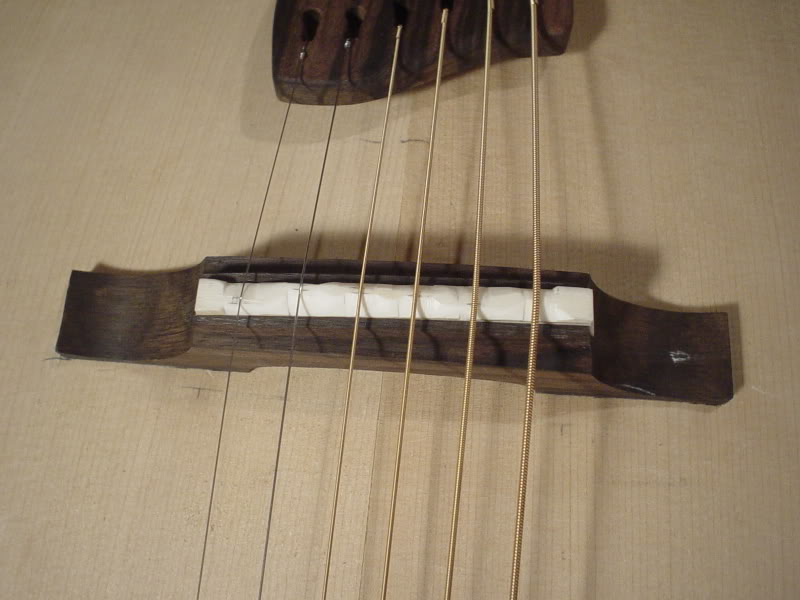
Here's what I came up with after cutting the facetts to the points established earlier.
Still needed the corners rounded off etc in this shot.
It's intonating very well at this point.
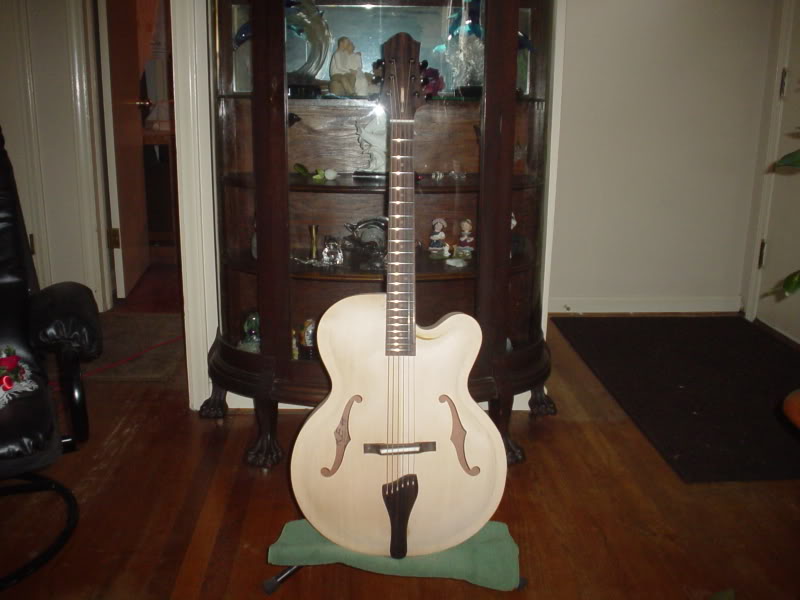
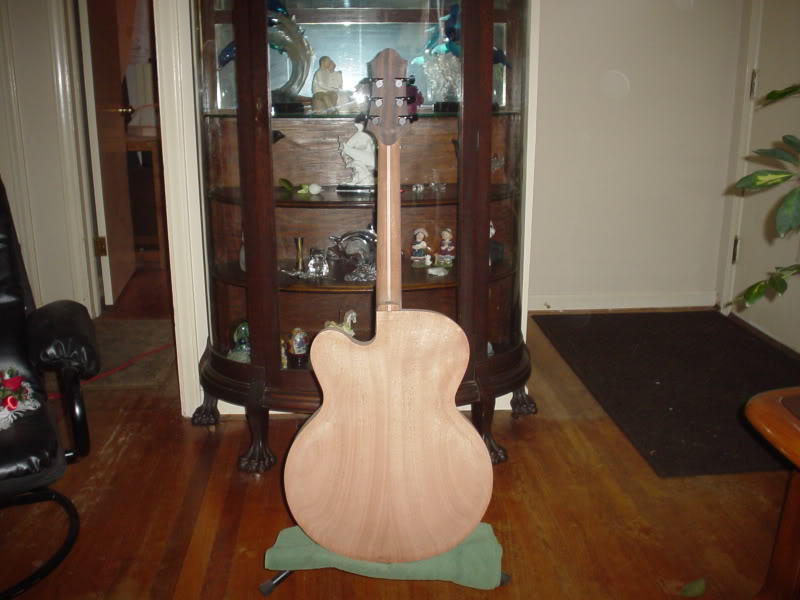
Got it strung up & been playin it for coupla days now.
Still doing some thinning in the recurves, listening to it open up.
Still needed the corners rounded off etc in this shot.
It's intonating very well at this point.
Got it strung up & been playin it for coupla days now.
Still doing some thinning in the recurves, listening to it open up.


