• TalkBass has been independent since 1998. Add your voice.
    Create a free account to reply to discussions, view embedded media, and browse with fewer display ads.
    Join freeLog in
    Want zero display ads or expanded classifieds tools? Compare plans.

Notation and readability question?

So I have finally decided to work on my transcription skills. I am self taught so my process may be more mathematical as I write my first draft. in this case since the smallest value is a 1/16 note I look at like a graph with 16 squares and fill in the space where there is music. Being self taught and not really being a sight reader, I never worried about the readability of my final product. Recently I got some feedback that let me know I need to worry about the readability of my final product. So I've been working on that to.

I think I've gotten a little carried away with trying to make it more readable and have actually changed the timing of the music. Here's an example. First measure is my initial draft. 2nd measure is first attempt to improve readability. 3rd measure trying to get ride of more rests, I think I've altered the intended timing and should just leave it as the 2nd measure. Or is there another solution to make it easier for a sight reader?
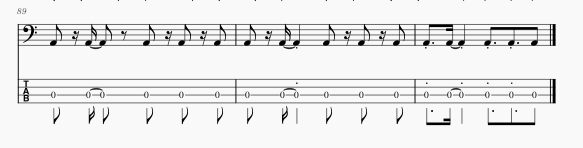

upload_2023-2-13_19-59-21.png
 
  • Like
Reactions: BassyBill
Some of your instincts are good: Consolidating rests (by indicating longer note values and adding a staccato articulation, rather than having lots of single 16th-notes followed by 16th-note rests) definitely improves legibility. As does beam grouping; I'm a fan of having beams cover an entire beat regardless of which of those 16th-note partials are notes versus rests.

However, the final figure in your third example isn't ideal. Firstly, it's standard convention to be able to see each beat of a measure clearly, so if a syncopated figure starts in between (for example) beats 3 and 4 it's considered more legible to show beat 4 as a distinct notehead which is tied to one of the preceeding notes. Likewise, having a beam group cross over beats 3 and 4 when 16th-note subdivisions are implied makes it more difficult to read; the last two beats of that measure would be more correctly notated as a dotted 8th note beamed to a 16th-note; that 16th-note is then tied (but not beamed) to a new 8th-note, which is beamed to the final 8th-note.
 
Some of your instincts are good: Consolidating rests (by indicating longer note values and adding a staccato articulation, rather than having lots of single 16th-notes followed by 16th-note rests) definitely improves legibility. As does beam grouping; I'm a fan of having beams cover an entire beat regardless of which of those 16th-note partials are notes versus rests.

However, the final figure in your third example isn't ideal. Firstly, it's standard convention to be able to see each beat of a measure clearly, so if a syncopated figure starts in between (for example) beats 3 and 4 it's considered more legible to show beat 4 as a distinct notehead which is tied to one of the preceeding notes. Likewise, having a beam group cross over beats 3 and 4 when 16th-note subdivisions are implied makes it more difficult to read; the last two beats of that measure would be more correctly notated as a dotted 8th note beamed to a 16th-note; that 16th-note is then tied (but not beamed) to a new 8th-note, which is beamed to the final 8th-note.

Thanks for the response I think I'm hearing you say this

upload_2023-2-13_21-45-38.png
 
I like to see each quarter note grouping:
View attachment 4968492
But that's me...
Thanks.
When the smallest subdivision is a 16th note, like in the present case, I agree with you: I need to identify the quarter notes; so 8th notes and 16th notes should be beamed by groups building a quarter note.

However, when the smallest subdivision is an 8th note, I find it preferable to group notes (and beam them) in half notes; so, I could have 4 8th notes beamed together, or the succesion 8th note-quarter note-8th note.
 
  • Like
Reactions: SoCal80s
When the smallest subdivision is a 16th note, like in the present case, I agree with you: I need to identify the quarter notes; so 8th notes and 16th notes should be beamed by groups building a quarter note.

However, when the smallest subdivision is an 8th note, I find it preferable to group notes (and beam them) in half notes; so, I could have 4 8th notes beamed together, or the succesion 8th note-quarter note-8th note.

That's the general rule. The video below goes into a lot of detail but in a nutshell, notes should be grouped together by divisions of the bar no longer than a note length two rhythmic levels larger than the smallest note in the group.

So, for example, if you're in 4/4 and the smallest division is an eighth note, you would show the half note division, since that is two rhythmic values above the smallest division. In your example of rhythms where the smallest note value is a sixteenth note, you would show quarter notes, since that is two rhythmic values above a sixteenth note.

 
Reading music, especially sight reading, relies a lot on seeing familiar patterns patterns that are easily and instantly recognizable - thus the use of notation conventions. I could instantly, almost instinctively, understand the notation posted by Don Kasper, and described by Bob Ross and Febs, mostly because I’ve seen it so many times before. Good transcriptionists make the life of the musician much easier. Good luck with your transcription studies.
 
So I have finally decided to work on my transcription skills. I am self taught so my process may be more mathematical as I write my first draft. in this case since the smallest value is a 1/16 note I look at like a graph with 16 squares and fill in the space where there is music. Being self taught and not really being a sight reader, I never worried about the readability of my final product. Recently I got some feedback that let me know I need to worry about the readability of my final product. So I've been working on that to.

I think I've gotten a little carried away with trying to make it more readable and have actually changed the timing of the music. Here's an example. First measure is my initial draft. 2nd measure is first attempt to improve readability. 3rd measure trying to get ride of more rests, I think I've altered the intended timing and should just leave it as the 2nd measure. Or is there another solution to make it easier for a sight reader?


View attachment 4968358

As the past president of the Dyslexic Bi-Focal Wearing Bassist club, we applaud your efforts towards improving read ability. Your work towards the horizontal spacing looks great to me. My issue has mainly been the vertical, especially when you get above and below the staff, as well as flipping pages back and forth.

One other point, I have an IPad, so it’s no problem if your charts are 15 sheets, just spare me as many repeats, DS to the sign, and codas as possible. LOL!!

Seriously, thank much for considering us visually challenged
 
  • Like
Reactions: pmatz2
So I have finally decided to work on my transcription skills. I am self taught so my process may be more mathematical as I write my first draft. in this case since the smallest value is a 1/16 note I look at like a graph with 16 squares and fill in the space where there is music. Being self taught and not really being a sight reader, I never worried about the readability of my final product. Recently I got some feedback that let me know I need to worry about the readability of my final product. So I've been working on that to.

I think I've gotten a little carried away with trying to make it more readable and have actually changed the timing of the music. Here's an example. First measure is my initial draft. 2nd measure is first attempt to improve readability. 3rd measure trying to get ride of more rests, I think I've altered the intended timing and should just leave it as the 2nd measure. Or is there another solution to make it easier for a sight reader?


View attachment 4968358

Notwithstanding what others have said about removing rests and cleary showing the 1/4-note divisions, i.e. using tied quavers across the beat rather than spanning with a crotchet, you have changed the intent of the music. To someone like me that will play the rests, those three measures sound completely different. If you want the articulation of shorter notes as in the first example, you must either leave the rests in or indicate some degree of staccato.

I use musescore 3 - after a google search. Time to go back and clean up some of my transcriptions....

View attachment 4968497

...

In 4/4 it is OK to only show the middle division, i.e. between 2 and 3. So bar 3 in the opening post is not wrong. If, however, the time signature was 2/4 then this later revision would be correct as you need to show both beats.
 
  • Like
Reactions: bigjames
So I have finally decided to work on my transcription skills. I am self taught so my process may be more mathematical as I write my first draft. in this case since the smallest value is a 1/16 note I look at like a graph with 16 squares and fill in the space where there is music. Being self taught and not really being a sight reader, I never worried about the readability of my final product. Recently I got some feedback that let me know I need to worry about the readability of my final product. So I've been working on that to.

I think I've gotten a little carried away with trying to make it more readable and have actually changed the timing of the music. Here's an example. First measure is my initial draft. 2nd measure is first attempt to improve readability. 3rd measure trying to get ride of more rests, I think I've altered the intended timing and should just leave it as the 2nd measure. Or is there another solution to make it easier for a sight reader?


View attachment 4968358

Your third measure is very confusing--particularly the beam with 2 doted eighths and a 3rd eighth note. The way you have it written, the first 2 notes have a different value than the last note, which is not what is written in the previous version. Using a dot at the end of the note INCREASES the note's time value and can't be used to substitute for a rest.
 
  • Like
Reactions: SteveCS
Your third measure is very confusing--particularly the beam with 2 doted eighths and a 3rd eighth note. The way you have it written, the first 2 notes have a different value than the last note, which is not what is written in the previous version. Using a dot at the end of the note INCREASES the note's time value and can't be used to substitute for a rest.

Thanks for the response;

I do realize it was more difficult to read and I also deep down new it was not equivalent musically. Now I would like to confirm my understanding of why it was wrong

I dotted the note and added staccato above in the 3rd example. (so lengthen and shorten at the same time :-)

I had a 1/8 note followed by a 1/16 note rest. dot the 1/8 note and I get 3/16 notes . staccato above means play it short or half so final output was still wrong 1/2 of 3/16 gets me 3/32 not 4/32 to be musically equivalent . Just wanted to make sure I understood why it was wrong musically. I do understand why it was wrong visually.