• TalkBass has been independent since 1998. Add your voice.
    Create a free account to reply to discussions, view embedded media, and browse with fewer display ads.
    Join freeLog in
    Want zero display ads or expanded classifieds tools? Compare plans.

NS Design Radius Bass

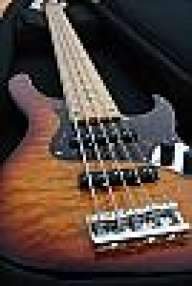
Removing worn out set screws on this design of bridge looks pretty fiddly. I'm not suggesting for a second that Leo Fender's bent-metal design is optimal, but at least you don't need to thread an allen key into a recessed set screw at a tricky angle to make a simple adjustment.

For what it is worth, I've only ever had to set the intonation on my basses once for each one. I tend not to mix up string types, gauges or tunings however. For me it is a 'set and forget' function. I still like each and every string to be optimally intonated however.

At least with the fretted F bass you can set the intonation for each string, regardless of how it appears in the photograph. Mr. Furlanetto would be mounting the exact same bridge to both his fretted and fretless instruments if he felt this was a non-issue.
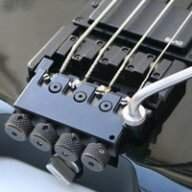
 
Removing worn out set screws on this design of bridge looks pretty fiddly. I'm not suggesting for a second that Leo Fender's bent-metal design is optimal, but at least you don't need to thread an allen key into a recessed set screw at a tricky angle to make a simple adjustment.

It isn't fiddly at all. Just to explain the principle: the bridge sits loosely (at first) on two pridge posts, which can be turned up and down for action setup. And then there are four set screws, two on each side, clamping that bridge posts between them and holding the bridge (horizontally) in place:

bm_CR5_Front_intonation.jpg


No difficulty at all to get these screws in and out. Just difficult to strip them in the first place, as there is no real load on them. And before the question arises: this drawing shows the principle and is not accurate in terms of angles and dimensions.

Regarding the necessity for intonation setup: this is my experience as well. Once set correctly, it usually stays so as long as you don't change string gauges or brands. And rest assured, the CR5 comes already with the setup done… for those who find it difficult to do :)

Bernd
 
If you cannot figure out why a fretted instrument needs individual string-lenth adjustment and why a fretless instrument does not, then get off Talkbass and actually do some research rather than slinging smug platitudes.

Be careful. Your charming personality is shining through.

Fretted instruments are a problem in general. When perfectly in tune and intonated, I hate how the G on the third fret of the E string on a 34" bass is out of tune. A 35" scale sounds better to my ears,but then the first five frets of the G string sounds funny to me. B strings in general ring sharp and then slowly settle into the correct pitch. Other strings do it too, but by the time the B string is big enough to overcome the inherent problem with overtones, it is particularly noticeable.

Fretted basses have bigger problems than a single saddle bridge, IMO.

Sorry I was slow posting a response. I was practicing instead of posting. Smugly practicing, but practicing none the less.
 
I guess that's why classical guitars have been unplayable for centuries.

There we go again, slinging smug platitudes.

Seriously, though, this bridge design is questionable in the modern era. However, I will bet that NS designed it to a specific string gauge, and it will intoate perfectly at that gauge. Just a guess, and that might be too limiting for some, I suppose. But, it is just plain stupid too write off an NS design without giving it a test drive. In this thread, only one guy has done so, and he doesn't think it would work for his rather unusual tunings. I can't speak to that; he has played it and I have not.
 
There we go again, slinging smug platitudes.
Smug platitude? It's my zeuhl-bro who's pontificating in absolutes. I just provided the screamingly obvious counter-example.
Seriously, though, this bridge design is questionable in the modern era. However, I will bet that NS designed it to a specific string gauge, and it will intoate perfectly at that gauge. Just a guess, and that might be too limiting for some, I suppose.
But that's just it. You and kohntarkosz are guessing without ever having played, much less tuned the instrument, and shouting down people's first-hand reports that contradict your assumptions.

"Questionable in the modern era"? Perhaps, it only becomes *reasonable* in the modern era, with the tolerances thar are now possible to maintain in the neck, fretboard, and nut? Don't get me wrong - it seems odd to me, too. But NS has made counter-intuitive things work well in the past, and I'm far more interested in the observations of people with experience on the instrument than in the presumptions of those who have none.
 
Smug platitude? It's my zeuhl-bro who's pontificating in absolutes. I just provided the screamingly obvious counter-example.

But that's just it. You and kohntarkosz are guessing without ever having played, much less tuned the instrument, and shouting down people's first-hand reports that contradict your assumptions.

"Questionable in the modern era"? Perhaps, it only becomes *reasonable* in the modern era, with the tolerances thar are now possible to maintain in the neck, fretboard, and nut? Don't get me wrong - it seems odd to me, too. But NS has made counter-intuitive things work well in the past, and I'm far more interested in the observations of people with experience on the instrument than in the presumptions of those who have none.

Easy with the fangs, Sid. In my posts, I was giving NS credit, but at the same time, I wasn't discounting another poster that said he tried it and didn't think it would work for him and his alternate tunings. In the clip I posted a link to, I don't hear anything that would turn me away. Quite the opposite; it sounds great.

It is true I have not played it. I haven't seen one, even when I have been in Music stores in northern Virginia. My point was that it is silly to discount this bass because, based on a picture, kahn thinks that it couldn't possibly work.

Edit: I had to look up "zeuhl.". I don't do well with made-up words.
 
Edit: I had to look up "zeuhl.". I don't do well with made-up words.

All words are made up at some point. :cool:

I admit, I probably went overboard in this thread yesterday. My biggest problem being that my initial concerns were met with a post that basically boiled down to "sum ppl jst want to bitch n moan", which sort of kicks the stuffing out of any reasoned argument I was trying to convey.

In all honesty I doubt a $2,700 bass would not intonate correctly. That would be madness on the part of the luthier. With the Ned Steinberger design and influence it is no doubt a very clever wee design that works perfectly, if perhaps for only one string gauge and type. Secondly the bridge is very visually clean, in my opinion, and looks far more graceful than a conventional Fender-style bridge, which would look out of place on such a 'space age' design. My grudge against fiddly set-screws comes from dealing with aftermarket tune-o-matic bridges that require the adjustment of set-screws to intonate them correctly (as stock Gibson ones tend to not have enough travel to really work well). One bridge somehow shed a set-screw, presumably from string vibration at the right resonance to loosen it off. Another one seized up completely, and I stripped the head of the screw trying to back it out. With both bridges I was happiest to get out the allen keys once the string tension was lowered, rather than fight against the downward force of the strings.
 
Perfect intonation is not possible. Matching up the 12th fret note to open note is not "perfect intonation". Intonating fretted instrument is a compromise at best.

When perfectly in tune and intonated, I hate how the G on the third fret of the E string on a 34" bass is out of tune. A 35" scale sounds better to my ears,but then the first five frets of the G string sounds funny to me. B strings in general ring sharp and then slowly settle into the correct pitch. Other strings do it too, but by the time the B string is big enough to overcome the inherent problem with overtones, it is particularly noticeable.

Fretted basses have bigger problems than a single saddle bridge, IMO.
 
With a name like that, I thought it was a bowable (!) bass guitar. Now that would have been a novel idea, and who but Mr. Steinberger could do it?

Looking at the specs, I realized it was just one more modern bass design... *yawn*

Actually, Steinberger invented the thing you're talking about prior to this "Radius" project. NS Designs calls it an "Omnibass", which is a variant on their electric upright (EUB) designs, shrunk to the standard bass guitar 34" scale and equipped with both a foot to play upright and a strap scheme to play standing.

eibansdcr5e_28-4.jpg
 
  • Like
Reactions: Bliff Curton 2