Today I needed to make a nut for the 7 string bass I am building so I thought I would take some pictures of my layout process.
First of all, I am using a zero fret on this so I am not going to be anal about my nut material or the action height. It's more like a string spacer with a zero fret. Now, the important thing is to get the spaces between the strings equal, not the center lines. You can buy fancy string spacing rulers for big bucks if you like but I find the following too easy to warrant any expense for a special ruler.
I won't be doing a final polish on the instrument until all of the set up is done. The nut in the following photos is sanded to 320 and still has a way to go, but again that will wait until I have her playing well. The first photo shows the outer most strings already notched and in place. I like just a little under 1/8" from the treble side of the neck to the string and dead on 1/8" on the bass side. I am using my digital caliper (wow they make these cheap these days!) to measure the distance between the strings.
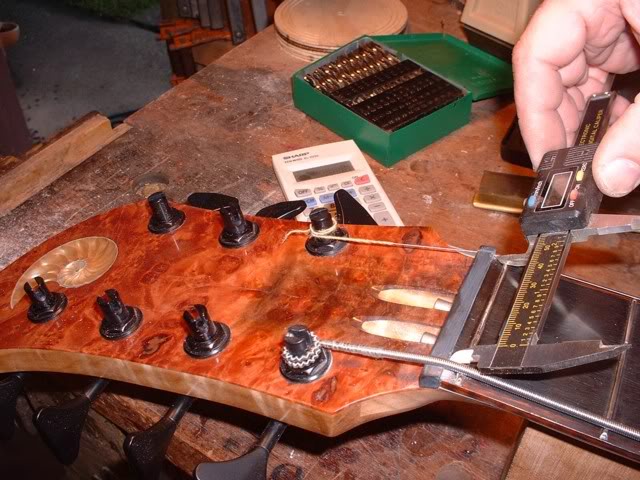
Next I subtract the thickness' of the remaining strings and divide the result by 6 (7 string bass = 6 spaces between strings). This gives me the space between the strings. Then I just set up the caliper to the space and scratch a mark in the nut, add the string thickness, scratch another mark, add the space, scratch, add next string thickness, scratch, etc.
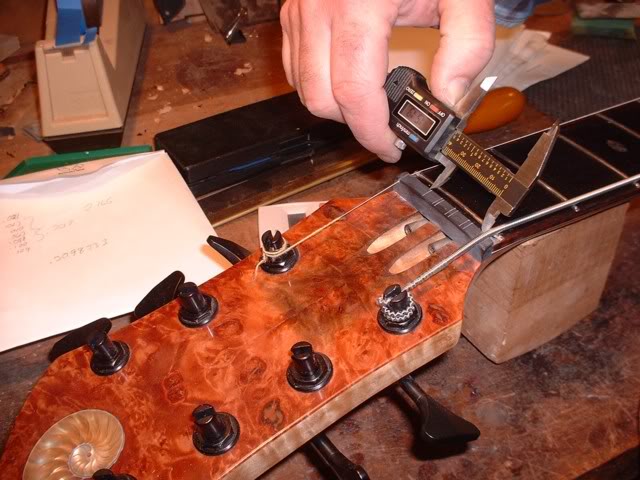
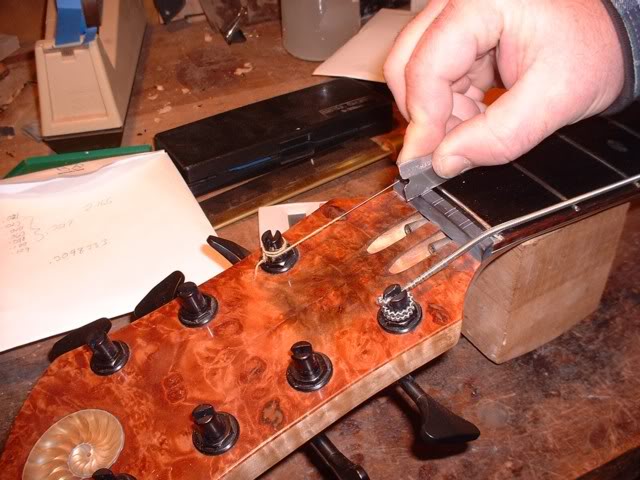
I like scratching my nuts. You should try scratching your nuts too. It's hard to see when it's bone though. (No jokes about what your Mother said would happen if you scratch your nuts.) The white bone doesn't show scratch marks well. Just rub some graphite over your bone and you will be able to see the marks.
Next I saw down the center of each string location to give the file a path to follow. I find this keeps me from wandering off the line much. I also have the outer limits of each string defined so that I can tell if I am filing one direction or another.
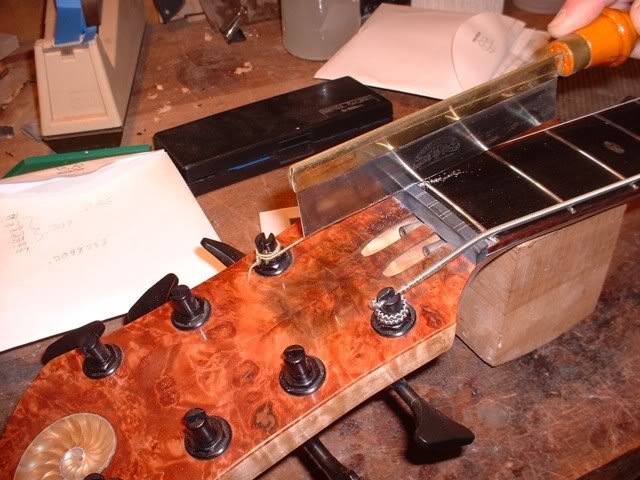
Then I file close but tight with various files.
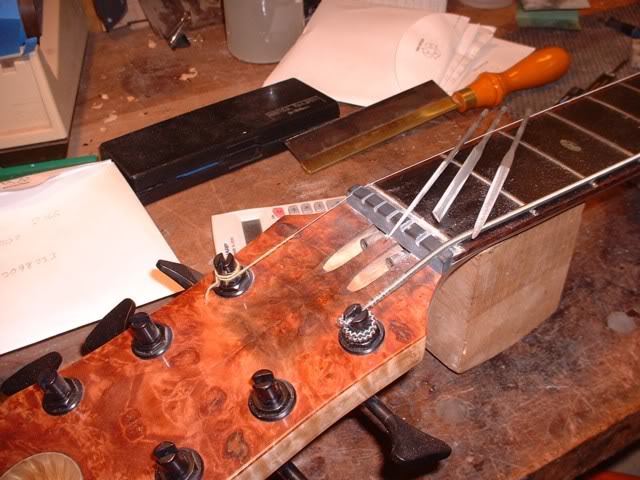
And finally finish the fit by using a numbered drill bit set to size the notch.
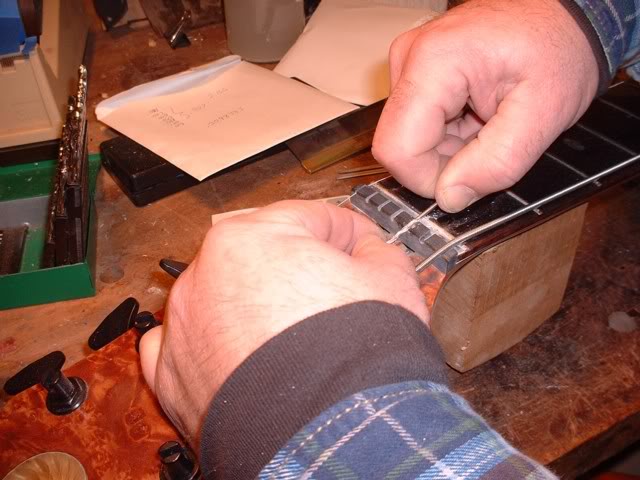
I take care even with zero frets to have a V shaped bottom. This cuts down on the chance of a buzz coming from a string that has bottomed out but is just a little sloppy on the sides.
If this were not a zero fret I would have made the notches too high to start and then worry them down little by little until the action was right.
Not the way just my way. Hope this helped someone.
Greg N
First of all, I am using a zero fret on this so I am not going to be anal about my nut material or the action height. It's more like a string spacer with a zero fret. Now, the important thing is to get the spaces between the strings equal, not the center lines. You can buy fancy string spacing rulers for big bucks if you like but I find the following too easy to warrant any expense for a special ruler.
I won't be doing a final polish on the instrument until all of the set up is done. The nut in the following photos is sanded to 320 and still has a way to go, but again that will wait until I have her playing well. The first photo shows the outer most strings already notched and in place. I like just a little under 1/8" from the treble side of the neck to the string and dead on 1/8" on the bass side. I am using my digital caliper (wow they make these cheap these days!) to measure the distance between the strings.
Next I subtract the thickness' of the remaining strings and divide the result by 6 (7 string bass = 6 spaces between strings). This gives me the space between the strings. Then I just set up the caliper to the space and scratch a mark in the nut, add the string thickness, scratch another mark, add the space, scratch, add next string thickness, scratch, etc.
I like scratching my nuts. You should try scratching your nuts too. It's hard to see when it's bone though. (No jokes about what your Mother said would happen if you scratch your nuts.) The white bone doesn't show scratch marks well. Just rub some graphite over your bone and you will be able to see the marks.
Next I saw down the center of each string location to give the file a path to follow. I find this keeps me from wandering off the line much. I also have the outer limits of each string defined so that I can tell if I am filing one direction or another.
Then I file close but tight with various files.
And finally finish the fit by using a numbered drill bit set to size the notch.
I take care even with zero frets to have a V shaped bottom. This cuts down on the chance of a buzz coming from a string that has bottomed out but is just a little sloppy on the sides.
If this were not a zero fret I would have made the notches too high to start and then worry them down little by little until the action was right.
Not the way just my way. Hope this helped someone.
Greg N