
Enjoy the benefits of a premium membership!
Upgrade Account
-
TalkBass has been independent since 1998. Add your voice.
Create a free account to reply to discussions, view embedded media, and browse with fewer display ads.
Join free Log in
Want zero display ads or expanded classifieds tools? Compare plans.
You are using an out of date browser. It may not display this or other websites correctly.
You should upgrade or use an alternative browser.
You should upgrade or use an alternative browser.
Observation
- Thread starter jg42
- Start date
More options
Who Replied?

My theory (as an ex-psychologist) - Research has shown that we all have various combinations of the different human aptitudes. No one can do everything, and it is hard to know exactly what all the aptitudes we have are. Some are apparent, but others can be hidden unless you try everything there is to do in the world.
In the case of musicians changing - they obviously have some of the major music skills, but perhaps not the right ones for what they were doing, or the instrument they were playing was not satisfying.
For violin, for example, you need extreme finger dexterity and very good pitch discrimination. For sax, a particular type of mouth is advantageous - same for horns. For drums, you must have rhythm. If you lack the natural ability, playing them will be difficult and unfulfilling. We have all seen the tryouts on American Idol where the people truly have no idea how bad they are. Most really cannot hear it!
I started as a guitar player, but I found I had limited finger dexterity but strong rhythm, so I changed to bass. Ideally, I should have become a drummer as I will never be able to play "fancy" bass no matter how hard I practice.
When I was a teenager, my mother found a research foundation where you can have your natural abilities tested and measured, and direct you in the right direction for your life. Of course I didn't listen to them because I was 19 and knew everything, but later in life I found out that they were 100% correct. I am very very very lucky that I just happened into doing the right thing to fit my abilities (audio engineer) or I would just be another one of the masses that just works for money and hates their job instead of enjoying every day as I do, and doing it well, besides.
Check this out - www.jocrf.org I have sent more than 100 people over the years, and they have all thanked me. It can explain a lot.
In the case of musicians changing - they obviously have some of the major music skills, but perhaps not the right ones for what they were doing, or the instrument they were playing was not satisfying.
For violin, for example, you need extreme finger dexterity and very good pitch discrimination. For sax, a particular type of mouth is advantageous - same for horns. For drums, you must have rhythm. If you lack the natural ability, playing them will be difficult and unfulfilling. We have all seen the tryouts on American Idol where the people truly have no idea how bad they are. Most really cannot hear it!
I started as a guitar player, but I found I had limited finger dexterity but strong rhythm, so I changed to bass. Ideally, I should have become a drummer as I will never be able to play "fancy" bass no matter how hard I practice.
When I was a teenager, my mother found a research foundation where you can have your natural abilities tested and measured, and direct you in the right direction for your life. Of course I didn't listen to them because I was 19 and knew everything, but later in life I found out that they were 100% correct. I am very very very lucky that I just happened into doing the right thing to fit my abilities (audio engineer) or I would just be another one of the masses that just works for money and hates their job instead of enjoying every day as I do, and doing it well, besides.
Check this out - www.jocrf.org I have sent more than 100 people over the years, and they have all thanked me. It can explain a lot.

"Bass" can be thought of as a low portion of the tone register, rather than an instrument. That is, the left hand of the piano, for example. Many instruments play in the bass register. Think of the tuba, for another example.
The upright bass being played as we know it is a relatively recent development. Even more recent is a low register instrument in a guitar shape (solid body electric bass).
All of this leaves us still riding the wave of the history/culture from the more remote past (rather than the more recent past).
Conclusion: for many, bass is a derivative instrument, not a "real" instrument.
But you're among friends here on TB, so feel free to be yourself, bass player from the start, or not.

The upright bass being played as we know it is a relatively recent development. Even more recent is a low register instrument in a guitar shape (solid body electric bass).
All of this leaves us still riding the wave of the history/culture from the more remote past (rather than the more recent past).
Conclusion: for many, bass is a derivative instrument, not a "real" instrument.
But you're among friends here on TB, so feel free to be yourself, bass player from the start, or not.

I started on Trombone (6th grade) then made the switch to bass around 9th grade. I see it more as a lateral move than an all out change. As I've said time and time again,
"I did not choose bass, it chose me." -me
"I did not choose bass, it chose me." -me


i noticed that a lot of punk rock pizza shops and underground clubs didn't have a piano for me, so i started playing bass

i think it's because bass is not a instrument that gets a whole lot of attention, so for some of us, it takes a little searching before we find it.

Some reasons:
1. In my view, instruction for electric bass has historically ranged from primitive to nonexistent. There's no school instruction for electric bass, and relatively few college-trained teachers. In a lot of school string programs, upright bass was historically treated as a backwater -- left to the kids who could figure it out for themselves. It also doesn't get much encouragement from parents. Kids who start on other instruments have an advantage in reading, basic theory, ear playing, etc.
2. If you start kids out young enough, their hands are too small for the bass, and I don't think they really appreciate the idea of playing a comping instrument until later.
3. People who play a variety of instruments discover that you can make money playing bass.
I started on cello in 4th grade.
1. In my view, instruction for electric bass has historically ranged from primitive to nonexistent. There's no school instruction for electric bass, and relatively few college-trained teachers. In a lot of school string programs, upright bass was historically treated as a backwater -- left to the kids who could figure it out for themselves. It also doesn't get much encouragement from parents. Kids who start on other instruments have an advantage in reading, basic theory, ear playing, etc.
2. If you start kids out young enough, their hands are too small for the bass, and I don't think they really appreciate the idea of playing a comping instrument until later.
3. People who play a variety of instruments discover that you can make money playing bass.
I started on cello in 4th grade.
And it doesn't help that:
1 - the eletric bass was usually left for the ones that couldn't play the guitar.
2.1 - It's common that an untrained ear can't notice the bass in a recording
2.2 - Many (many!) bands that kids like to listen to leave the basses buried under 4 overdrived guitars
2.3 - Many (many!) bass players (of bands kids like to listen to) play only roots/5ths along with the guitars in every song (thus making the bass almost useless)
1 - the eletric bass was usually left for the ones that couldn't play the guitar.
2.1 - It's common that an untrained ear can't notice the bass in a recording
2.2 - Many (many!) bands that kids like to listen to leave the basses buried under 4 overdrived guitars
2.3 - Many (many!) bass players (of bands kids like to listen to) play only roots/5ths along with the guitars in every song (thus making the bass almost useless)
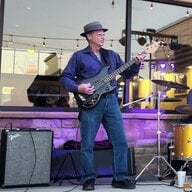
I don't think I ever "switched" to bass. I play guitar and bass. I have always accepted that they are two completely different instruments and have tried to do my best on each. Next weekend, I play guitar on one stage Friday night, and then Saturday I will be on bass with a different band.
I do remember in ninth or tenth grade, I told my best freind and fellow guitar player that he had to get a bass because he was taller. The was when he switched. He became an excellent bassist. So, sometimes someone might switch just because someone has to.
I do remember in ninth or tenth grade, I told my best freind and fellow guitar player that he had to get a bass because he was taller. The was when he switched. He became an excellent bassist. So, sometimes someone might switch just because someone has to.
Latest posts
-

-
 Future Impact now available!! WAS: deep impact reissue!!! interested?
- Latest: Quatschmacher
-

-

-
