• TalkBass has been independent since 1998. Add your voice.
    Create a free account to reply to discussions, view embedded media, and browse with fewer display ads.
    Join freeLog in
    Want zero display ads or expanded classifieds tools? Compare plans.

Official Tobias Club

Wow! Just loving my Tobias! Being a newbie, I have some questions about pre-Nashville hardware:
  1. Mine has a brass nut which you can see in the brochure but it seems like most Tobias do not. Was a brass nut an extra option? I feel it adds a super crisp ping to popping like on the video and similar to my Status. Doesn't seem to be a signature line thing. Loving it!
  2. Even though they are all Bart pups, why do some have the Bart logo like skb5string's awesome Classic and most have blanks. I think all the blanks are shouldered?
  3. The bridges seem to be a mix bag. I remember the Omega I played had a bridge I never, ever heard of before. Can't remember what it was called. Feel like pinging Brad because it is on the tip on my tongue. I believe I've seen what I would consider "stock" bridges on Tobias that didn't always have name stamped on them.
Is there a rhyme / reason or just what hardware was available when they built them? I'm pretty sure the tuners always had the logo on the back.
 
  • Like
Reactions: chupacerveza
Wow! Just loving my Tobias! Being a newbie, I have some questions about pre-Nashville hardware:
  1. Mine has a brass nut which you can see in the brochure but it seems like most Tobias do not. Was a brass nut an extra option? I feel it adds a super crisp ping to popping like on the video and similar to my Status. Doesn't seem to be a signature line thing. Loving it!
  2. Even though they are all Bart pups, why do some have the Bart logo like skb5string's awesome Classic and most have blanks. I think all the blanks are shouldered?
  3. The bridges seem to be a mix bag. I remember the Omega I played had a bridge I never, ever heard of before. Can't remember what it was called. Feel like pinging Brad because it is on the tip on my tongue. I believe I've seen what I would consider "stock" bridges on Tobias that didn't always have name stamped on them.
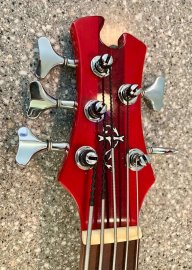
Is there a rhyme / reason or just what hardware was available when they built them? I'm pretty sure the tuners always had the logo on the back.

Yeah, Depending on customer wants/requirements and what Mike liked using at the time depended on what hardware you may find on these beauties.

Here is kinda what I have seen:

Early Tobias Hardware was in alot of cases Schaller.
Schaller Tuners with the "S" logo on the back and Schaller roller bridge where you could adjust the string spacing and had "More Mass" then a standard Schaller bent tail piece bridge a'la fender. But I have seen the bent tail piece as well on Tobias basses, I owned an old Basic from 87 that had the bent tailpeice.

Sometime around the time Gibson got involved The hardware changed to have the Name and Logo on them. The Bridge on the classics and Signatures went to a more Hipshop like bridge with the "Tobias" name on the plate and the tuners looked to be more grover like with the "T" logo on the back. I think the basics had the newer hardware as an up charge. I may add too that when operations were fully moved to Gibson the bridge changed again and the Tobias name was on the side on the bridge. Thats almost a dead give away that the bass is a Gibson made Tobias without even looking at the serial number, But always check cause right before they moved to Nashville things were changing.

I'm not 100% sure the brass bridge was an option. May have been, but may have been a mod too. I would reach out direct to Mike on that but to be honest I've not seen one until yours!

So the pickups have been discussed alot. Bartolini was using a proprietary pickup for Tobias basses and a TCT preamp. Sometimes, at the customers request the TCT pre would have a tone control that worked in both active and passive mode. The pups on the 4 and 5 string did not have the Bartolini logo and had the "Drop Shoulder". The 6 string had Bart pups that were not logo'd and did not have a "Drop Shoulder". As the time went on Bartolini started branding those pickups, then as Gibsons influence became more prevalent and operations moved to Nashville Gibson started using more off the shelf Bart Products. My Classic 6 you see in the pics has the older style proprietary pups with the logo. When Mike started MTD he again worked with Bartolini to make a proprietary Pickup and Preamp.

Hope that helps. Whenever I'm looking for a Tobias I always look for a Drop Shoulder Pup and TCT pre on the 5's. My only exception is the Jim Williams Audio Upgrades Pre this 6 has in it.
 
Last edited:
Yeah, Depending on customer wants/requirements and what Mike liked using at the time depended on what hardware you may find on these beauties.

Here is kinda what I have seen:

Early Tobias Hardware was in alot of cases Schaller.
Schaller Tuners with the "S" logo on the back and Schaller roller bridge where you could adjust the string spacing and had "More Mass" then a standard Schaller bent tail piece bridge a'la fender. But I have seen the bent tail piece as well on Tobias basses, I owned an old Basic from 87 that had the bent tailpeice.

Sometime around the time Gibson got involved The hardware changed to have the Name and Logo on them. The Bridge on the classics and Signatures went to a more Hipshop like bridge with the "Tobias" name on the plate and the tuners looked to be more grover like with the "T" logo on the back. I think the basics had the newer hardware as an up charge. I may add too that when operations were fully moved to Gibson the bridge changed again and the Tobias name was on the side on the bridge. Thats almost a dead give away that the bass is a Gibson made Tobias without even looking at the serial number, But always check cause right before they moved to Nashville things were changing.

I'm not 100% sure the brass bridge was an option. May have been, but may have been a mod too. I would reach out direct to Mike on that but to be honest I've not seen one until yours!

So the pickups have been discussed alot. Bartolini was using a proprietary pickup for Tobias basses and a TCT preamp. Sometimes, at the customers request the TCT pre would have a tone control that worked in both active and passive mode. The pups on the 4 and 5 string did not have the Bartolini logo and had the "Drop Shoulder". The 6 string had Bart pups that were not logo'd and did not have a "Drop Shoulder". As the time went on Bartolini started branding those pickups, then as Gibsons influence became more prevalent and operations moved to Nashville Gibson started using more off the shelf Bart Products. My Classic 6 you see in the pics has the older style proprietary pups with the logo. When Mike started MTD he again worked with Bartolini to make a proprietary Pickup and Preamp.

Hope that helps. Whenever I'm looking for a Tobias I always look for a Drop Shoulder Pup and TCT pre on the 5's. My only exception is the Jim Williams Audio Upgrades Pre this 6 has in it.

Wow! Great info! Thank you very much! Yeah I'm trying to remember if I've ever seen a Tobias with a brass nut except mine. The story of mine bass was Mike got the bass back from Keith Jones and used it in the photo shoot. The bass came with the negatives of the photo shoot, the invoice from the photo company and a copy of the brochure and it definitely has a brass nut in the photo! I remember back then brass nuts were gaining popularity with other makers (Alembic comes to mind) but why would you make the centerfold of your Signature brochure with a brass nut if no other ones are built that way? Again probably a lot more to the story which Mike would know.

Thanks about the 6 string have the logo Bart pickups. Make sense. Same with the original ones having Schaller hardware. I do remember coming across one with the tone control working in both active and passive. Blew me away the first time and I thought I was losing my mind. My bass is wired definitely as midrange boost on the bridge pickup only instead of active / passive switch.

That has been my motto too:

Whenever I'm looking for a Tobias I always look for a Drop Shoulder Pup and TCT pre on the 5's.
.

Thanks again!
 
Hey Fellow Tobias Heads, got some Truss Rod questions:

I have just a couple questions about the double truss rod in the older Tobias Basses.

1.) Its always been my understanding that when adjusting the neck you should tighten or loosen each rod the same, so if you want less relief tighten the Bass side rod a 1/4 turn and the treble side rod a 1/4 turn, more relief, loosen each rod a 1/4 turn, or untill desired effect. this is the proper procedure on these older rods, correct?

2.) I currently own 2 Older Tobias basses, #76X Red Basic 5 and #17XX, a Classic 6 String owned once by Kim Stone of The Rippingtons. The Classic 6 has a little more neck relief than I like. If the procedure above for the double rods is correct then the rods are a little close to being pretty tight. Is there a way/procedure to "reset the rods/Neck" so the rods have a little more effect. I know they work cause when I loosened them the relief increased and got better as tightened but still too much relief.

Any thoughts or suggestions would be much appreciated!

Thanks again,
 
  • Like
Reactions: chupacerveza
Hey Fellow Tobias Heads, got some Truss Rod questions:

I have just a couple questions about the double truss rod in the older Tobias Basses.

1.) Its always been my understanding that when adjusting the neck you should tighten or loosen each rod the same, so if you want less relief tighten the Bass side rod a 1/4 turn and the treble side rod a 1/4 turn, more relief, loosen each rod a 1/4 turn, or untill desired effect. this is the proper procedure on these older rods, correct?

2.) I currently own 2 Older Tobias basses, #76X Red Basic 5 and #17XX, a Classic 6 String owned once by Kim Stone of The Rippingtons. The Classic 6 has a little more neck relief than I like. If the procedure above for the double rods is correct then the rods are a little close to being pretty tight. Is there a way/procedure to "reset the rods/Neck" so the rods have a little more effect. I know they work cause when I loosened them the relief increased and got better as tightened but still too much relief.

Any thoughts or suggestions would be much appreciated!

Thanks again,

Bump!
 
2.) I currently own 2 Older Tobias basses, #76X Red Basic 5 and #17XX, a Classic 6 String owned once by Kim Stone of The Rippingtons. The Classic 6 has a little more neck relief than I like. If the procedure above for the double rods is correct then the rods are a little close to being pretty tight. Is there a way/procedure to "reset the rods/Neck" so the rods have a little more effect. I know they work cause when I loosened them the relief increased and got better as tightened but still too much relief.
You might want to contact Mike Tobias directly with that question. If there is a solution, he'll know what it is.
 
You might want to contact Mike Tobias directly with that question. If there is a solution, he'll know what it is.

Yup, I did. He had me remove the truss rod nuts, put in 2 small thin washers per side and put the nuts back on. This gave the nuts a little more room to push against the metal that adjusts the rods. Worked like a charm!! Neck is straight and more life in the truss rod system now.
 
Hey Everyone, got a question to ask.

A friend of mine and I are trying to help Terrance Palmer find his old Pre-Gibson Tobias from the Fred Hammond / New Breed days. I think it was sold on here a few years ago. Anyone know where it is? He really wants it back. Any help would be much appreciated! Terrance is a hero to a lot of us and would be a great service!

Thanks
 
Hey TBers! Helen is changing the world and making history again!

[Invalid or Expired Link Removed]

I've been chatting it up with the owner and explained that bass players are WWWWWAAAAAYYYY better than guitarist and better customers because we truly appreciate fine craftsmanship and exotic woods. The photo is a proto of the case he's building for me. Went with flame maple as a nice contrast. Even though Helen is 28+ years old, the neck is still moving in the Florida heat and humidity even in a fully air conditioned house. Strings been going slightly sharp on me. Their climate control and fully seal cases are the only way to go. Now you can enjoy your basses, will play them more and the other half doesn't have to look a bunch of black hardshell cases. Definitely check them out and tell them TB sent you their way!

Still hoping a fellow TBer with a original pre-Gibson Tobias 6 string will sell me my "Can of shutup and go to the woodshed". Maybe I should say a "6 pack of shutup and go to the to woodshed". Emmett's working on my Stick and I'm thristy. :laugh:
 
Last edited:
Finally got my case!

Acoustic Remedy ClimaCase for Bass!

I was able to get a couple of original Tobias leather bass straps from the previous owner.

Now that I have a proper shrine, can I join the Official Tobias Club?
20200428_203811.jpg
20200428_203818.jpg
20200428_203905.jpg
 
Basic 5 question ?
I got a used Gibson made Basic 5 a while ago and the 2 way switch had been removed.
Does anyone know the function of it ?
Was it Active/Passive switch or mid frequency selector ?
Want to make it original before possibly selling.
Appreciate any input.
 
Basic 5 question ?
I got a used Gibson made Basic 5 a while ago and the 2 way switch had been removed.
Does anyone know the function of it ?
Was it Active/Passive switch or mid frequency selector ?
Want to make it original before possibly selling.
Appreciate any input.

Gibson went through a few different Bart electronics packages. Some early Gibson's (after serial #2044) were still active/passive then they went with the mid selector. I would say if you are after 2600 then it's probably mid selector
 
  • Like
Reactions: WayneP
Not bad for a Nashville bass :roflmao:
Nice!

The bad rap against the Nashville basses was mainly centered on a) the bad blood that developed between Gibson and Mike (who is one of our Bass treasures), b) an observed issue with quality control - mainly poor fretwork on some of the instruments, and c) Gibson hiked the prices. Taken together, those all pissed off a bunch of players. Justifiably so.

But, take note that performance of the instruments is only barely touched on by those issues. The fretwork can be addressed by a proper luthier visit. The higher prices have since translated into actually lower prices in the used market. And, the reality is that Gibson pretty faithfully executed Mike's designs on a large number of instruments, making them more generally available than the pre-Nashville population.

I have a Nashville C6, which cost me $1500, and after a visit with Pat Wilkins is an instrument they will pry from my cold dead hands. In fact, here in Tucson, we were under evacuation preparation orders yesterday for the Bighorn fire; and my C6 was one of three basses that made the cut to go in the car, had things gotten out of control.

869C0E0B-1E93-472D-8405-533A4BBBFCC3.jpeg


The pre-Nashville instruments can certainly be endearing. I went through several, two of which I gigged extensively; but, none of them stuck. Now, I'm left with my Nashville C6 and an MTD 534, which Mike built to my specs. I apologize for nothing.
 
Nice!

The bad rap against the Nashville basses was mainly centered on a) the bad blood that developed between Gibson and Mike (who is one of our Bass treasures), b) an observed issue with quality control - mainly poor fretwork on some of the instruments, and c) Gibson hiked the prices. Taken together, those all pissed off a bunch of players. Justifiably so.

But, take note that performance of the instruments is only barely touched on by those issues. The fretwork can be addressed by a proper luthier visit. The higher prices have since translated into actually lower prices in the used market. And, the reality is that Gibson pretty faithfully executed Mike's designs on a large number of instruments, making them more generally available than the pre-Nashville population.

I have a Nashville C6, which cost me $1500, and after a visit with Pat Wilkins is an instrument they will pry from my cold dead hands. In fact, here in Tucson, we were under evacuation preparation orders yesterday for the Bighorn fire; and my C6 was one of three basses that made the cut to go in the car, had things gotten out of control.

View attachment 3864045

The pre-Nashville instruments can certainly be endearing. I went through several, two of which I gigged extensively; but, none of them stuck. Now, I'm left with my Nashville C6 and an MTD 534, which Mike built to my specs. I apologize for nothing.

I totally agree with all your points for the early Nashville basses (up to around 97/98). After that though, the quality severely dropped. One of the other reasons the Gibson basses got dismissed was Mike taking his electronics specs with him and thus the sound substantially changing. Gibson used that cluster, dual voicing "slap mode" pre that (IMO) only sounded good in slap mode and suffered from battery draining/reliability issues. Also Gibson started using more generic spec Bartolini pickups and wired them (dual/quad coil models) in series at the pickup so you didn't have the choice to use parallel (what Mike normally used) or series, which again changed the sound. Even in the pre-nashville basses, there is a distinct difference btwn the 80's and 90's era models. The earlier Tobias' had drop shoulder, MT(*)T wind pickups and TCT preamps, then (sometime during the Burbank era) Mike moved away from the TCT and started using MT(*)CX wind pickups with the WTMB which sounded different (more towards the MTD sound). I am personally a fan of the 80's basses with the drop shoulders. Those pickups had this very active/EMG-like sizzle to them and the warmth/bottom of the TCT paired very well to them.
 
Last edited:
I totally agree with all your points for the early Nashville basses (up to around 97/98). After that though, the quality severely dropped. One of the other reasons the Gibson basses got dismissed was Mike taking his electronics specs with him and thus the sound substantially changing. Gibson had that cluster "slap mode" pre that (IMO) only sounded good in slap mode and suffered from battery draining/reliability issues. Plus Gibson started wiring the (dual coil model) pickups in series at the pickup so you didn't have the choice to use parallel (what Mike normally used) or series, which again changed the sound. Even still, there is a distinct difference btwn the 80's and 90's era pre-nashville basses. The earliest Tobias' had drop shoulder, MT(*)T wind pickups and TCT preamps, then Mike moved away from the TCT and started using MT(*)CX wind pickups with the WTMB which sounded different (more towards the MTD sound). I am personally a fan of the 80's basses with the drop shoulders. Those pickups had this very active/EMG-like sizzle to them and the warmth/bottom of the TCT paired very well to them.
First, Mike himself will tell you that the electronics and preamps were never his strongest part of the package. and, what I mean is that his luthiery expertise far outweighs his electronics tech capability. That said, certainly each to their own. There are def a bunch of players, like yourself, who prize the TCT / drop shoulder pickups.

That's all cool; but, for my part, I struggled with all of that. Both of the pre-Nashvilles I gigged extensively were Sig5's. The first one had the later preamp you described; and I had to work extensively with the Nashville folks to finally get a preamp I liked in it. Sort of.

That didn't stick; and a few years later I obtained an earlier Hollywood bass with the TCT / Drop Shoulder pickups. In my hands the TCT, after I removed some objectionable LPF wiring that had been installed as an option, was OK going to tape, but just meh in a live mix. I ended up (carefully / reversibly) stripping that out and installing a Pope preamp, which opened the live voicing up to a considerable extent.

Meanwhile, Pat Wilkins did the refin on my C6, which included the Pope preamp AND what were then prototype Nordstrand Zen Blades. And, that result was SO successful, that I ultimately sold the Hollywood Sig 5, because I didn't want to do an irreversible rout to replace the Drop Shoulder pickups; and used to proceeds to fund the bass Mike more recently built for me. For MY purposes, the Zen Blades plus Pope preamp are a significant improvement over the Drop Shoulders / TCT, the latter of which both just sounded more closed up. Which is fine for studio tracking; but, I prefer more open voicing so for live work. So, as always, YMMV; that's just my experience.

FWIW, here is the Hollywood Sig5 carrying the Pope preamp with the Drop shoulders:
073D52F5-1474-4EE5-9E81-213097829165.jpeg


...aaand here is the MTD, which replaced it.
5E9B3B01-24B0-427D-AE2A-A407366EA359.jpeg
 
Last edited: