

Enjoy the benefits of a premium membership!
Upgrade Account
-
TalkBass has been independent since 1998. Add your voice.
Create a free account to reply to discussions, view embedded media, and browse with fewer display ads.
Join free Log in
Want zero display ads or expanded classifieds tools? Compare plans.
You are using an out of date browser. It may not display this or other websites correctly.
You should upgrade or use an alternative browser.
You should upgrade or use an alternative browser.
Ohms FAQ
- Thread starter IvanMike
- Start date
More options
Who Replied?
True dat!
Thanks for the welcome, guys! As for "geezer"... those of us in our little group who happen to hail from the other side of rock & roll - AND - for that matter, World War II, (self included) are proud, card-carrying ones who've earned our stripes.

Chasarms! Can it really be that simple and straightforward? I think that you are my new best friend! Mooooochas gracias! I will be looking into this one for sure! Many thanks!!
UPDATE 02/20/2016 - Just ordered the second amp from Jed at Sweetwater Music who matched a competitor's Prez Day sale price. He even tossed in a nice cable for the patch! Those folks truly rock!
Thanks again, Chasarms, for the solution! Techies at both GK and Ampeg were telling me "it can't be done", but YOU immediately pointed the way through the fog! Genuine gratitude here!

UPDATE 02/20/2016 - Just ordered the second amp from Jed at Sweetwater Music who matched a competitor's Prez Day sale price. He even tossed in a nice cable for the patch! Those folks truly rock!
Thanks again, Chasarms, for the solution! Techies at both GK and Ampeg were telling me "it can't be done", but YOU immediately pointed the way through the fog! Genuine gratitude here!
Maybe I am just getting old. We did crap like that all the time when I was a kid. Sometimes we would "bi-amp," that is, split the signal with a crossover of some type and run the lows to one amp and cabinet and the highs to another. It was pretty common practice. In fact, I still have an Ampeg head that has a built-in crossover for that purpose.
Or you can just slave the second amp and run both full range.
Maybe I am just getting old. We did crap like that all the time when I was a kid. Sometimes we would "bi-amp," that is, split the signal with a crossover of some type and run the lows to one amp and cabinet and the highs to another. It was pretty common practice. In fact, I still have an Ampeg head that has a built-in crossover for that purpose.
Or you can just slave the second amp and run both full range.
I s'pose that we can point to all kinds of 'lost knowledge' kinds of examples - where something once quite common is now just as quite obscure... phased out by later technologies, etc. A couple of challenges for me with this amp thing... 1) I've only been dealing with guitar amplifiers for about four years now, and 2) I know less than nothing about electronics. My entire life, my music equipment has all been 'plug and play' stuff - pretty much ready to go right out of the box (once I figured out the cable connections, that is). Your solution for me instantly brought back to me the old story of the huge truck rig stuck fast in the tunnel - until the little girl suggested letting the air out of the tires. (And before any GOFs jump in on this, I have NOT called anyone here a little girl!)

I'm a noobie so all I can say is that I would keep it simple. Mixing cabinets with different impedance is beyond me. I think most amps are rated 4 ohms, and that means one 4 ohm cabinet or two 8 ohm cabinets. Beyond that I am befuddled.
I'm a noobie so all I can say is that I would keep it simple. Mixing cabinets with different impedance is beyond me. I think most amps are rated 4 ohms, and that means one 4 ohm cabinet or two 8 ohm cabinets. Beyond that I am befuddled.
Thanks for your comment, befuddled one! Not to get into one of 'those' kinds of contests, but I'll bet MY befuddle is bigger than yours! (And no, I won't show you mine if you show me yours.)
Anyway, the earlier suggestion (above) to run the incompatible cabinets each with its own amp, with the amps connected one to the other via 'line out' has solved my dilemma! Rock on!
I recently bought an Eminar tube amp from the 70's (it sounds fantastic). I'm currently running an Ampeg 115, however I'd like to run a 410 simultaneously.
The amp is rated at 150w and it has 8-16 ohms written on it, no switch to switch resistance though. There is one speaker output, another output that says 'extension' and another that says 'line out'. Both cabs are rated at 4 ohms. How should I go about this?
Many thanks!
Will.

View attachment 1102910 Hi,
I recently bought an Eminar tube amp from the 70's (it sounds fantastic). I'm currently running an Ampeg 115, however I'd like to run a 410 simultaneously.
The amp is rated at 150w and it has 8-16 ohms written on it, no switch to switch resistance though. There is one speaker output, another output that says 'extension' and another that says 'line out'. Both cabs are rated at 4 ohms. How should I go about this?
Many thanks!
Will.
One option is a serial speaker cabinet connection. Your two four ohm cabs will be connected in series to provide an eight ohm load for the amp. You can do this with this box.
Invalid Link Removed
One potential problem, if your cabs perform differently, one could be louder than the other. You'd have to test them together to see how well the work together.
I would have a tech examine the amp to determine how it is wired and to see if there are any unused output transformer taps. Knowing that the impedance is 8-16 ohms is not good enough. I'd want to know what the true impedance is so that you can properly match a cab to the amp.
Last edited:
One option is a serial speaker cabinet connection. Your two four ohm cabs will be connected in series to provide an eight ohm load for the amp. You can do this with this box.
Invalid Link Removed
One potential problem, if your cabs perform differently, one could be louder than the other. You'd have to test them together to see how well the work together.
Awesome thank you,
I have just realised that I have typed 4 ohm cabs when they are in fact both rated at 8 ohms.
The principal is still the same. Do you have any clue what the extension port is for?
Cheers.
Awesome thank you,
I have just realised that I have typed 4 ohm cabs when they are in fact both rated at 8 ohms.
The principal is still the same. Do you have any clue what the extension port is for?
Cheers.
Typically an extension speaker jack is wired in parallel with the main speaker output. This will connect your cabinets in parallel. So with two 8 ohm cabs the amp would see 4 ohms.
It could be that the amp has an 8 ohm output impedance. But will tolerate 16 ohms at the expense of some loss of output power and a small change in the tone. There is always a tradeoff when running the amp with an impedance mismatch. This is where a tech checking out the amp can help you. They can let you know if it is truely safe to operate the amp with a 16 ohm load. I doubt that the manufacturer scrawled 8-16 ohms on the chassis.
With two 8 ohm cabinets connected with a series speaker box, the impedance would be 16 ohms.
Typically an extension speaker jack is wired in parallel with the main speaker output. This will connect your cabinets in parallel. So with two 8 ohm cabs the amp would see 4 ohms.
It could be that the amp has an 8 ohm output impedance. But will tolerate 16 ohms at the expense of some loss of output power and a small change in the tone. There is always a tradeoff when running the amp with an impedance mismatch. This is where a tech checking out the amp can help you. They can let you know if it is truely safe to operate the amp with a 16 ohm load. I doubt that the manufacturer scrawled 8-16 ohms on the chassis.
With two 8 ohm cabinets connected with a series speaker box, the impedance would be 16 ohms.
Earlier in this thread, I posted a comparable question, except my issue was wanting to run a 115 and an 810 - with mismatched ohm ratings (4 and 8) for the two cabinets. After several negative technical (you can't do that) answers from very knowledgeable folks, I got a suggestion to simply run individual amps for each cabinet, connected one to the other, utilizing the 'line out' and 'return' connections on the back of the two amps. Eureka! Works like a charm!
It is good to see the great technical response coming back to you, but sometimes the technical stuff can obscure the more pragmatic and simple solutions!
I do remain grateful for TalkBass.com and all the helpful folks!
Earlier in this thread, I posted a comparable question, except my issue was wanting to run a 115 and an 810 - with mismatched ohm ratings (4 and 8) for the two cabinets. After several negative technical (you can't do that) answers from very knowledgeable folks, I got a suggestion to simply run individual amps for each cabinet, connected one to the other, utilizing the 'line out' and 'return' connections on the back of the two amps. Eureka! Works like a charm!
It is good to see the great technical response coming back to you, but sometimes the technical stuff can obscure the more pragmatic and simple solutions!
I do remain grateful for TalkBass.com and all the helpful folks!
One potential problem with this approach is that the phase of one amp may not be the same as the other. In other words, the speakers from one cab will be moving inward while the those of the other cab are moving outward. The overall effect is a thinner sound if the cabs are close to one another which would defeat the purpose of using two cabs. This can be easily fixed by reversing the polarity on one cabinet.
The only way to know if it will work properly is to try it and see.
Good that it worked out in your case.
Awesomeness at it's best!The purpose of this post is to hopefully answer the FAQ about Ohms (as they regard to speakers and the power ratings of amplifiers) , hooking up cabinets, how many cabinets can a given head power, etc. - Hopefully even become a sticky - I spend a lot of time answering posts about the info contained here
As always - your comments, and corrections are welcome. Be brutal, I'd rather have this as a good post than for you to be nice.
At some point in your bass career you have found yourself confused by the term Ohms, and by this term when it applies to speaker cabinets, (what the heck is the difference between 8 ohms and 4 ohms anyway?), and when it applies to amplifiers (what does 4 ohm min load mean? - I thought this was a 300 watt amp, why do they say it's only running at 190 watts?).
Let's start with a quick glossary of terms used in this post.
Ohms are a measure of resistance to an electrical signal.
Impedance Is very similar to resistance and will be treated as the same for our purposes. Impedance is expressed in Ohms. (e.g., "8 ohm") this cabinet has an impedance of 8 ohms.. Impedance actually incorporates resistance, capacitance, and inductance in an AC circuit. But it still holds the same basic principles as resistance in a DC circuit.
Load: This is a term used to describe the total impedance a power amp has plugged into it in terms of speakers or cabinets.
Speaker or Driver: These are the round things in cabinets that actually produce the sound. Each speaker will have its own impedance in ohms, (hopefully printed on it).
Cabinet: A box containing one or more speakers or drivers. A cabinet will have a net impedance in ohms, (hopefully printed on it). Often referred to as a speaker.
Amp: For our purposes here, when I say "amps" I mean power amps, or the power amp section
of a head or combo.
Power Amplifier: A power amplifier is designed to take line level signals (from a preamp) and convert it into speaker level signals capable of powering speakers.
Amp Head: An amp head is a preamp and power amp in one box. You'll know if you have an amp head if all you need is a bass, an instrument cord, a speaker cord, and a cabinet.
Combo Amp: These are "combinations" of a preamp, power amp and cabinet all in one. All you need is a bass and an instrument cord to rock!
Solid State Amps: A power amp section that creates power by using solid state devices. Be careful, a lot of heads called "tube amps&" really only have tubes in the preamp section, but use a solid state power amp. These are more correctly called "hybrid amps".
Tube Amps: A power amp section that creates power by using "vacuum tubes" or "valves", (same thing).
Speakers and Cabinets: Speaker cabinets for bass are typically rated at 8 ohms or 4 ohms. An 8 Ohm cabinet will have twice as much resistance to the electrical power coming out of an amp than a 4 Ohm cabinet. This means that the 4 Ohm cabinet will end up getting about twice the wattage from the amp than the 8 Ohm cabinet will. Some players use PA cabinets and guitar cabinets rated at 16 Ohms. I've never seen a 2 ohm cabinet for bass or anything else, but they must exist. Some bass cabinets are rated at 5.3 ohms (usually these are the various 3x10 cabinets). For practical purposes, these 5.3 ohm cabinets should be treated as 4 ohm cabs, but I'll explain that later. A cabinet's Impedance Depends on the impedance of the speakers in it and how they are wired. Speakers can be internally wired in series, parallel, or a combination of both. If a cabinet has one speaker in it, you guessed it, the cabinet's impedance is equal to the speaker's impedance. When wired in series the ohms of the speakers get added together for more resistance (so a 2x10 cabinet wired in series with 4 ohm speakers would have a net impedance of 8 ohms.). When wired in parallel, the impedance is decreased according to a formula. The formula is based on adding and reducing fractions. (For you in school this should be no problem, for us older people - this will seem familiar (maybe) if a bit hazy - lol. The formula for parallel impedance is as follows;
Total impedance = 1/(1/a + 1/b + 1/c ... + 1/n).
When all the cabinets or speakers are the same impedance, all you have to do is add up the # of speakers and divide the resultant number into the # of ohms of each speaker. For example, three 16 ohm speakers wired in parallel in a cabinet = 3/16, or 5.333333... ohms. That's how they get those 5.3 ohm 3x10s btw! (The 2x10 cabinet with 4 ohm speakers mentioned above wired in parallel would have a net impedance of 2 ohms). When the impedance of the different cabinets or speakers is different, you have to use the full formula. With a 4 ohm cabinet and an 8 ohm cabinet run in parallel the formula is 1/(¼+1/8). You can't add ¼ to 1/8 without having the same denominator (I told you this was gonna sound like school), so you have to reduce ¼ to 2/8 so they match. Then adding 2/8 to 1/8 gives you 3/8, dividing 8 by 3 gives you 2.67. So, hooking up an 8 ohm cabinet and a 4 ohm cabinet in parallel to your amp gives the amp a load of 2.67 ohms to power.
For the most part, you'll never have to worry about the impedance of individual speakers, only the net impedance of the cabinets. All that math junk is a pain, but needed to figure out the total impedance of a cabinet combination you plan on using. Most cabinets are designed to be "daisy chained" together. On the back of the cabinet you'll probably see 2 ¼ inputs labeled "parallel inputs'. This is the most common method of "daisy chaining" cabinets together. Almost always this results in the cabinets being run together in parallel. You may want to check with a particular brand of speaker, but I've never run across a cabinet that daisy chains in series.
Solid State Amps are rated for the amount of watts they will put into various loads. A typical rating might be "200 watts @ 8 ohms, 350 watts @ 4 ohms, 425 watts @ 2 ohms". They are also rated for the minimum safe load they can power before the amplifier is likely to become damaged, (typically 4 ohms or 2 ohms). You should never run the amplifier below its minimum safe load - doing so will most likely damage the amplifier, and void your warranty!! For example, for an amplifier rated at 4 ohms minimum safe load you could run it with one 8 ohm cabinet, two 8 ohm cabinets (for a net load of 4 ohms), or one 4 ohm cabinet. Running with three 8 ohm cabinets gives you a net impedance of 2.67, as does running with one 8 ohm cabinet and one 4 ohm cabinet. So in the case of the 4 ohm minimum amp, you can't do it. Even worse would be running with 2 4 ohm cabinets for a net impedance of 2 ohms!. Before I mentioned that for our purposes we should treat 5.3 ohm cabinets as 4 ohm cabinets. Tha's because when figuring out net impedance of cabinet combinations the result is almost the same as using a 4 ohm cabinet in the equation. If you use one 5.3 ohm cabinet in parallel with one 8 ohm cabinet the formula is (1/8+1/5.3) = (8/42.4 + 5.3/42.4) = 13.3/42.4 = 3.13 ohms. You still can't use that combination with a 4 ohm minimum amplifier. A solid state amp, head, or combo, will have speaker outs on the back of it. Combos may not have any speaker outs, and this is generally because they are already running at their minimum safe load. A head or power amp with more than one speaker output, (per side if stereo - see below), will almost always have those outputs run in parallel, (but as always, check if you're not sure).
Most solid state power amps and a small amount of amp heads are "stereo"; containing 2 separate power amp sections. This allows you to connect more cabinets to the amp, and of course gives you more wattage. Most of these stereo amps can be run in "bridged mode". This connects the two amplifiers together and requires you to hit a switch when the amp is off, and to hook up your speaker cable differently, (usually by connecting a banana jack to the positive terminal of both 5 way output jacks on the back of the amp. When running in bridged mode each amp "sees" ½ of the total impedance of the cabinets connected to it. Therefore, an amp rated at 4 ohms minimum per side that will put out 300 watts into 4 ohms per side can only be safely bridged into an 8 ohm load, and will put out 600 watts into the 8 ohm cabinet. Most amplifiers only safely power a minimum of 4 ohm loads, however, more and more amplifiers have been produced that handle 2 ohm minimum loads, which is good news for us, as we can run a good number of cabinets in different combinations. As a last point, you may have noticed that the ratings for our "typical amplifier" didn't double each time the impedance of the load was cut in half. Why not? Well, in a perfect world, an amplifier that put out 200 watts into 8 ohms would put out 400 watts into 4 ohms and 800 watts into 2 ohms. In the real world, other consideration, (such as thermal limits), limit the actual number of watts an amplifier will safely produce at a given impedance.
Tube Amplifiers are a different animal, and many have switches to match the impedance of the cabinets to be connected to them. A given tube amp might be able to send a 400 watt signal to an 8 ohm, 4 ohm, or 2 ohm load, but the switch on the back must be set to the load being used). Generally it's safe to be up to 100% off on the load hooked up to a tube amplifier from where it's selected. For a tube amp set for a 4 ohm load that would mean that you could run it into anywhere from an 8 ohm load to a 2 ohm load and still be reasonably safe. The important difference between tube amps and solid state ones is that it's dangerous to run tube amps above their impedance rating!! Running a tube amp set at 2 ohms into an 8 ohm load can dangerously raise the plate voltage of the amplifier and ruin it. Also, while most solid state amps will do ok with no speakers plugged into them (infinity ohms), tube amps need to have a load connected to them, or they will generally self destruct.
Volume A general discussion of decibels (dB), and volume is too big to include here, so I'll keep to the basics as it applies to this post. You would think that doubling your wattage would result in twice the volume, but it's just not so. Doubling your watts results in a 3 dB increase in volume, which is generally the smallest change in volume a person can hear. That's why using a 4 ohm cabinet instead of an 8 ohm cabinet with your head doesn't always blow you away. Cabinets also have sensitivity ratings (measured in dB). The higher the sensitivity a cabinet, the louder it will be. So, using a head with a 4 ohm cabinet with a sensitivity rating of 100 dB will be about as loud as using it with an 8 ohm cabinet with a sensitivity rating of 103 dB! These ratings aren't generally printed on cabs, you have to do some research to find them out. Using multiple cabinets (say, two 8 ohm cabs on a head instead of one 8 ohm cabinet generally results in a volume increase of from 3 - 6 dB. This is because not only are you increasing the wattage, but you're also moving more air with the additional drivers. Of course, if you are using different cabinet configurations,
( like a 4x10 and a 1x15), your results may vary considerably. Also, if you hook up a 4 ohm cabinet and an 8 ohm cabinet to an amp that can power a 2 ohm load, the 4 ohm cabinet will get twice the wattage as the 8 ohm one. Depending of the sensitivity and size of the cabinets, you may notice a significant difference in volume between the 2, or none at all. Even using two 8 ohm cabinets of different sensitivities or configuration on a 4 ohm min amp may result in volume differences. You'll just have to experiment.
Thank you!
Choosing an amp and speaker set for bass is one of the great challenges of life
First the choice must be made between tube or solid state amp. That has great effect upon what comes next.
Tube amps can tolerate varying loads about their nominal load value and deliver more or less the same power output to a varying load in the typical bass range, particularlywhen playing in the mid to upper neck positions.
When overloaded the sound will generally collapse into a garbled mess - eg "fuzz"
On the other hand solid state amps simply try to pump out as much power as they can, so the lower the load the more power out
Because of internal feedback systems they will generally not deliver audible distortion when overloaded, until they overheat and either switch-off or self-destruct
The important element in the system is the changing load impedance of the speaker - which varies with frequency - and its effect on amplifier performance
The graph below shows the frequency response and impedance of a typical high quality dynamic bass speaker. Speaker size makes little difference, so an 8 or 10 inch will behave in the same way as a 21 inch driver.
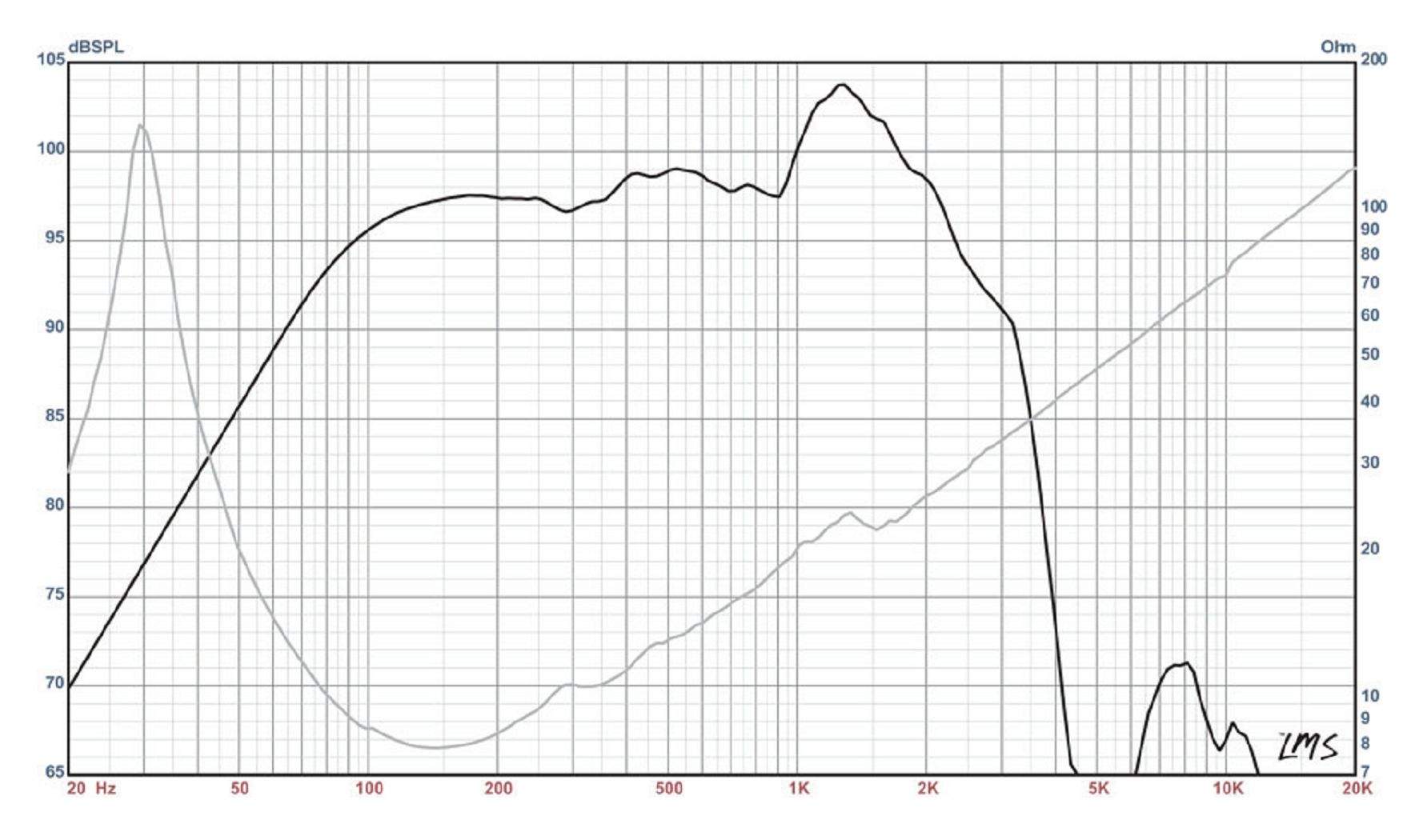
The above graph shows a raw driver mounted in a flat wall for test purposes. In real life the enclosure or cabinet will reduce the actual low frequency SPL - or "loudness". Vented or ported bass cabinets behave slightly differently but the general principle is the same. Sealed bass cabinets exhibit a much faster LF rolloff.
As previous writers have explained, the power output is proportional to the load. Power can be expressed as decibels or watts, but they are just saying the same thing in different ways.
But as can be seen from the graph, the load is proportional to the frequency - but not in a linear way.
The nominal 8 ohms in this case is actually 10 ohms, so there is already a 25% variation from the nominal.
Now here is where we have to think a little. Tube amps will respond to the changing load impedance with ease and the power output will be reasonably constant over the frequency range - excepting in the range below 100 Hz, where the output transformer characteristics also add to reducing the power and therefore SPL. So obviously the better the output transformer the better the LF. (Modern guitar amps often have physically small output transformers because they do not need to reproduce deep bass)
But for the above driver example a solid state amp will respond poorly to the LF region, where in this case the impedance rises to about 38 ohms at 40 Hz - bottom E
So some simple maths tells us that the power output will be the result of an increase in load from 10 ohms to 38 ohms - roughly four times the power loss or -6 db at 40 Hz
Unfortunately this example is with an excellent speaker driver. Many makes and models show impedances of around 80-100 Ohms at 40 Hz, and much less efficient LF, which explains why your bass drops off in the bottom end range.
It is common to see drivers with a 40 Hz SPL 10-15 db below the average mid-range - requiring 10 to 30 times the power output at 40 Hz
If the speaker in the above graph was a 2 Ohm unit the maximum impedance at 40 Hz would be only about 10 Ohms - the same as the starting point for the example
So for any given solid state amp, a 2 Ohm speaker enables the amp to deliver substantially more power across the frequency range than an 8 Ohm speaker connected to the same amp
Alternatively we could say the amp could be proportionately smaller.
In this example a 50 watt amp driving a 2 Ohm speaker would deliver the same loudness level as a 200 watt amp driving an 8 Ohm speaker having similar characteristics. Check your amp specs though - many modern amps will not tolerate an average load of less than 4 Ohms
But all is not lost.
The easiest way is to use a graphic EQ, which allows the bassist to compensate for the amp/speaker power rollof.
Just set the 40 Hz slider to +6 db and problem solved !! A reasonably flat response is then delivered.
But read above again.
The power rolloff in the above example was 6 db so a + 6db EQ setting means that the power output at 40 Hz will be +6db greater than at say 200 Hz
So the amp will pump out four times the power at the lowest played frequency with a risk of blowing the speakers.
This is why the amp AND speakers must have a power rating at least equal to the required power level at the lowest frequency to be reproduced
It is easy to blow a woofer bass driver when playing "loud" in the lower frequency range
But all is not lost.
Multiple drivers both improve the electical/acoustic transfer efficiency. This is why 8 x 10" cabinets work so well.
Multiple drivers - either in the same cabinet or side by side or one over the other, all add efficiency by several db.
So instead of doubling the size of the amp just use two cabs side by side for similar effect. Alternatively for more loudness use a higher powered amp to drive more cabinets
In the case of the amp a tube amp must be correctly loaded so if you have 2 x 8 ohm cabs in parallel it is advisable to use the 4 Ohm socket
But a solid state amp will deliver better bass with the lowest permissible load.
My amp stable is exclusively Peavey because they will comfortably handle a 2 ohm load. This means a Peavey mono amp will be OK with a 2 Ohm cabinet and a Peavey stereo power amp is OK for a 2 Ohm cabinet to each channel - but check the amp specs first.
But justwhen we thought we had it licked there remains the problem of power loss in the cables. Short cables are best but the longer the cable the greater the power loss in the cable itself. So always use the heaviest gage cable that will fit into your plugs and sockets. The lower the cable loss the more power reaches the speaker.
On a technical note, in recent years capacitors have become available in very high values compared with the 50's and 60's. Because the filter caps are in series with the speaker load in both tube and solid state amps, the value of the capacitor affects the very LF response. Generally speaking the better the amp the bigger the caps. This not only delivers better bass but more sustained bass.
Again, care is needed, because sustained bass means continuous power into the speakers compared with short bursts.
And then we have to learn to play as well !!
On mixing cabinets in my experience it does not matter much what you do. Each cabinet will only draw as much power from the amplifier as it's impedance will permit. (Ohms Law). So an 8 Ohm cab in parallel with a 4 Ohm cab means the 4 Ohm unit will draw twice the power as the 8 Ohm cab. But if the 8 Ohm cabinet has an SPL 3 db higher than the 4 Ohm unit then they will deliver sound at the same SPL ("Loudness")
The reverse is also true. Either one will be louder than the other or they will both sound about the same loudness.
Same applies to a 4 x 10 system mounted over a 1 x 15 driver.
So the best way is to get to know your system and it will give you many years of faithful service.
First the choice must be made between tube or solid state amp. That has great effect upon what comes next.
Tube amps can tolerate varying loads about their nominal load value and deliver more or less the same power output to a varying load in the typical bass range, particularlywhen playing in the mid to upper neck positions.
When overloaded the sound will generally collapse into a garbled mess - eg "fuzz"
On the other hand solid state amps simply try to pump out as much power as they can, so the lower the load the more power out
Because of internal feedback systems they will generally not deliver audible distortion when overloaded, until they overheat and either switch-off or self-destruct
The important element in the system is the changing load impedance of the speaker - which varies with frequency - and its effect on amplifier performance
The graph below shows the frequency response and impedance of a typical high quality dynamic bass speaker. Speaker size makes little difference, so an 8 or 10 inch will behave in the same way as a 21 inch driver.
The above graph shows a raw driver mounted in a flat wall for test purposes. In real life the enclosure or cabinet will reduce the actual low frequency SPL - or "loudness". Vented or ported bass cabinets behave slightly differently but the general principle is the same. Sealed bass cabinets exhibit a much faster LF rolloff.
As previous writers have explained, the power output is proportional to the load. Power can be expressed as decibels or watts, but they are just saying the same thing in different ways.
But as can be seen from the graph, the load is proportional to the frequency - but not in a linear way.
The nominal 8 ohms in this case is actually 10 ohms, so there is already a 25% variation from the nominal.
Now here is where we have to think a little. Tube amps will respond to the changing load impedance with ease and the power output will be reasonably constant over the frequency range - excepting in the range below 100 Hz, where the output transformer characteristics also add to reducing the power and therefore SPL. So obviously the better the output transformer the better the LF. (Modern guitar amps often have physically small output transformers because they do not need to reproduce deep bass)
But for the above driver example a solid state amp will respond poorly to the LF region, where in this case the impedance rises to about 38 ohms at 40 Hz - bottom E
So some simple maths tells us that the power output will be the result of an increase in load from 10 ohms to 38 ohms - roughly four times the power loss or -6 db at 40 Hz
Unfortunately this example is with an excellent speaker driver. Many makes and models show impedances of around 80-100 Ohms at 40 Hz, and much less efficient LF, which explains why your bass drops off in the bottom end range.
It is common to see drivers with a 40 Hz SPL 10-15 db below the average mid-range - requiring 10 to 30 times the power output at 40 Hz
If the speaker in the above graph was a 2 Ohm unit the maximum impedance at 40 Hz would be only about 10 Ohms - the same as the starting point for the example
So for any given solid state amp, a 2 Ohm speaker enables the amp to deliver substantially more power across the frequency range than an 8 Ohm speaker connected to the same amp
Alternatively we could say the amp could be proportionately smaller.
In this example a 50 watt amp driving a 2 Ohm speaker would deliver the same loudness level as a 200 watt amp driving an 8 Ohm speaker having similar characteristics. Check your amp specs though - many modern amps will not tolerate an average load of less than 4 Ohms
But all is not lost.
The easiest way is to use a graphic EQ, which allows the bassist to compensate for the amp/speaker power rollof.
Just set the 40 Hz slider to +6 db and problem solved !! A reasonably flat response is then delivered.
But read above again.
The power rolloff in the above example was 6 db so a + 6db EQ setting means that the power output at 40 Hz will be +6db greater than at say 200 Hz
So the amp will pump out four times the power at the lowest played frequency with a risk of blowing the speakers.
This is why the amp AND speakers must have a power rating at least equal to the required power level at the lowest frequency to be reproduced
It is easy to blow a woofer bass driver when playing "loud" in the lower frequency range
But all is not lost.
Multiple drivers both improve the electical/acoustic transfer efficiency. This is why 8 x 10" cabinets work so well.
Multiple drivers - either in the same cabinet or side by side or one over the other, all add efficiency by several db.
So instead of doubling the size of the amp just use two cabs side by side for similar effect. Alternatively for more loudness use a higher powered amp to drive more cabinets
In the case of the amp a tube amp must be correctly loaded so if you have 2 x 8 ohm cabs in parallel it is advisable to use the 4 Ohm socket
But a solid state amp will deliver better bass with the lowest permissible load.
My amp stable is exclusively Peavey because they will comfortably handle a 2 ohm load. This means a Peavey mono amp will be OK with a 2 Ohm cabinet and a Peavey stereo power amp is OK for a 2 Ohm cabinet to each channel - but check the amp specs first.
But justwhen we thought we had it licked there remains the problem of power loss in the cables. Short cables are best but the longer the cable the greater the power loss in the cable itself. So always use the heaviest gage cable that will fit into your plugs and sockets. The lower the cable loss the more power reaches the speaker.
On a technical note, in recent years capacitors have become available in very high values compared with the 50's and 60's. Because the filter caps are in series with the speaker load in both tube and solid state amps, the value of the capacitor affects the very LF response. Generally speaking the better the amp the bigger the caps. This not only delivers better bass but more sustained bass.
Again, care is needed, because sustained bass means continuous power into the speakers compared with short bursts.
And then we have to learn to play as well !!
On mixing cabinets in my experience it does not matter much what you do. Each cabinet will only draw as much power from the amplifier as it's impedance will permit. (Ohms Law). So an 8 Ohm cab in parallel with a 4 Ohm cab means the 4 Ohm unit will draw twice the power as the 8 Ohm cab. But if the 8 Ohm cabinet has an SPL 3 db higher than the 4 Ohm unit then they will deliver sound at the same SPL ("Loudness")
The reverse is also true. Either one will be louder than the other or they will both sound about the same loudness.
Same applies to a 4 x 10 system mounted over a 1 x 15 driver.
So the best way is to get to know your system and it will give you many years of faithful service.

- Feb 12, 2006
- 61,047
- 5
- 221,002
- Disclosures
- Development Engineer-Mesa Boogie, Development Engineer-Genzler (pedals), Product Support-Genz Benz
Note that tube amps and solid state amps will behave very similarly power-wise in the example above with varying impedance (at 40Hz) though it's entirely possible that the solid state amp might have an advantage due to output transformer losses and lower global feedback.
Without changing taps, a tube power amp's power output also varies with load.
Without changing taps, a tube power amp's power output also varies with load.

First the choice must be made between tube or solid state amp.
False Dichotomy
Hi using a friends powered mixer with my speakers the other day whenever there was a loud passage an overload light flashed and sound would momentarily cut, wattage is compatible but on further inspection we found next to the speaker outs on the mixer there was an 4 ohm stamp i know the speaker cabs are 8 ohm would this be the problem
- Feb 12, 2006
- 61,047
- 5
- 221,002
- Disclosures
- Development Engineer-Mesa Boogie, Development Engineer-Genzler (pedals), Product Support-Genz Benz
8 ohm speaker on a solid state amp rated for 4 ohms minimum load is not a problem.
Something else is responsible for your issue.
Something else is responsible for your issue.


