• TalkBass has been independent since 1998. Add your voice.
    Create a free account to reply to discussions, view embedded media, and browse with fewer display ads.
    Join freeLog in
    Want zero display ads or expanded classifieds tools? Compare plans.

Ohms FAQ

Thanks for this amazing thread. Apologies if this has already been asked and answered, but I read through all 48 pages and didn't see a comparable scenario.

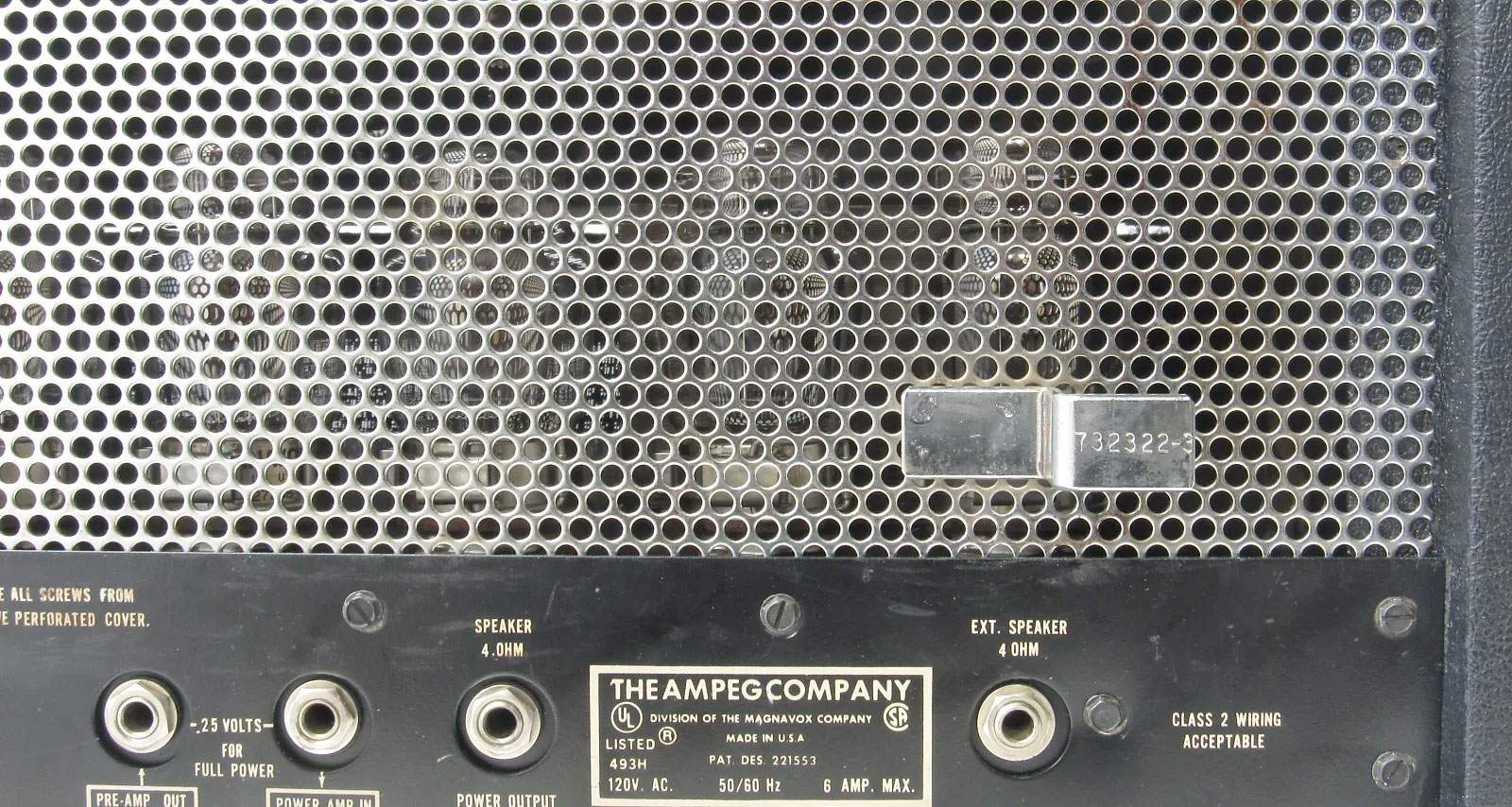
I have an Ampeg V-9 300W tube head. It has a 4 ohm main speaker out, and another "extension" 4 ohm speaker out.

A plain reading of the panel suggests that I could run two 4 ohm cabs, one in each speaker jack. Is that right, or should I run two 8 ohm cabs instead? There is no ohm switch on this amp.

Thanks!

v9_back_detail.jpg
 
Beat this Dead Horse. I have an Ashdown CTM 300, that has a 2, 4, and 8 Ohm Speaker port.
I am rebuilding a 4x10 like this. Does it appear correct? And if I add a second cab like it as an extension, I am at 2 ohms correct? Just needing verification and I dont want to blow up a $3000 Bass Head.
4ohms.png
 
Beat this Dead Horse. I have an Ashdown CTM 300, that has a 2, 4, and 8 Ohm Speaker port.
I am rebuilding a 4x10 like this. Does it appear correct? And if I add a second cab like it as an extension, I am at 2 ohms correct? Just needing verification and I dont want to blow up a $3000 Bass Head.
View attachment 3927271

You wired that up for 8-ohms

If you have two such cabinets, hooked in parallel you'll have 4 ohms total.
 
  • Like
Reactions: Downunderwonder
I'm not quite sure about the wisdom of having the link between the two pairs of series drivers. At a casual glance I think it means that if one driver goes open circuit it's opposite number gets a lot more power which might kill it too, whereas without that link you lose two drivers instead of one, but the impedance doubles, so there'll be less extra power on the remaining. Its probably a rare circumstance though, maybe someone with practical experience of on the road failures could comment?
 
I'm not quite sure about the wisdom of having the link between the two pairs of series drivers. At a casual glance I think it means that if one driver goes open circuit it's opposite number gets a lot more power which might kill it too, whereas without that link you lose two drivers instead of one, but the impedance doubles, so there'll be less extra power on the remaining. Its probably a rare circumstance though, maybe someone with practical experience of on the road failures could comment?
A casual glance reveals the voltage shown each driver in the remainder stays the same or less with one blown open. Iirc I almost flunked the electronics part of highschool physics so we will see later.
 
and i quote..........."Also, if you hook up a 4 ohm cabinet and an 8 ohm cabinet to an amp that can power a 2 ohm load, the 4 ohm cabinet will get twice the wattage as the 8 ohm one. "

looks like someone didn't read all the way to the end of the post :p

There is more in this situation than appears

If the 8 ohm driver and cabinet system is 3 db more efficient than the 4 Ohm driver and cabinet system, then they should deliver about the same loudness (SPL)

But the limiting factor is the maximum power capability and/or loudness of the lesser speaker

For maximum effect the 4 Ohm driver would have a power rating of twice the 8 Ohm driver.

If the cabinets are placed side by side or one over the other then the system SPL is higher than for each cabinet on its own. so there is some compensation for the loss in potential power when using other than identical drivers.

Easiest method is to plug them in and drive them to maximum practical loudness

That will be your maximum performance from the system you have

"Also, if you hook up a 4 ohm cabinet and an 8 ohm cabinet to an amp that can power a 2 ohm load, the 4 ohm cabinet will get twice the wattage as the 8 ohm one. " :p

This condition applies to any amp safe working load rating

The actual reactive load presented to the amplifier with unequal drivers is not just the simple mathematical equivalent value because each driver is in parallel with the other and therefore presents a reactive load to the other as well as to the amplifier. The driver characteristics over the useable frequency range will vary depending upon driver design, driver behaviour, cabinet loading and cone excursion (how hard the cones are driven).

A further variable is the negative feedback voltage supplied back into the amplifier, which varies according to the load. That will also affect the damping factor.

The actual load presented to the amplifier is therefore complex and dynamic. Whatever happens it will always be an average of the two driver characteristics.

The practical solution is to plug them in and drive them within their maximum practical loudness capability.

It is also possible to instal a matching transformer to one or both cabinets but you are still left with unequal circuits in each half of the load.

Try not to think about it too much - spoils the music.
 
Hi guys!

Is this setup possible without explode anything?

3fb0ca91-e286-40e1-8ba8-689cfbeac25c.jpg
WhatsApp Image 2020-12-08 at 14.52.55.jpeg
WhatsApp Image 2020-12-08 at 14.52.53.jpeg

Basicly, it's an Epifani PS600 head (1x 4ohm max load output) loaded into an Epi UL112 cabinet (8 ohms) daisy chained into an UL310 (5.3 ohms). I am buying this set, and the previous owner swear by god that he always used the set this way, but IME this will result in a load below 4ohms, or I am wrong?

Thanks!
 

Attachments

  • WhatsApp Image 2020-12-08 at 14.52.56.jpeg
    WhatsApp Image 2020-12-08 at 14.52.56.jpeg
    64.8 KB · Views: 48
Hi guys!

Is this setup possible without explode anything?

View attachment 4082230
View attachment 4082232
View attachment 4082233

Basicly, it's an Epifani PS600 head (1x 4ohm max load output) loaded into an Epi UL112 cabinet (8 ohms) daisy chained into an UL310 (5.3 ohms). I am buying this set, and the previous owner swear by god that he always used the set this way, but IME this will result in a load below 4ohms, or I am wrong?

Thanks!
It's not the worst load that ever survived but you're dead right that it's less than 4ohm. More like 3ohm. Sum reciprocals of parallel connected cabs and take reciprocal of the sum to get result. You would not expect the amp to live a long happy life. I would pass on the deal.
 
  • Like
Reactions: jairasj
That looks like 3 x 16 ohm drivers in parallel plus an 8 ohm driver in parallel.

Since 2 x 8 ohm loads in parallel would result in a 4 ohm load, an 8 ohm load paralleled with a less than 8 ohm load will result in a less than 4 ohm load.

If the 112 cabinet was 16 ohms, then the result of the 4 parallel connected drivers would be 4 ohms.
 
  • Like
Reactions: jairasj
I am basically buying the two cabinets and the amp is coming for "free", by the asked price.
I am considering to keep the 3x10 and selling the 1x12 and the head later, but this crazy chain was driving me nuts. Unfortunately, the seller is hundreds miles from me, and I cannot check the real situation in the equipment...
 
Audio impedance meters are a good investment . After many years of applied experience I can still ere .
Hence my investment and reliance on test gear .
I NEVER power up a new rig or system without running a static impedance test with a good quality meter.
This rule applies even after moving gear . You never know what happens in transit .
My gear is expensive , I buy good stuff .
Respectfully ,
JT