Okay, here's the short of it.
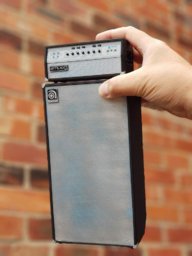
Your head (the Ampeg SVT-VR) can operate at either 4 ohms or 2 ohms. There's a switch on the back. Your cab (the SVT-610HLF) is a 4 ohm cab. Use a speaker cable (NOT an instrument cable! They are different and not interchangeable!), preferably one with speakon connectors (the connectors that don't look like instrument cable connectors) to connect the speaker output of the head to the input of the cab. These are labelled, as I recall.
Make sure that the little switch on the back is set to "4 ohms," since your cab is a 4 ohm cab.
After checking to make sure everything is connected properly and the switch is set at 4 ohms, turn the power on. Wait a minute (you can use this time to tune or something) and switch it from standby to on (the second switch on the front of the head near the little light).
Absolutely NEVER turn the amp on without it being connected to a speaker.
Also, the little dial on the back of your cab is to control how loud the tweeter (high frequency speaker) is. Turn it to whatever position sounds good to you. However, I'd be cautious if you're playing at volumes high enough that you're getting overdrive from the SVT. Tweeters and overdrive sometimes aren't the best of friends.
And now for the long version.
There's good advice in this thread, but I'm going to restate it anyway.
"Ohm" is a measurement of impedance. Tube amps such as the SVT-VR have output transformers (if you look through the grill on the back, there should be a couple big square/rectangular metal things... these are the transformers, one of which is the output transformer). These basically exist, IIRC, to convert the high impedance signal from the power tubes (again, looking through the grill on the back of the head, these are those large glass things) to the low impedance of the cab(s) you're using. This is probably an oversimplification, but it'll work for now. The output transformer has a couple "taps," which are basically points at which the signal can be sent out to the speaker cabs. The SVT-VR has a 4 ohm tap and a 2 ohm tap. The switch on the back of the head determines which of the taps is in use.
If you were, say, to get another 610HLF (having two), you would switch to the 2 ohm setting. When wired in parallel (which the vast majority of amplifier outputs are), the impedance the two cabs present to the amplifier is divided. The 610HLF is a 4 ohm cab, so two of them would make a total of a 2 ohm impedance.
The reason you must never turn your amp on without a speaker cab connected is that a tube amp reads no load as an infinite load. This can cause some pretty major trouble for the amplifier. Some amps are designed to short out if this happens to avoid more significant damage, but others aren't. To avoid having to take your amp to a tech to repair it (which can get very expensive, depending on how bad the damage is), always have your amp connected to a speaker cab when you turn it on. If you turn the amp on and there's no sound, immediately turn it off and make sure that it's connected to a cab properly and that it's set correctly. Do NOT turn it up if you don't get any sound when you play.
Also, as Bill said, read the manual. A lot of this information is in there. Additionally, there are some very helpful links with lots of useful information at the top of this forum.