• TalkBass has been independent since 1998. Add your voice.
    Create a free account to reply to discussions, view embedded media, and browse with fewer display ads.
    Join freeLog in
    Want zero display ads or expanded classifieds tools? Compare plans.

Ok, so what bass evolution do you actually want?

Apparently people don't like the evolution or lack thereof with fender and keisel, but....

What do you actually want?

At some point, the bass has to still be a playable bass.

There is that bass with the half fretted, half fretless that's an interesting evolution, but nobody bought it...

Headless basses are a thing to some, but heavily divisive....

P/j, p/mm, j/mm are all combos of other basses...

People hated gibson's robot tuning guitar...

So, what do you people actually want?

For the record, I'm mostly a traditionalist. That is, most of my basses are FSOs... Fender-Shaped Objects. I do own a single-cut, so I'm not totally old school. No fanned frets, though... they make me dizzy above the 14th fret.


Anyway: I wasn't on board with the Steinberger simply because the twig body was uncomfortable for me. However I got a headless Zon Sonus a couple years ago and love it. Easier to manage on the tiny, cramped stages I usually play. Also, no headstock tuning keys means that the bass is completely in tune almost every time I take it out of the gig bag (the tuning rollers on the bridge have stayed put). The composite neck also helps the bass to stay in tune, but the lack of bumpable keys is the bigger factor WRT case storage.


So, I would love a headless bass with reasonably standard body... and an automatic tuning system assuming one is ever built that's compact and reliable. Change strings, push button, ready to go. Out of the case, push button, ready to go. I don't know how the Gibson system worked, but the one I envision allows alternate tunings -- although now that I've switched to five string, I don't need drop D or anything, I just need to choose between standard tuning or half-step-down, depending on which band I'm playing with. :)
 
I don't want any evolution for the bass. I want "de-evolution". Umm, wasn't that the name of a band?

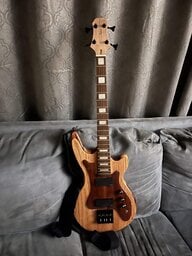
upload_2020-12-16_14-8-57.jpeg
hqdefault.jpg
 
Second idea: we should all know that pickup location is one of the biggest factors in determining the overall tone of a bass. Regardless of any other factors, a mudbucker will sound wildly different than a J-bass bridge pickup. So, I'd like to see some sort of large pickup array that goes between bridge and neck, and you can programmatically choose P-style, J-style, MM-style, Ric-style, any other style of pickup location(s).

Let's assume it's a new system that isn't magnetic (optical?), so you don't get ridiculous pull on the strings.

Just for fun, there could be virtual selections for parallel, series, single-coil, bucking, etc. But heck, just changing locations alone would provide tons of versatility. The Gibson Grabber was just a baby step compared to this. :D

And as long as we're in fantasyland, let's say that the new system could be hidden in the body, overlaid with wood. I suppose that would rule out optical, but we have some other magic at work: Higgs bosons, or whatever.
 
Most of the instruments used in classical music are basically the same as they were hundreds of years ago. Tried and true. There will still be a Precision and a Jazz bass 300 years from now. You can argue about it in 300 years, when I'm proven right or wrong.

 
  • Like
Reactions: Ricky Rioli
Most of the instruments used in classical music are basically the same as they were hundreds of years ago. Tried and true. There will still be a Precision and a Jazz bass 300 years from now. You can argue about it in 300 years, when I'm proven right or wrong.

True, but before Antonio Stradivari developed the now famous F holes in his instruments there were at least as many styles of instruments then, as there are now. The Stradivarius violins produced a notably better tone than their contemporaries. However, there have been numerous blind tests conducted on large scales in the past 30 years that rate some modern instruments equal to or better than Stradivarius. So no design is so superior that it cannot be improved upon.
I personally have a design for a violin which I hope to some day build. It is unique in its approach to tone holes, which I hope will produce a slightly more mellow tone than the standard F holes. We will never know unless and until I actually build one.
 
The one thing that I kind of wish would have worked better/been developed more aw the Line 6 Variax. I think they had a good start, but then just dumped it because I'm sure there just isn't a big enough market of bass players to make it worth while. Hence all their guitar stuff.

But really, a modeling bass (especially with how far that area has come) would be awesome - especially for us "cover band" types. I even liked/agreed with most of the models they had originally. I think having the tech available to be installed in whatever body you chose would help. I get that they probably needed to do a "generic" shape to avoid issues and try to have a mass appeal, but it didn't really work. I wish I could find the video of where a guy took the guts and put it in a Ken Smith or some "nice" bass. That would help a lot I think.

If the "guts" din't have to be in the bass maybe? If the piezo pickups were under the bridge, and the knobs were obviously on the bass, the rest could be in a pedal or rack unit?. You'd probably have to be wired but that's a sacrifice I'd make. I'm wired anyway.

Or not.

Cheers,

I'm going to chime in specifically on your Variaxe reply.

In 2003 I was one of three people Line 6 interviewed to develop the Bass Variaxe and to do a custom shop at their operation in SoCal. When I submitted my designs and photographs I was working at Warmoth Guitar Products and had worked for four years with Mark Erlewine (Dan's cousin) in Austin, Texas.

The Bass Variaxe that hit the US market was a design from Japan. During a lunch with a couple of the Line 6 folks they asked; "why do you want to do the project?" I said, "I want to work with your proprietary technology." The representative told me, "you are one of three from the submissions nationally, but you are the only one who has not run your own building business. Why have you never done it on your own?" I replied taking a bite of my sandwich..."Bass building is a good way to go broke!"

This could be the very reason that the Japanese design is what went to market and they never opened the envisioned custom shop. Warmoth did offer custom routing to support a Variaxe electronics package for a number of years. I have never owned a Variaxe Bass, but think the technology is very cool.

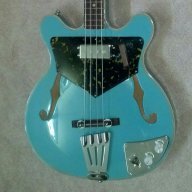
Just for kicks...here is the first Bass I ever designed while working with Mark Erlewine and was included with my submission to Line 6 in 2002/3.
1216201617.jpg

It has the first extra set of Alembic 20th Anniversary electronics those cool folks were so kind to provide while they were doing the 20 Bass Limited Edition.

I would have done something cool with the Bass Variaxe, but I think Line 6 was wise to focus on what they dominate!
 
Last edited:
I want them to build something unique so that I know they are still innovating. I don't want to buy from a company that rests on its laurels. Having said that, I'm still going to buy the thing they've been making for 60 years.

Am I seeing computer thinking, smart phone thinking here? We have to have new features and abilities every year? There will come a time when that technology will mature and the design will stabilize. Then the innovation will slow down.
As someone pointed out, there is very little innovation in most musical instruments because they have reached the point where the design is mature. Another example, the fork, there has been no innovation in fork design for a very long time because 4 tines and a handle work, the design is sound.
The Fender company exists for one purpose, to make money. Spending money on innovation has not improved the profit picture because the musicians who spend most of the money like the mature technology of the J and P bass. There are those who like being on the bleeding edge, but they are not in sufficient numbers to make the new designs profitable. In the meantime, other bass manufacturers are offering different designs and there is no rule that says a person must buy Fender. It is interesting to note that these other companies don't sell as many basses as Fender.
 
  • Like
Reactions: PhatBottomBass1
The Squire Mini Precision and the new Jackson Mini basses are real innovations , they cost less than 200 bucks
and sound pretty close to their big brothers and at least the Mini Precision is selling very well. For any major manufacturer they have to produce guitars and basses that will sell----especially when Fender requires a guitar store to in vest in a quarter of a million dollars per year in new Fender products
 
  • Like
Reactions: Luigir
Hear Hear! I really like my Fender CS 60 but the lack is frustrating for me since one of the two groups I pay in bans any form of electronic amplification

Have you put your hands on one of these, not too crazy expensive Guild 140E Acoustic/Electric Bass Guitars?
westerly_b_140_1.jpg

I was impressed with the overall sound and PROJECTION unplugged. $849 w/soft case.

I have owned a Guild B-30 and while the large body and short-scale lend to a deeper timber/Tone, the projection of a phosphor-bronze full scale string on the 140E is better to mix with a couple of simular acoustic style guitars.

Electric Bass is Electric Bass!