Hello, I'm curious as to what kind of wood was most common for Fender Precisions back in the late 70's. Reason being that I have a '76 Fender P and the thing is a damn TANK! I weighed it and it's a whopping 12.7 pounds, it destroys my shoulders when we play long and enduring sets(Also doesn't help I'm 6'1 at a 135). So what kind of wood were these old boat anchors made out of? I've played newer Fenders and they don't come close to being as heavy for some reason...Thanks-Andrew

Enjoy the benefits of a premium membership!
Upgrade Account
-
TalkBass has been independent since 1998. Add your voice.
Create a free account to reply to discussions, view embedded media, and browse with fewer display ads.
Join free Log in
Want zero display ads or expanded classifieds tools? Compare plans.
You are using an out of date browser. It may not display this or other websites correctly.
You should upgrade or use an alternative browser.
You should upgrade or use an alternative browser.
Old P-bass wood type?
- Thread starter Altarsmadness91
- Start date
More options
Who Replied?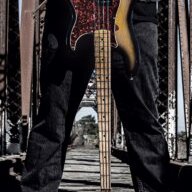
Ash? Well, I'm glad to know because my guitarists were telling me it was Maple and I didn't think Maple would be so heavy haha Also, nice punThat wood be Ash.


- Feb 16, 2008
- 21,240
- 23,636
- Disclosures
- John K Custom Basses
your late 70's P is hard ash which is very heavy, as opposed to swamp ash is generally very light.
Not all are ash. I have not doubt that there are a few alder walking around. They also made some out of walnut. Wow. And I remember seeing a mohahgony strat so they might have made a p bass also. And there was a Rose wood strat that was going to Jimi that walked out the back door. If you have that you owe to the rest of the world to let us play it.
I remember a CAR heavey as a anything but what a sound. I think the heavey ones are the best for tone.
I remember a CAR heavey as a anything but what a sound. I think the heavey ones are the best for tone.
Hello, I'm curious as to what kind of wood was most common for Fender Precisions back in the late 70's. Reason being that I have a '76 Fender P and the thing is a damn TANK! I weighed it and it's a whopping 12.7 pounds, it destroys my shoulders when we play long and enduring sets(Also doesn't help I'm 6'1 at a 135). So what kind of wood were these old boat anchors made out of? I've played newer Fenders and they don't come close to being as heavy for some reason...Thanks-Andrew

Well the vast majority of 70's Fenders were ash and alder, solid colors getting alder. My 76 is ash and it's sort of heavy, but I can handle it. That's a seriously heavy bass you have, holy cow! I'd be looking to sell it to someone way braver than you or I!
You see, back in the 70's, musicians got it into their heads that mass = sustain and fat tone, and that resulted in "innovations" (ymmv) like high mass bridges, brass hardware, and as you've discovered, 900lb hard ash bodies. CBS/Fender, in a quest to fix things that weren't broken, hopped on this bandwagon - on top of cutting costs at the expense of build quality (after all, sustain and tone have everything to do with mass, not quality parts and construction, right?) This is not to say Fender didn't produce some good instruments in this time period, but those were the exception, not the rule.
This led to Fender circling the drain until the employee buyout in the 80's, and not truly recovering until the late 80's/early 90's, when popular indie and grunge/alternative bands were seen playing vintage Fenders because that was what they could afford (and if I'd only been born 10 years earlier, I too could have taken advantage of pawn shops being littered with dirt-cheap vintage 60's Fender basses...).
This led to Fender circling the drain until the employee buyout in the 80's, and not truly recovering until the late 80's/early 90's, when popular indie and grunge/alternative bands were seen playing vintage Fenders because that was what they could afford (and if I'd only been born 10 years earlier, I too could have taken advantage of pawn shops being littered with dirt-cheap vintage 60's Fender basses...).

It's more like Fender used whatever wood they had available and the cheapest on the market was hard ash.
CBS hired Bill Schultz around 1980 to turn Fender around. He hired people who had music biz savvy and who had a handle on what players wanted. Dan Smith, Paul Rivera, Roger Balmer, etc. They started the Vintage Series, the new guitar amps, the Elite and Standard Series, set up s deal to have Fuji Gen Gaki (who also manufactured guitars for Ibanez) to make Fender-branded guitars for the Oriental market as well as the original Squier brands for the US market. They did indeed make headway on the goal of turning the company around. However, CBS still wanted out of the music business doe they put FRR (Fender, Rogers ,Rhodes) on the market along with Gemeinhardt, Gulbransen, etc.This led to Fender circling the drain until the employee buyout in the 80's,...
Schultz put together a consortium of investors from around the industry including, in the words of the press release,"a prominent musician" to buy Fender. The deal was effected in 1985.
So, while Bill Schulz was a CBS employee, and some others in the consortium may have been as well, it wasn't really an employee buyout. Based on the new company NOT getting any real estate, so they had no factories, it's safe to assume a good number of employees lost jobs- although that likely would have happened no matter who bought them from CBS.
John

I remember a CAR heavey as a anything but what a sound. I think the heavey ones are the best for tone.
Hmmm... was always under the impression that heavy dense basses were good for sustain and lighter less dense ones were good for complexity of tone?


(Also doesn't help I'm 6'1 at a 135).
Is this right? How are you even alive? Let's get you to the nearest Hometown Buffet STAT!
Haha I'm 21, I don't think my metabolism has caught up with me yet.Is this right? How are you even alive? Let's get you to the nearest Hometown Buffet STAT!
Well the vast majority of 70's Fenders were ash and alder, solid colors getting alder. My 76 is ash and it's sort of heavy, but I can handle it. That's a seriously heavy bass you have, holy cow! I'd be looking to sell it to someone way braver than you or I!
If it wasn't for the amazing sustain it has and the sentimental purposes(dad bought it 1983, used it during his era of metal bands in the 80's and then gave it to me on my 8th birthday in '99), then yea, I would probably get rid of the shoulder killer lol
12.7 pounds, that's HE-A-VY! I have a '75 ash-body P that's 11.5 pounds. Get an extra-wide padded strap, that helped me a lot. Good, ergonomic playing posture makes it easier on your back, too.

I had one just like it. I never weighed it, but 12.7 sounds about right. It was natural ash and really pretty. Over the years, I added a jazz p/u, replaced the precision p/u with a Bill Lawrence and mated it with a fretless neck. Wish I still had that one.Hello, I'm curious as to what kind of wood was most common for Fender Precisions back in the late 70's. Reason being that I have a '76 Fender P and the thing is a damn TANK! I weighed it and it's a whopping 12.7 pounds, it destroys my shoulders when we play long and enduring sets(Also doesn't help I'm 6'1 at a 135). So what kind of wood were these old boat anchors made out of? I've played newer Fenders and they don't come close to being as heavy for some reason...Thanks-Andrew
Last edited: