• TalkBass has been independent since 1998. Add your voice.
    Create a free account to reply to discussions, view embedded media, and browse with fewer display ads.
    Join freeLog in
    Want zero display ads or expanded classifieds tools? Compare plans.

On a vintage SVT mission

May 29, 2020
132
187
IMG_5230.jpeg
IMG_5229.jpeg
IMG_5219.jpeg
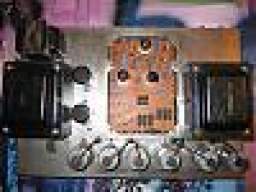
Hey all, out of nowhere I feel the need for a completely impractical, and massively oversized bass amp for my situation. My guitar teacher had a 69 SVT and matching 8x10 cab that I played many years ago and it still haunts me. Never heard anything like it since. I had a 63 B15 that was way cool but stupidly sold it.
I found a guy locally that has a V9-SVT for a good price. Trying to get the serial number to date it but it looks to be early 70s. From what I read it was only made from 72-74. It's point to point wiring.
Is this a desirable SVT?
 
It's 75-79, as those graphics and the V9 models were only made in that range. They were discontinued with the sale to MTI in early 1980.

You have pictures of two different amps here.

Most of the pictures appear to be a mid to late 70s SVT. The last one is a V9 front input. The power amp chassis is the same for both so the back of the amp will be labeled for both.

The V9 isn't really the same as an SVT. It's the V4 distortion preamp with an SVT power amp. It's close. But it's not identical if you're specifically after a vintage SVT.

This is a V9:
https://reverb.com/item/87347366-ampeg-v-9-svt
 
Last edited:
Thanks for the info! Yes, just caught the fact that one pic shows a foot switch jack on the front panel. I think he sent me that after I was asking for more info on what the V9 was. The first batch of pics is the one he has for sale. He said it's point to point wiring. That along with the white rocker switches made me think it was early 70s prior to PCB.
 
  • Like
Reactions: nickelwound
After further research it appears that the amp in question is an SVT black curved line. There are similar ones on reverb that are 4 hole, no reference to V9 on the front, no distortion channel/footswitch but it says V9-SVT on the back. Unless I'm missing something it does appear that this a straight SVT.
Would love to hear some additional perspectives on this model, thanks!

 
Last edited:
After further research it appears that the amp in question is an SVT black curved line. There are similar ones on reverb that are 4 hole, no reference to V9 on the front, no distortion channel/footswitch but it says V9-SVT on the back. Unless I'm missing something it does appear that this a straight SVT.
Would love to hear some additional perspectives on this model, thanks!


If the first set of pictures is the amp they're selling then yes, mid to late 70s SVT.

 
If the first set of pictures is the amp they're selling then yes, mid to late 70s SVT.
Yes, I confirmed that he sent the other set to contrast with what the V9 SVT looked like. I'm guessing it was a cost saving thing to use the V9 back panel interchangeably, IDK.
I'm just happy it's a straight SVT and point to point wiring, think I'm gonna pull the trigger on this!
 
I would avoid point to point wiring myself, hard to work on when components/connections are buried, and the performance can be inconsistent from unit to unit. The larger components aren't generally well supported either,, resulting in broken connections and fractured leads. Just my experience.

Fortunately, I don't recall any Ampeg SVT version being built point to point, they all used PCBs of some form. Here's a picture of a V9:
1746727654665.png
 
I'm guessing it was a cost saving thing to use the V9 back panel interchangeably, IDK.

It's not just the back panel. The same power amp was used for SVTs and V9s.

This amp is not point to point. Even 69 SVTs are not point to point. There is a main preamp circuit card, the front panel has circuit cards for the controls, and the power amp has a circuit card.

The first SVTs ran 6146 output tubes. The preamp had blue lines with squared corners. I believe the tubes were changed to 6550 sometime in 1970. This change involved some significant updates to the amp. A different power transformer was used, the output tube socket wiring changed, and the Power PC card was updated to add Node H of the power supply. Following this update the same basic circuit layout was used all the way till 87, with a some minor changes to component values. Around 72 the preamp graphics were changed to square black lines. At some later date the lines were rounded.

Different people prefer different eras. I own a 69 and an 87. Basically the first and last production runs of the original style SVT. IMHO the 87 has what is considered the iconic SVT sound. The differences in tone are fairly small, but I would say my 69 is a bit bigger and looser sounding. It also has a bit more headroom and is less grindy. I can't say if these differences are typical, as they could be due drift in component values.

I do agree that an SVT and 810 is impractical for most bassists. Some who love the sound are willing to pay the price. I own SVTs and a bunch of other amps, but they are basement queens. For gigging I would choose something smaller and lighter.

The biggest concern is the condition of the amp. It's old and maintenance and repair can get expensive. Also a lot of techs don't seem to know how to work on them. I.E. finding a qualified tech can be difficult. So try to make sure the amp is in good working order.

Tubes are wear items that must be replaced from time to time. When an output tube goes bad in an SVT it may take out a resistor. This should be considered a feature as the resistor fails to protect the circuit card and transformers. The resistor must be identified and replaced for the amp to operate properly.

I own a lot of old tube amps that I bought previously loved. I would say 40-50% needed tubes when I received the amp or within a few months. So when buying a used tube amp, I suggest budgeting for a new set of output tubes and bench fee to set the bias and give the amp a once over. A new set of 6550s is currently running about $360 and bench fee is probably around $125. So add about $500 to the purchase price when considering if the amp is a good deal. Maybe you will need to spend more, or maybe the amp will operate perfectly for years.
 
Super helpful, thanks for taking the time to share your knowledge!

This will be a total basement queen as you called it. Purely for my own enjoyment and recording purposes.

I have a GK Legacy 800 and matching 4x10 cab that sounds great and is much easier to move if needed.

I'm a guitar player who's always enjoyed bass as well. Getting back into recording has helped me to rediscover the joy of bass playing.

The amp above I can get for $1300. Recently serviced, had a couple of caps replaced but everything else is original and tip top.

I have another option which is exactly the same head but it comes with a 71 8x10 cab with original CTS alnicos for $1900. Also serviced and given a clean bill of health. Original tubes and caps tested strong and they recommended to not replace them.

They both seem like a good deal to me, would you agree or should I keep looking?

Thanks!
 
  • Like
Reactions: Patrice B
Lot's of factors to consider. I would pay more for a local amp in good condition, especially if it has something like a 30-day warranty.

Reverb has a price history.

These are for square blackline SVTs (72-75):

View attachment 7221946
View attachment 7221957
View attachment 7221948

These are for curved blackline SVTs.
View attachment 7221951
Thanks for the reference sales! They are both local pickup deals and are in very similar "very good" condition and both have been serviced and are all original. Both are second owner and they were able to share some history on the previous owner and how they were cared for. Based on this and the completed sales, they seem like good deals. Leaning towards the one for $1900 that includes the 71 cab but I overthink everything!
 
We're gonna find out! 😁 it's my hearing that I'm more concerned with!

Is your hearing firmly bolted to the foundation?

I think the CTS SVT speakers of the day were absolutely brilliant and the best sounding of any…until the Heritage SVT speakers. They sound extremely close to the CTS but take tons more power. Not that I ever needed to be that loud, but CTS's will give you about 240w handling before damage starts to happen. Beautiful tone, though.
 
The 1st pics are a 76-79. $1300 is a good price for a good working example. What kind of tubes are in it, brand?

The 71' with a cabinet is a good price also. The 71' should be blue face, what type of tubes are in it?

I do not think either of those should have any original caps in them still. If any original caps are still in these heads, I would recommend getting the caps replaced as a good maintenance on them.
 
  • Like
Reactions: anderbass and Frome
The 1st pics are a 76-79. $1300 is a good price for a good working example. What kind of tubes are in it, brand?

The 71' with a cabinet is a good price also. The 71' should be blue face, what type of tubes are in it?

I do not think either of those should have any original caps in them still. If any original caps are still in these heads, I would recommend getting the caps replaced as a good maintenance on them.

If the original caps test good, there's no reason to replace them under most circumstances. It's not necessarily a maintenance item (in spite of popular internet mythology and lore).