• TalkBass has been independent since 1998. Add your voice.
    Create a free account to reply to discussions, view embedded media, and browse with fewer display ads.
    Join freeLog in
    Want zero display ads or expanded classifieds tools? Compare plans.

One Bass to do it all?

Interesting topic as always Doc.

I think this is all subjective. For example, what electric bass for jazz, gospel, rock, etc should sound sound like is going to vary based on everyone's earballs. So just defining the standard in some universally acceptable way is likely not possible.

Me personally, I don't think there is one bass that does everything because I hear different genres differently. But I definitely believe some basses or electronics configurations do more than others.

As to why people go through careers on one instrument, I think that has to do with comfort and familiarity. A virtuoso like Victor Wooten will be that same virtuoso no matter what he plays, but he feels most at home on a Fodera. It's like an athlete finding the perfect pair of shoes.

Just my $.02

When it comes to an artist using one bass, I think there are a few variables. For years, a Fender and flats was the standard sound, so a Chuck Rainey, Max Bennett, Joe Osborne, Jerry Jemmott, were under no pressure to sound different on a gig. Later studio guys, like Marcus Miller, became hot because of a particular sound, in the Eighties, Marcus Miller was slapping his Jazz for everybody and their momma. Louis Johnson was doing the same thing with his Stingray’s and Sabre’s.

Finally, you get someone like Nathan East, who uses super versatile basses and simply seeks to blend at every session, not sonically dominate.
 
But I am the same as you. I prefer the burpier tone of the Ken Smith pickup placement. I only wish I would have realized the importance of pickup placement a lot sooner during the earlier days of when I began tinkering with different pickups and preamps. I would have saved some serious cash!

Yeah, took me a lot of basses to figure that out. I even put a pair of Smith pickups in one of my Fodera 5'ers but it still wasn't quite there. For me the Smith positioning is what I like, both tonally and thumb anchor placement.
 
  • Like
Reactions: bongostealth
I think the studio musician experience is relevant because it reflects eras and styles of music. Jamie Jamerson or Tommy used P-bass with Flats tone that was dominant in the Sixties. When I really started playing in the late Seventies, the sound had gotten brighter and was not always a Fender. The dominant sound and gear choices changed for players regardless of skill level.
 
  • Like
Reactions: Watchootognbout
I think the studio musician experience is relevant because it reflects eras and styles of music. Jamie Jamerson or Tommy used P-bass with Flats tone that was dominant in the Sixties. When I really started playing in the late Seventies, the sound had gotten brighter and was not always a Fender. The dominant sound and gear choices changed for players regardless of skill level.

My point is, a top studio musicians has needs (and ears) more than sensitive than us mere mortals. I'm not talking about your situation - the Pedulla fretless is very different than a fretted. I'm talking about the guy in a cover band (or weekend warrior originals) who NEEDS a P with flats, P with rounds, jazz, and a MM to get the "proper tone" for his Saturday night gig.
 
... The dominant sound and gear choices changed for players regardless of skill level.

... but still we are bass afficionados; after a period of gas i went to 5 strings on a '93 Warwick Streamer, and later i came to the Steinbergers which changed everything. I always had good basses, specially the Warwick (my main axe for 10 years) but the L2-5 top it all in any matter: 3,6kg full punch, easy to carry, almost none of a tuning and string changed within minutes; i should have bought me one in '83. :smug:
 
  • Like
Reactions: Dr. Cheese
You can't compare weekend warriors to studios. That's like comparing a major league pitcher to someone playing amateur baseball on weekends.

live <=> studio are two diverse animals. One doesn't supersede the other....
live, the process is for the moment
studio, its moments that can be accessed and re-accessed/microscoped

lot of different criteria outside of what overlaps
 
Try taking the other bass that you wish would work better and boost or cut the low-mids. In my 20+ years of playing, to me it's the sound of the low-mids differing from bass to bass tends to be what makes or breaks them in an application.

Play with your amp/preamp low mids and see if you can get one bass to "speak" like the other.
 
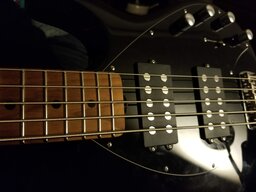
I think the pros who only use one bass can pretty much do so because a) they play in one band/they have a signature sound and b) they are great players who can make any bass sound good. Im no pro but I play in 3 different projects that require different sounds. I use a Spector euro5 for my metal band, and a stingray 4 for everything else. If I had to only use 1... it'd probably be the 5er.
 
  • Like
Reactions: Watchootognbout
There's actually a very telling hint in that video about the stage sound they had. What you're hearing is (I think) mostly the DI sound from his Radial Firefly. It's a tube DI that is reasonably priced, but definitely has a sound to it.

Anyway, at one point while they're playing the audio for video pulls up the audience sound and you hear just how boomy Nathan's sound is around the room. It's not quite as tight as his direct sound.

Also, Nathan uses moisturizer on his hands during that show, and he changes his strings for each show.
Nathan's tone is always relatively subdued. It's never really "in your face" like Marcus. But that's his fingers, not the bass. As I'm sure you've heard, Yamaha basses can grind and growl with the rest of them. Nathan's basses all have his "Magic Box" built in - and that's a parametric mid cut with a couple of other narrow cuts in the audio spectrum.


Good as Nathan East is, the sound he is getting pales compared to Marcus Miller on the original. East sounds good, but it is just not the optimal sound for this composition.
 
I think the pros who only use one bass can pretty much do so because a) they play in one band/they have a signature sound and b) they are great players who can make any bass sound good. Im no pro but I play in 3 different projects that require different sounds. I use a Spector euro5 for my metal band, and a stingray 4 for everything else. If I had to only use 1... it'd probably be the 5er.

Pros like Marcus Miller and Nathan East also have nice endorsement deals that are a nice extra stream of income that can ties them to a particular bass or brand of bass.
 
  • Like
Reactions: Strung_Low