Surely you'd have to wait for the beat to roll around b4 you played the next note. I just say rake because I've heard other people call it that.
I had assumed that would go without saying.

TalkBass has been independent since 1998. Add your voice.
Create a free account to reply to discussions, view embedded media, and browse with fewer display ads.
Join free Log in
Want zero display ads or expanded classifieds tools? Compare plans.
Surely you'd have to wait for the beat to roll around b4 you played the next note. I just say rake because I've heard other people call it that.

Me too but I couldn't think what else you'd mean by reset your finger. I probably could've phrased it better.I had assumed that would go without saying.
Me too but I couldn't think what else you'd mean by reset your finger. I probably could've phrased it better.
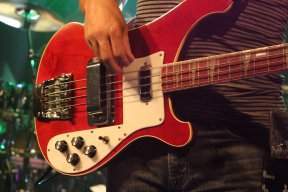
I prefer use just my index finger whenever possible because I think it sounds better. When you play busier parts with just one finger, like Jamerson, you get a different feel that I happen to really like. It’s like the difference between playing 16th notes on a hi-hat with 2 hands (smooth) or 1 (a little grittier, more intensity).Hi everyone,
Just wanted ask about playing fingerstyle, using predominantly the index finger on the plucking hand. I know we are taught to use alternate plucking when we first start out, and why I do find myself doing that. On fast 16th note phrases (I play a lot of hard rock and high bpm), I tend to use one finger a lot. Just wondered who else takes this approach?
I use a pick sometimes but I much prefer using my fingers, it’s way more natural. I’d say I use fingers 90% of the time.
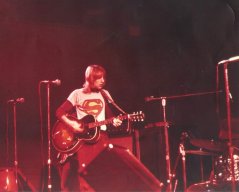
I know of a few bassists in the rock game who use this technique (or a version of it). Geddy Lee, Timmy C, Matt Rubano, JPJ to name a few. I would love to hear some more suggestions and examples though!
Just had surgery on my middle finger, so I will be joining the one finger club for the foreseeable future.
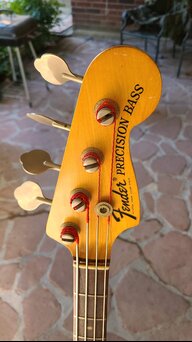
View attachment 5331435

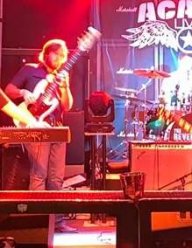
When I started playing, I did not have any electric bass instruction books, but I did have a copy of the Noad classical guitar method kicking around. He makes a distinction between a “free stroke”, where the finger only makes contact with the string being plucked and comes to rest above them, and a “rest stroke” where the finger comes to rest on the adjacent string. Whether or not a rest stroke is considered a partial rake seems kind of academic. It seems to me that most traditional two finger electric playing is largely rest strokes. In a purely theoretical sense, yes- any two rest strokes in same direction could be considered a rake, even if not in quick succession.My distinction is that a rake, at whatever speed to suit tempo, is one continuous movement of one fingertip across two adjecent strings along a single, almost straight, path. By 'reset' I meant a pause combined with a lift and/or a short reverse before moving on.
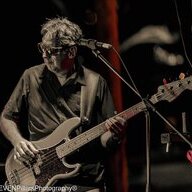
Why limit yourself to only two fingers?What I don’t understand is, why limit yourself to one finger playing? Why not just learn to play with two fingers? It’s not that hard and it makes your life much easier. What’s the point?
Why limit yourself to only two fingers?
Why not three? Billy Sheehan uses three.
It only takes a little practice to get it down.

There's the misunderstanding, right there. I almost never play notes for their written duration unless I'm practising scales. So I tend to pluck with a finger that's already resting on the string. Could be why I don't find a lot of use for raking.My distinction is that a rake, at whatever speed to suit tempo, is one continuous movement of one fingertip across two adjecent strings along a single, almost straight, path. By 'reset' I meant a pause combined with a lift and/or a short reverse before moving on.
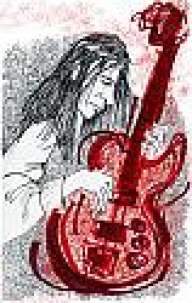
You're right he only needed one finger...James Jamerson is well known for playing only with his index finger he called "The Hook".