• TalkBass has been independent since 1998. Add your voice.
    Create a free account to reply to discussions, view embedded media, and browse with fewer display ads.
    Join freeLog in
    Want zero display ads or expanded classifieds tools? Compare plans.

One head, 2 cabs = One cab MUCH louder than the other, why?

David Sutkin

“Bass Upfront” Founder
Commercial User
Apr 20, 2017
2,636
8,106
58
Brooklyn, NY
Hey all,

I was hoping I could get some help trying to understand why the following is happening.

Last night at a band rehearsal I tried running my Mesa D800+ head into a Mesa 6x10 "traditional" cabinet (900 watt cab) then I ran a speaker cable out of the Mesa parallel jack port into a GK 4x12 cabinet (1000 watt cab) ... The one Mesa head powering both.

While I was absolutely pushing air out of both cabinets, the GK was shockingly louder than the Mesa cab ... If I had to guess, it sounded like a 75/25 volume output ratio with the 75% coming from the GK cab.

I used to have a Hartke LH1000 head that came with a "leveling" dial and I could manually turn that dial to blend the two volumes but the Mesa D800+ head doesn't have that feature.

Can anyone give me some insight (in layman terms please) as to why the GK cab is pumping such a drastically louder volume?

Is there a better way to run this set up? I have a few other heads and I wouldn't mind buying an ABY splitter and running two separate rigs (1 cab with one head and another cab with another head) to level out the volumes .... but do I need to do that to get the volume levels equal?

Any help would be great, thanks
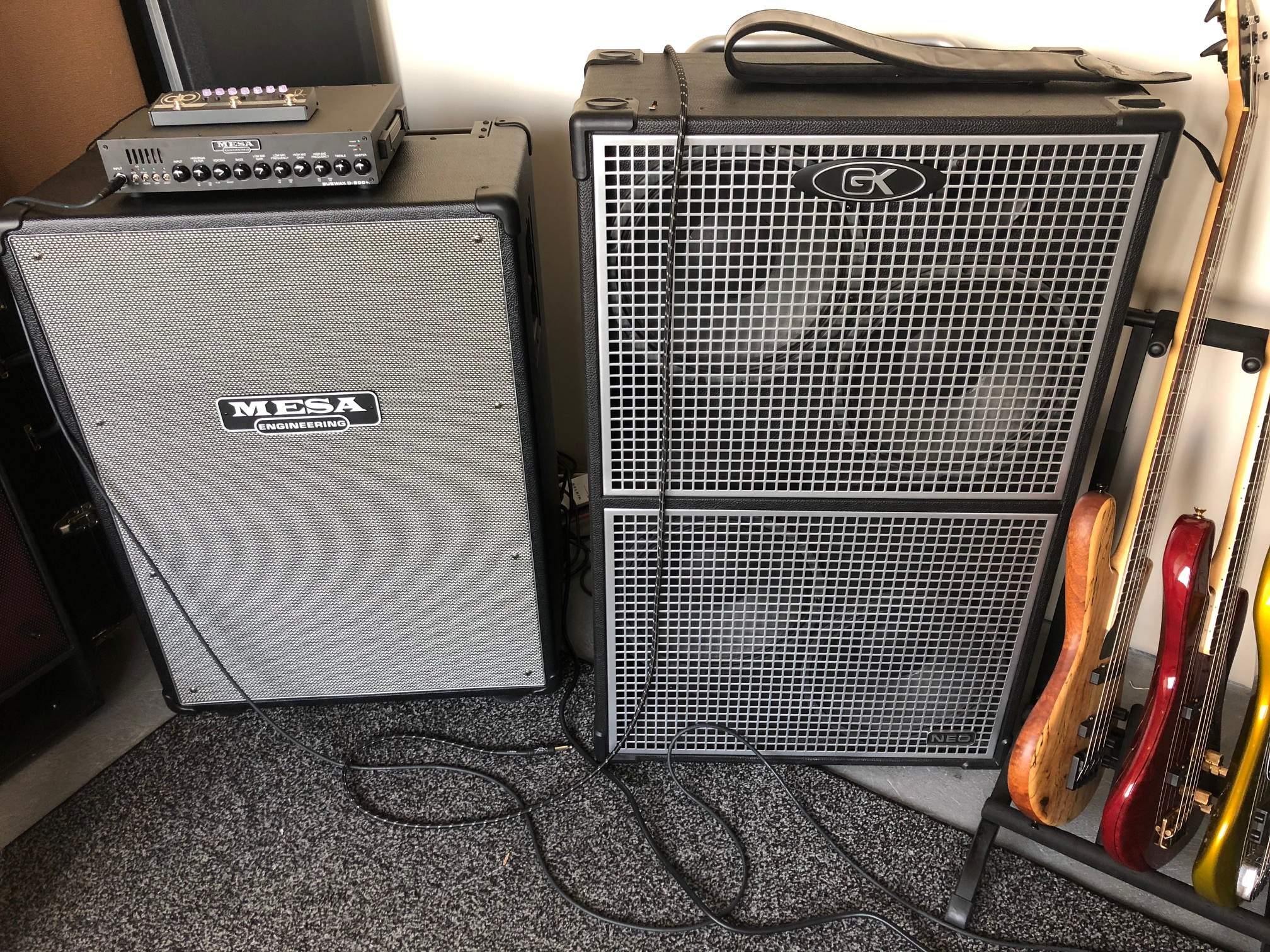
IMG_1384.jpg
 
Last edited:
the answer is 'sensitivity',

show 1 speaker/box 10 watts it gets so loud, show a 'more sensitive' speaker/box the same 10 watts, it will get louder.

*but the 'less loud' speaker/box probably will have better 'low end clarity' then the louder speaker/box.

if you want to use mis-matched (different sensitivity) speakers/cabs together, you can, but you will need to find a way to control the signal strength going to each cab. there are several products/ways available to do this do some guitar pedal searches..

****** BUT******

there is a danger you will get CANCELLATION (loss of bass) because the speakers have 'not' been designed to work together.

you cant always just slap a chevy master cylinder in a ford.
 
Last edited:
the answer is 'sensitivity',

show 1 speaker/box 10 watts it gets so loud, show a 'more sensitive' speaker/box the same 10 watts, it will get louder.

*but the 'less loud' speaker/box probably will have better 'low end clarity' then the louder speaker/box.

I appreciate the reply, thanks ... but I don't quite understand how that helps me level out the volume between the 2 cabinets
 
  • Like
Reactions: trickyric
I appreciate the reply, thanks ... but I don't quite understand how that helps me level out the volume between the 2 cabinets

something like the $30
ART ZDirect 1-channel Passive Instrument Direct Box

or maybe the

Donner Guitar Bass Passive DI Box Instrument to Balanced & Unbalanced Micro Direct Box Pedal


might work for you ?

using 2 'bass' speakers together can get really complicated,

Speaker Placement 201, Part Two: Using Subwoofers -
 
Last edited:
  • Like
Reactions: BK bassist
Not to get all nerdy on you, but this comes down to what "loud" means.
Before you roll your eyes, hang on...
What frequencies in a certain situation a cab produces is what makes it audible. A 200w cab EQed to stand away from frequencies being used by other people in a band is "louder" than a 500w cab EQed to operate in the same range as everything around it. Now, since you are using the same head with the same EQ on both, this isn't your exact problem, but it may have something to do with it. Certain cabs have a "baked in" tone that isn't going to work in every situation.
Then there is how the cab is built. I owned some GK Neo cabs and I will tell you that they aren't built to project as well as some other cabs, nor do they project well off axis (meaning if you stand to the left or right of them, do they sound the same.) They are fine cabs for the money, but after having to spend more time than I'd like digging around in my 112 Neo cabs, I learned that they aren't built particularly well. That is why they are comparably inexpensive.
Then we come to the marketing iffyness that is "wattage" when it comes to amps and cabs. Because it is one of the few easily understood specs us non-engineers can grasp, we use watts as a guideline for loudness, but in truth it is a very relative thing. It is an absolute measurement of electricity, but what it translates to in terms of real world decibels is hard to nail down. 100 watts at 800hz goes a lot further than 100 watts at 30hz. The speaker may say it is rated for 300w, but under what conditions and for how long? Will it do 300w consistently and without distortion, or will it do that exactly once before instantly blowing out? And even if the speaker is doing all it can to produce how many watts it can, if the construction of the enclosure is inefficient, the sound generated by wattage is bleeding all over the place and not in a focused direction, preferably towards the audience.
Some people also warn about cab positioning and how the waves work together or cancel each other out. I'm not geeky enough to know if there is any truth to that.
 
Last edited:
I prefer to use 2 cabinets, I've found that I don't have to drive the head so hard when I do and I don't come anywhere "clipping" when I use 2, plus I get considerably more volume.
You're driving the head harder with two cabs because of the lower impedance load. I can't imagine needing more than a 612. Driving the room is the PA's job, not the stage amps.
 
So you're saying it can't be done with this particular cabinet configuration?
Well, you're never going to get equal volume out of two entirely different design cabinets, and in this case the disparity is very great, but is that a problem? If you have enough volume then isn't that job done? Yes, you could run separate amps, with or without a crossover, but do you really need that much complication? Especially as you'll have to be running a lot less power into the 6*12 to get it to deliver the same volume as the 4*10. A 6*12 is very roughly equivalent to two 4*10 cabs.
 
Last edited:
You're driving the head harder with two cabs because of the lower impedance load. I can't imagine needing more than a 612. Driving the room is the PA's job, not the stage amps.

This is a rehearsal room ... not for gigs and we don't use a PA.

I like using these 2 particular cabinets together because the GK's speakers are naturally very bright and the Mesa traditional cabinets speakers are very dark and the two together make for a tone that I really like.
 
The DI boxes provide line level signals to mixers. They do not appear to provide speaker level signals.

What sensitivity means is that one of the cabs is louder than the other. That's all. And you already know that. Either run two better matched cabs or use two amps.
 
  • Like
Reactions: eJake and yodedude2

Latest posts