• TalkBass has been independent since 1998. Add your voice.
    Create a free account to reply to discussions, view embedded media, and browse with fewer display ads.
    Join freeLog in
    Want zero display ads or expanded classifieds tools? Compare plans.

Organ into bass amp?

So I have an old Hammond organ, nothing fancy but I love how it sounds. Anyways recently I noticed it has an output tucked away on it, all it says is 120 volts 60 hertz 2 amps. I can't find any info on this particular organ online.

So would it be most likely a speaker out I should only use with a cab? I haven't opened it up yet but I assume it has some sort of amp built inside, maybe a tube amp as it's from the 70's.

I have mic'd it before and it sounds amazing, it needs some repairs but it sounds great. Sadly the bass floor pedals often don't work, I need to check the wiring in the back soon...

Anyways should I avoid plugging it into anything? I have a cheap old guitar amp I could test it on.


My advice would be to try an unpowered speaker first. If there's little to no sound try the amp. Are you sure the 120v 60hz 2 amp isn't referring to the ac input? The 120/60 is standard outlet voltage. You could also plug a patch cable into the mystery jack and read the voltage at the other end of the cable if you have a voltmeter of multimeter. I hope this helps. Good luck.
 
  • Like
Reactions: Sunset Shalom
Correction, apparently the 710 does have a bass rotor, but also has two stationary 6x9 speakers, but unfortunately has a solid state amp. I found a few on eBay, offered at $800-$1,000 with no bids, and one more that sold for a whopping $41. With Leslies, it's location, location, location, because they're so big, heavy and risky to ship.
 
You don't need a "power" output, just plug 1/4" cable in and go.

Here's a guide to Leslie models:

Leslie model guide

If you can find a 710, it looks to be not too bad a model. nice wood cabinet, and rotating horn, albeit with a stationary bass speaker, but the spinning horn is about 2/3 of the sound anyway, so that's a good thing. It shows that it uses a type "9" interface. Presumably, any other model shown that uses that interface would just plug right in. To retrofit it for another model, you'd need to dig deep into the arcane subject of Leslie interfaces. Good Leslies aren't cheap, though. A 122 or 147 (the most commonly used models) can set you back well over $1,000. No telling how common a 710 is, but if you find one, it's likely to be a lot cheaper.

I am more just curious as to where the power output is so I can be sure I understand the overall layout. I saw a 720 for 350$ on ebay, local pickup only though 1 state over. I guess a 720 is what's for sale locally too but for 750$ and it has a 540 amp. I am on a budget so won't be buying one any time soon sadly.

My advice would be to try an unpowered speaker first. If there's little to no sound try the amp. Are you sure the 120v 60hz 2 amp isn't referring to the ac input? The 120/60 is standard outlet voltage. You could also plug a patch cable into the mystery jack and read the voltage at the other end of the cable if you have a voltmeter of multimeter. I hope this helps. Good luck.

I don't think I even have any passive speakers, I could use the cabs of my bass/ guitar combo amps possibly though.

I would not plug any amp or speaker input into any kind of receptacle labeled "120v/60hz" or similar.

That is what is right by the mystery jack I was leaning towards being a headphone jack. It is on a little label paper that is stapled and taped to the underside of the organ right by the jack. It looks like it may have just been slapped on there though and might be unrelated. I do have a cheap voltameter laying around so I could try testing a patch cable plugged in.
 
I'd really like to see a picture of that "mystery jack" and that label. If it's physically a 1/4" phone jack, and the organ's manual indicates it has a headphone jack, but doesn't specify it's location, that's probably it. I can't imagine a 1/4" jack being used to deliver AC power - that would just be silly. The Leslie socket will look like a tube socket. Any other kinds of jacks/sockets/connectors that might be present, I could only guess at without a picture.
 
I'd really like to see a picture of that "mystery jack" and that label. If it's physically a 1/4" phone jack, and the organ's manual indicates it has a headphone jack, but doesn't specify it's location, that's probably it. I can't imagine a 1/4" jack being used to deliver AC power - that would just be silly. The Leslie socket will look like a tube socket. Any other kinds of jacks/sockets/connectors that might be present, I could only guess at without a picture.

I am trying to get a Robin Trower ticket right now before I forget again, will try and get a pic up soon though.
 
  • Like
Reactions: BassManKK
No sweat. We've beaten this to death enough for one day!

Robin Trower - cool!

I am stoked! I only discovered him within the past few years but I was an instant fan! He has a lot of great solo stuff.

I was lucky enough to get to upload one of his albums a year ago, Long Misty days, and it has been one of the most popular albums I have put on youtube:


It's one of my favorites by him too so I am very proud to be the one to upload it :D He still seems to do a great job live too!
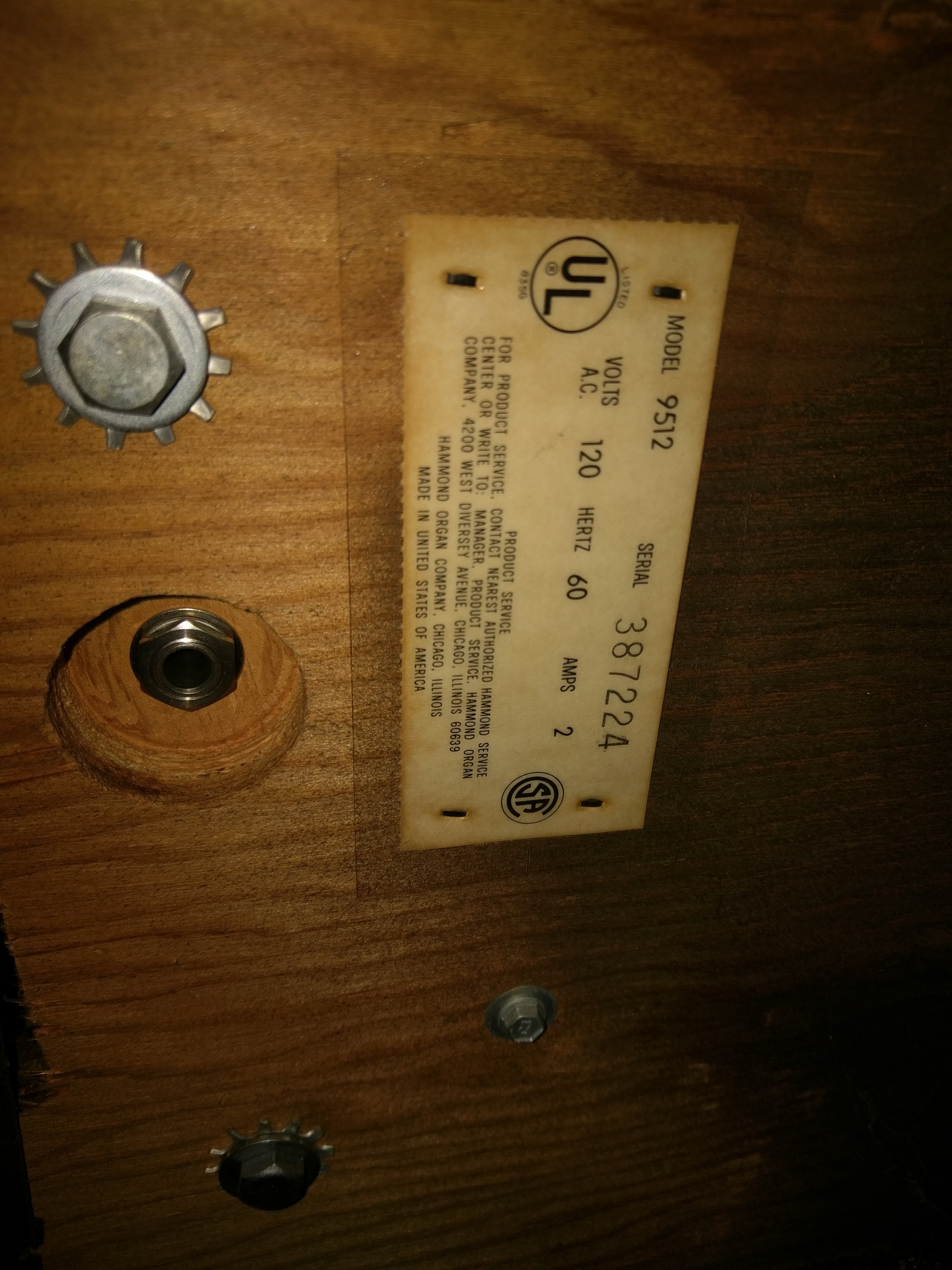

Anyways here is the organ output:

961118993-IMAG0491.jpg


I assume 9512 means this is the 12th made in the series too right? I wonder how many they even made...
 
The tag tells you that the organ requires 120VAC. It has nothing to do with the jack. Good news.

That is what I figured, the placement seemed somewhat random even though it's near the jack. So it didn't really look like a label for the jack or anything.

The manual says the headphone jack silences the internal speakers, I wonder how hard it would be to mod a switch or something to turn the speakers on or off...

Here's pics of the old seat and manual:

961325517-IMAG0492.jpg

961322972-IMAG0493.jpg


The manual has a really strange "old" feel to it.
 
It's not too difficult to wire up, really. Once you have a 1/4" output from the organ, just plug that into the Hiwatt head, then connect the speaker output directly into the Leslie crossover, bypassing the Leslie's internal amp. The Leslie amp really does sound great, especially when overdriven, but it's kind of anemic. Lots of keyboardists upgrade the speaker and horn driver in their Leslie with JBL or similar components, then drive them with an external tube head. Lots of variations, possible, I'm sure, including bi-amping with multiple heads, etc.

The reason I mentioned Jon Lord is that he's most well-known for his extreme overdriven Hammond/Marshall sound and NO Leslie.

I seem to remember some concert footage where there was a hiwatt/Marshall type amp next to the Hammond Organ
 
You'd have to look at the schematic to see how to turn off and on the main speakers with the headphone connected. It might be an easy mod.

I found a thread earlier on a random site where someone asked for the schematic but never got a response.

Maybe if I look around I will get lucky and find it, if not hopefully I can take pics when I open it up and map out the relevant parts.
 

120V 60Hz is normal electricity from the wall... so I'm guessing that's either where you plug the organ in, or maybe a courtesy power output for a rotary speaker cabinet or something? I wouldn't plug that into a speaker or amp though! Is it a 1/4 output jack? that would be weird and unsafe, but lots of old stuff was weird and unsafe. A multimeter would be useful...
 
After Hammond stopped producing the tonewheel organs they had a bunch of SS home organs. They never were very successful because people compared them to the tonewheel, but they produced some ok tones. Most folks have trashed these organs so materials on them are not readily available.

Most likely that jack is a separate headphone out. You should be able to use it for input into a bass amp but the impedance and level won't be a good match. It may sound ok though.
 
I found a thread earlier on a random site where someone asked for the schematic but never got a response.

Maybe if I look around I will get lucky and find it, if not hopefully I can take pics when I open it up and map out the relevant parts.

The schematic may be hard to find but it's worth taking a look. Sometimes a copy is left inside the organ, I'd look there first.
 
  • Like
Reactions: Sunset Shalom
120V 60Hz is normal electricity from the wall... so I'm guessing that's either where you plug the organ in, or maybe a courtesy power output for a rotary speaker cabinet or something? I wouldn't plug that into a speaker or amp though! Is it a 1/4 output jack? that would be weird and unsafe, but lots of old stuff was weird and unsafe. A multimeter would be useful...

The power plug is fixed into the back and is a standard 2 prong wall plug, no idea where the power out is but I am almost positive the picture output is a headphone jack.

I was just considering plugging it into my cheap amp to see if it works. Like I said it is almost 100% likely the headphone jack according to the manual which has an arrow pointing towards that area.

The organ sounds great mic'd but I have always wanted to be able to use it like a modern keyboard through amps and effects. If the headphones out doesn't work too well I will have to try modding it eventually. I saw some guides for other hammond organ mods to add line out jacks I believe. Could be worth a shot.
 
So I have an old Hammond organ, nothing fancy but I love how it sounds. Anyways recently I noticed it has an output tucked away on it, all it says is 120 volts 60 hertz 2 amps. I can't find any info on this particular organ online.

So would it be most likely a speaker out I should only use with a cab? I haven't opened it up yet but I assume it has some sort of amp built inside, maybe a tube amp as it's from the 70's.

I have mic'd it before and it sounds amazing, it needs some repairs but it sounds great. Sadly the bass floor pedals often don't work, I need to check the wiring in the back soon...

Anyways should I avoid plugging it into anything? I have a cheap old guitar amp I could test it on.


Which model, find the cord and look for a Data plate.

What kind of plug?

My C3, basically a B3 with a full cabinet and pedals. The output for the Leslie is a multi pin as the speed control wires are run with this cable.

Be careful.

These have a very specific starting procedure.

Do not, under any circumstances move the stops in and out quickly in an attempt to rid yourself of the static it produces, you could do more damage.

PM me I can check my books on them, Hammond made a bunch of models.
 
I am stoked! I only discovered him within the past few years but I was an instant fan! He has a lot of great solo stuff.

I was lucky enough to get to upload one of his albums a year ago, Long Misty days, and it has been one of the most popular albums I have put on youtube:


It's one of my favorites by him too so I am very proud to be the one to upload it :D He still seems to do a great job live too!
Anyways here is the organ output:

961118993-IMAG0491.jpg


I assume 9512 means this is the 12th made in the series too right? I wonder how many they even made...


Without taking a meter to it and knowing this has its own speakers, it's likely an extension speaker jack as the built in isn't very powerful.
 
So it worked through the cheap amp and sounded alright, going to try it with my bass amp now which should sound better.

Depending on how that goes I will try it with my Bugera 333xl which is a Marshall style tube amp I believe. I like to play guitar and keys stereo through the bass and guitar amp for a well rounded tone, and I have a stereo leslie sim pedal from Line 6 so I am excited to try playing the organ through that, it works great with synthesized organ patches to make them sound more organic and "full". So I bet it will sound great with organ, I also have a stereo flanger by them which would be cool.

Which model, find the cord and look for a Data plate.

What kind of plug?

My C3, basically a B3 with a full cabinet and pedals. The output for the Leslie is a multi pin as the speed control wires are run with this cable.

Be careful.

These have a very specific starting procedure.

Do not, under any circumstances move the stops in and out quickly in an attempt to rid yourself of the static it produces, you could do more damage.

PM me I can check my books on them, Hammond made a bunch of models.

It's the 9500 and I realized the plug is indeed a headphone jack. It does have a power out according to the manual but that is likely inside on the amp I would assume, and the leslie out is on the back and is indeed a strange multi pin jack. I won't have a leslie for awhile most likely so I don't have to worry about that at least :atoz:

If you have any more info on the 9500 series I would appreciate it as I can't seem to find much online. Even the wiki page list of Hammond models didn't have it, or I missed it but I looked pretty hard... If it's a hassle no problem though, I need to open it up anyways and that should help fill in the blanks :bookworm: