Yeah,Doctors are a rip off. You can do the surgery yourself at home!
My wife is a nurse and my son spent the night at the holiday in express!

TalkBass has been independent since 1998. Add your voice.
Create a free account to reply to discussions, view embedded media, and browse with fewer display ads.
Join free Log in
Want zero display ads or expanded classifieds tools? Compare plans.
Yeah,Doctors are a rip off. You can do the surgery yourself at home!
Good question, usually toward the ceilingCurious if you hold your thumb behind your second finger and have it pointing towards the ceiling rather than letting it lie more naturally on the neck, pointing (more or less) towards the nut.
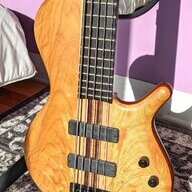
Thanks for suggesting that. Bass has nice low action. Ernie ball regular slinky’s. I wonder if a jazz width neck wound help. I don’t like the odd jazz body shape. May have to zip by GC. Well, maybe I shouldn’t.When was your bass setup last? That may be an issue?? Sounds like neck "death grip" to me. My cousin complained about his thumb for an along time. I watched him play one night and it looked like he was trying to choke the neck. He said a buddy had set his bass up. He brought it over. It was terrible! I'd start there (suggestion is all) and see if that might help. If a doctor is what you wish to do, give it a try.
South AlabamaTell us where you live. If you’re near Boston, I can recommend a great hand guy. I’m sure other members can too.
I got a single cortisone shot for trigger finger in my left hand little finger - free on the NHS (UK)I wouldn’t get a cortisone shot under almost any circumstance. They don’t fix the problem, they mask the symptoms so you go right on aggregating the injury, you just don’t know it until the shot wears off.
“Cortisone injections work by reducing inflammation and pain in injured tendons. However, they can also suppress the body's natural healing process, which can lead to:
- Weakening of the tendon: Cortisone can inhibit the production of collagen, the protein that gives tendons their strength.
- Increased risk of rupture: Weakened tendons are more prone to tearing.
- Delayed healing: Cortisone can interfere with the body's ability to repair damaged tendons. “
There may be things in addition to playing that are causing the problem. For example, something as simple as the way you sit at a computer keyboard, the angle of your left wrist when you're typing, if you're resting your wrist on a surface when you type, and so on. Even the position(s) your hand and fingers are in when you're sleeping. If the pain's there when you wake up and it's worse than when you went to bed, that's something you should investigate.Ouch, it feels like I have tendonitis or trigger thumb on my fretting hand. I missed way too many notes at my gig last night! I kept trying not to use my thumb for fretting. I can fret without my thumb, but some songs you just can’t get around it. I told the lead to reduce my pay per note I missed. Any suggestions ? Cortisone shots, brace,
I keep my hand/fretting tight, in other words I utilize all fingers to minimize moving my hand. I believe that is what has caused my pain.
Thanks ! I found a nearby hand specialist I will go see if it does not improve.I had the same issue for a year on my right thumb. It just kept getting worse until I couldn't slap anymore, and could barely play. I saw a hand specialist and tried a cortisone shot. Helped about 80% but the pain was still there and started coming back slowly. Back to the hand specialist and opted for trigger release surgery. What a relief! Within a week I was playing again, and (currently at two weeks post op) I'm quite certain I'll be able to slap soon.
It's a simple outpatient procedure. 3 hours, complete with pre and post op. I highly recommend you consider release surgery (based on my outcome) if the issue doesn't clear.
Take away: SEE A DOCTOR.


Sorry, thumb applying pressure on the back side of the neck.
Thanks, I can play some songs without any pressure on my thumb. There are just a few songs/notes that strain my thumb. Especially notes I have to use my pinky or playing/stretching between several frets.The pressure there should be minimal to nothing - the thumb is there just to locate position. Have you tried playing without even touching the back of the neck, i.e. providing the stopping force such as it is, through the weight of your arm?
Sorry,Curious if you hold your thumb behind your second finger and have it pointing towards the ceiling rather than letting it lie more naturally on the neck, pointing (more or less)
Sorry,
I can’t get the images to save vertical!
Which position is correct? Is there no corre t way? I read where thumb is supposed to be behind midde finger View attachment 7299553View attachment 7299554
To be honest, they all look OK. What you have to remember is that playing is a dynamic process - the handshapes in a static image might only exist for a fleeting moment as the music moves on. What IS important is that the hand remains relaxed and stable, even whilst moving, such that it provides a reliable 'datum' position from which fingers can accurately locate the notes without over-extending or running out of reach.Sorry,
I can’t get the images to save vertical!
Which position is correct? Is there no corre t way? I read where thumb is supposed to be behind midde finger View attachment 7299553View attachment 7299554

Fingers bunched and supporting each other. Move the whole hand! It's the traditional way on bass. Once I got used to it my technique opened up and actually play over a wider range of frets than I used to. Plus zero strain on thumb or fingers and automatic mutingYeah, i was trying different positions with my hand. At the gig is not the best time! Missed a few notes. I keep my wrist straight, most notes i can fret easily. The song thag hurts the most is “on the road” by canned heat. (Of all songs! )!played in F index finger on 1st fret 4th string,
Painful note is the 2nd, little finger on 4th string 4th fret. I keep my hand/fretting tight, in other words I utilize all fingers to minimize moving my hand. I believe that is what has caused my pain. I saw a guy playing. It looked like his fingers were all together, he kept is fingers together and skillfully played. He utilized each finger but they were all together. He was not reaching for that note with his little finger. Thoughts ?