• TalkBass has been independent since 1998. Add your voice.
    Create a free account to reply to discussions, view embedded media, and browse with fewer display ads.
    Join freeLog in
    Want zero display ads or expanded classifieds tools? Compare plans.

P bass. Alder vs ash

The 75th anniversary American Commemorative Precision Bass in bourbon burst finish from a few years ago is ash and maple. Love mine.

That is a beauty! My favorite P bass was made for me by Dingwall. Sonic Blue over swamp ash with a maple neck and fret board with a custom AlNico V Nordstrand NP-4. Everything I ever wanted out of a P bass and it only weighs seven pounds. :cool:
 
Last edited:
  • Like
Reactions: Pet Sounds
I have an ash body, maple board Precision that I bought back in 2012. It is a great sounding bass. Much different than my 2015 alder body, rosewood board Precision.
But I don't think it is just the wood. They have different pickups too. I've always thought about the sum of the parts and never thought it was just tone wood.
The ash is a little heavier, but man it sounds great.

I've tried to find the pickups, but Fender said they don't make them.

Fender American Standard Hand-Stained Ash Precision Bass
Limited Edition
November 2012

Precision Bass ash body
Hand-rubbed stain/satin lacquer top coat finish
Modern "C" shape maple neck with maple fingerboard
20 Medium jumbo frets
Satin finish on back, gloss finish on front
Posiflex graphite neck support rods
S/S pickup configuration
American Standard Precision Bass single split coil pickup
Master Volume and Master Tone controls
Chrome hardware
HMV, High Mass Vintage bridge (Strings-Thru-Body or Topload)

Pickups:
0061276000
0061277000
 
  • Like
Reactions: spiritbass
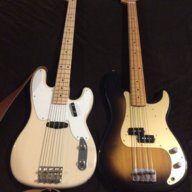
Thought I would post a photo of it:
20220630_140614_001.jpg
 
I own a Warmoth Swamp Ash build, maple neck P-J configuration, passive. I also own two Fender Japan PB 62 reissues. Basswood bodies, maple neck with rosewood boards. One has an active EMG, the other is passive with a Duncan vintage 60's pickup. I have a Squier P-j with a custom neck, and a maple body. That bass has active EMG's. And rounding it out, a 2014 Fender American Standard Precision bass. That just got a DiMarzio Relentless P-bass pickup.
ALL of these basses sound like a Fender Precision bass. Are there differences in the body woods, as far as tone goes? There's been a lot of debate about all of this. But I still say, if I recorded all of these basses just with the P-bass pickup selected on the P-J's, and compared them to each other, I know that it would be very difficult to identify which body wood you were listening to. I compared my Japanese Basswood body P-bass with LaBella Jamerson heavy flats to my American Standard with medium Fender 9050's and the tone was so close, I don't think it would matter much at all, recording or live.
 
Personally I trust Fender's orinigal combination.
- 50's P: alder or pine body, maple fretboard;
- 60's P: alder body, rosewood fretboard;
- 70's P: ash body, maple fretboard.
This goes for Jazz Bass as well:
- 60's J: alder body, rosewood fretboard, narrow pickup spacing;
- 70's J: ash body, maple fretboard, wide pickup spacing.
I understand that the 70's configurations give a bright snap and growl, while the 60's give a slightly warmer focussed punch. The (late) 50's P may get in between?
 
Reminder that there are two kinds of ash: northern, which is hard and heavy (think baseball bats and 70's Fenders), and swamp ash which is soft and light. In my somewhat limited experience, hard ash gives a bright piano like tone while light ash is softer in the highs and sweeter in the high mids. And I'm specifically talking P-basses with maple boards.

That said, the variable nature of wood means that "identical" twins can sound remarkably different. I've experienced this myself with sibling basses. Point is, spec'ing out a bass for tone is like playing craps. You have the best chance of rolling 7 (your target tone), but there are other possibilities, some not so close to your target.
 
Last edited:
Anyhow, the "tone woods don't make ANY difference" crew will be in shortly, to politely remind us that our opinions/perceptions are wrong...:roflmao:

b109622da5e858f747faff9d16a97ab3.jpg


In all seriousness, the true purpose of a bass is to help you play/sound your best....however it gets you there. A good bass is a good bass, I try not to think on it too hard and just roll with what's punchy :thumbsup:
 
The fist band I was in as a kid I had my 62 alder body rosewood fretboard P bass. The lead guitar player had a 70s P bass ash body maple neck I would play at times. His bass had a lot more punch to it, I thought. I was a little jealous of it 😐

That's okay I modded the dickens out of that 62 P bass, making it sound “better” 😔

20220123_160719 (1)_Original.jpeg


Hey, it was da 70s and I was a kid 🤣
 
The fist band I was in as a kid I had my 62 alder body rosewood fretboard P bass. The lead guitar player had a 70s P bass ash body maple neck I would play at times. His bass had a lot more punch to it, I thought. I was a little jealous of it 😐

That's okay I modded the dickens out of that 62 P bass, making it sound “better” 😔

View attachment 7536188

Hey, it was da 70s and I was a kid 🤣

i LOVE this vibe. forever I was all about pristine, no scratches...yada yada, but now all i can do is see a bass that was loved, played, and made music. its perfect.
 
i LOVE this vibe. forever I was all about pristine, no scratches...yada yada, but now all i can do is see a bass that was loved, played, and made music. its perfect.
I still play it today. It does have a lot of good sounds to it. With it being fretless and with the various pickups blended together, I can get sounds from a quasi-upright sound to Alphonso Johnson, who was part of the inspiration for the mods. Along with that San Francisco hippie Alembic modding thing going on in the 70s that caught my little kid eye 😊
 
  • Like
Reactions: cataract