

Enjoy the benefits of a premium membership!
Upgrade Account
-
TalkBass has been independent since 1998. Add your voice.
Create a free account to reply to discussions, view embedded media, and browse with fewer display ads.
Join free Log in
Want zero display ads or expanded classifieds tools? Compare plans.
You are using an out of date browser. It may not display this or other websites correctly.
You should upgrade or use an alternative browser.
You should upgrade or use an alternative browser.
P bass in Jazz?
- Thread starter lousybassplayer
- Start date
More options
Who Replied?
- May 30, 2000
- 4,707
- 257
- Disclosures
- Creator of: iGigBook Sheet Music Manager
Why hasn't a major manufacturer come up with a model of bass called the "Metal."
Think about it.
Well, maybe DON'T think about it.
I don't care.
Or the "Bossa Nova".

I heard somewhere that jazz players back in the day where having a tough go using a precision bass for jazz music, since that type of music isn't so precise. Leo caught wind and come up with the jazz bass and the rest is history.


bass_study said:If someone use billy sheehans Yamaha with scallops to play jazz would be interesting.
What exact purpose do those scallops serve?
I've asked this a few times but nobody seems to really know.
Best answer so far is that it's just a speed thing.
My own personal thought was that maybe it allows him to further bend the string on certain notes.
Anyone know for sure what his intentions were there?

Of course, "Jazz" is just a model name, same as saying Ford "Mustang". There was a "Mustang" bass, too, to capitalize on the popularity of the car. Is it only for cowboy music?
As mentioned before, Dave Holland played a P with Miles, and Carla Bley (see: "Tropic Appetites"), before giving up the electric. I had the good fortune to hear this live at Fillmore East in 1970. It was badass. See also: Paul Jackson, Chris Wood, even Ron Carter played a P on some commericial sessions.
As mentioned before, Dave Holland played a P with Miles, and Carla Bley (see: "Tropic Appetites"), before giving up the electric. I had the good fortune to hear this live at Fillmore East in 1970. It was badass. See also: Paul Jackson, Chris Wood, even Ron Carter played a P on some commericial sessions.

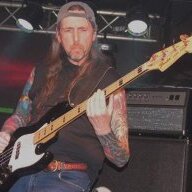
I don't know if its possible, but if anyone can help me figure it out, it's you guys.
You probably would have gotten less sarcasm and more legit answers if you'd asked, "Who uses a Precision bass in jazz."
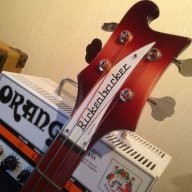
You can play any bass for any type of music, it just may not provide the traditional sound. In college I studied jazz and played in the jazz band. I could only afford one bass so I played jazz on my Rickenbacker. Probably not the ultimate jazz bass, but with judicious tweaking of the nobs, when it sat in the mix, no one ever said a word about it not sounding right.
I'm all for tradition and building on what came before, but you play what you've got.
This is a totally legitimate question. Before I learned to play, my son wanted to learn. The local music store had those Fender "Learn to Play" packages (a bass and Rumble 15 amp) with either the Squier by Affinity Jazz or Precision bass. I had to ask the salesman what that meant, and he said it has nothing to do with Jazz, then went on to explain the one vs two pickups, etc., etc. I believe those packages are now simply labeled as P style or J style, they probably got sick of noobs like me asking the same question over and over again.
1SHOT1HIT said:What exact purpose do those scallops serve?
I've asked this a few times but nobody seems to really know.
Best answer so far is that it's just a speed thing.
My own personal thought was that maybe it allows him to further bend the string on certain notes.
Anyone know for sure what his intentions were there?
Isnt it for bending strings ?
What exact purpose do those scallops serve?
I've asked this a few times but nobody seems to really know.
Best answer so far is that it's just a speed thing.
My own personal thought was that maybe it allows him to further bend the string on certain notes.
Anyone know for sure what his intentions were there?
Some players dont like the feel of wood under their fingers and its good for bending. It has nothing to do with speed.
Some players dont like the feel of wood under their fingers and its good for bending. It has nothing to do with speed.
Before CNC wood machining, they were rare, and hard to make. Ritchie Blackmore of Deep Purple tried to make one himself with a kitchen knife. I don't believe he ever got it right. He had a major Fender neck resentment that manifested itself by him stuffing his Strat neck-first into a Marshall cab during shows.

To actually give you a serious response, I think your question is legit, since most electric players (IMO and IME) who play in most jazz contexts (e.g., cocktail jazz gigs, fusion, pop jazz, smooth jazz, even some straight ahead gigs, etc.) tend to play basses with two pickups and, in many cases, flatter radius necks with a more 'modern' flattened neck/board feel.
The P Bass doesn't have that feeling of 'space between the notes' that many 'jazz' players like, and the frequency response results in the upper register to not feel quite as articulate. Combine that with many P Basses having relatively round, fat neck profiles, and it seems easy to understand why other basses (more influenced by the Fender J than the Fender P) are more popular among players who play this type of music.
For me, who at most, plays 'cocktail jazz' sets on occasion at this point (i.e., pretty straightforward 'Real Book' type tunes at medium tempos), I love my P Bass on those types of gigs. Fat and a bit bloomy down low. It puts a nice pillow under the group, and also (at least in my case) forced me to move away from at least some of the cliche's and ruts I'd fallen into over the years, since the feel and reaction of the P is so different than a J or 'J inspired' bass (like Fodera, MTD, etc., etc.).
Pure IMO, and lots of over-generalizations, but I am TOTALLY digging the P (in my case, a Nordy passive 5 string) for virtually every playing context I perform in at this point.
this is getting closer to the heart of it. My fretless '78 P with flats, pictured above, is better for jazz than my Jazz, which has rounds. The reasons are several: the P is fretless (duh), the rounds are more twangy (and thus less suitable for jazz IMO), and perhaps the most subtle - the P responds better to muting that I do, with both hands, to take away the sustain that sounds more rocklike and less jazzlike. So my vote actually goes to the P for playing jazz, but you can't look at it in a vacuum without consider frets/no frets and flats/rounds. (In my opinion.)
Cool fretless P bass Chuck 3
I somehow doubt upright players had any trouble with the neck profile on a Precision. I had read Fender conceived the Jazz as a deluxe instrument and made the neck profile slim to cater for those, er herm, six string guitar players who wanted to play electric bass and had difficulty with the Precision's neck width, because of their small fingers. As has been said, Montgomery was in a really cool jazz band (MJQ) and used Precision.
If you want to hear some jazz played on a Precision, listen to the band Back Door (bass player is Colin Hodgkinson) - a three piece jazz trio - alleged to have inspired Stanley Clark to turn to the electric - mind you I don't recall seeing him play a Jazz bass either, until very recently.
You can certainly get one or two extra tones from a Jazz bass, but in a genre founded on the upright, this may not always be neccessary - and many players in modern jazz/fusion turn to an instrument with far more dynamic range than a Jazz or Precision anyway.
My jazz bass is this, strung with flats:-
I heard somewhere that jazz players back in the day where having a tough go using a precision bass for jazz music, since that type of music isn't so precise. Leo caught wind and come up with the jazz bass and the rest is history.
I somehow doubt upright players had any trouble with the neck profile on a Precision. I had read Fender conceived the Jazz as a deluxe instrument and made the neck profile slim to cater for those, er herm, six string guitar players who wanted to play electric bass and had difficulty with the Precision's neck width, because of their small fingers. As has been said, Montgomery was in a really cool jazz band (MJQ) and used Precision.
If you want to hear some jazz played on a Precision, listen to the band Back Door (bass player is Colin Hodgkinson) - a three piece jazz trio - alleged to have inspired Stanley Clark to turn to the electric - mind you I don't recall seeing him play a Jazz bass either, until very recently.
You can certainly get one or two extra tones from a Jazz bass, but in a genre founded on the upright, this may not always be neccessary - and many players in modern jazz/fusion turn to an instrument with far more dynamic range than a Jazz or Precision anyway.
My jazz bass is this, strung with flats:-
Attachments

odin70 said:Some players dont like the feel of wood under their fingers and its good for bending. It has nothing to do with speed.
Makes sense, I figured it had to do with being able to bend and get a higher pitch out of certain notes.
Speed just didn't seem logical.
I've been so tempted to try it on my cheap Squier neck.
I may just have to sometime soon.
As far as the OP's question, it's a bass guitar regardless of the name on the headstock.
If a player likes a P and plays Jazz hell have no problem doing it on a P.
It's a bit of a ridiculous notion that one bass can only be used for certain types of music.
Hell one of my uncles has been playing guitar for almost 50 years, he spent a good bit of time playing a lot of the real heavy rock and metal through the 70's 80's and 90's.
I can pull out my freaking 6 string acoustic electric large body cut away and he can plug it in and make it scream like ANY electric guitar you've ever heard with an amp and effects.
Hell he was just playing around on my bass a few weeks back playing metal and not bass lines but actually making the thing sound like a damn guitar. He's incredibly talented.
It's the player not the instrument, a player that knows their music and knows their way around a fret board well enough can make it work.
Any guitar, any music, any style.
Just my opinion.
You probably would have gotten less sarcasm and more legit answers if you'd asked, "Who uses a Precision bass in jazz."
Actually this thread was taken way more seriously than I had anticipated.


