• TalkBass has been independent since 1998. Add your voice.
    Create a free account to reply to discussions, view embedded media, and browse with fewer display ads.
    Join freeLog in
    Want zero display ads or expanded classifieds tools? Compare plans.

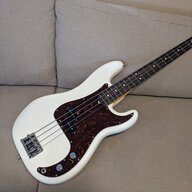
What's the deal with P basses in particular making it into every corner of music while being so clearly limited? I understand the need for a thumpy, vintage tone sometimes, but a PJ will do it just as well while allowing for far more sounds outside of that niche in my opinion. Especially just going through a DI, which I tend to do in the vast majority of cases (I feel much more aware of my playing and volume when I get out what I put in), the pickup in post '57 P basses, especially by itself, feels restrictive, insensitive, and generally counterintuitive.

To be clear, my issue is not with the pickup on its own, as touched on before. In fact, reverse P pickups, especially when used in PJ configurations, are among my favorite pickups I've used. The problem lies in the standard P pickup and the fact that, on a normal P bass, that's all you get. The bass side being closer to the neck means a thumpy, muddy, tone- and the opposite for the treble side, having plenty of snap thanks to being closer to the bridge. Sounds great until you realize that that's ALL IT DOES.

Getting snap out of the bottom end is near impossible, even with the tone cranked, and the high end is crispy and bright all of the time (though somehow is not sensitive at all to light touch or strumming). It seems as if the whole point of the split-coil is to force extremes out of the bass all of the time, which may not be noticeable through preamps and pedals and such but is glaringly obvious through DI. And to seal it all off, you've got to play a log of a neck with strangely wide string spacing, making it even harder to be articulate than it already was.

Again, a reverse P sounds great. A reverse P sounds balanced. A PJ sounds balanced, reversed or not. I am sincerely wondering, why would you choose to spend considerable money on such a flawed and limited bass when reverse P and PJ basses are available for the same price with far more room for tone adaptation and the ability to produce the vintage sound that so many people say they look for in a P bass? I will gladly give the P a second chance if you can explain to me any actual benefit to owning one, and of course I'll be sure to look for what you bring up when I give it that chance, but I just really can't see the point.
 
I think @bwildt summed it up perfectly. The P-Bass IS a “one-trick pony” by itself, but in a band set-up look at all the genres it fits into. If I had to narrow down to one bass, it would be a P-Bass of some sort, perhaps a PJ.
I seldom use the J pickup in my PJs.
To be honest, looking back, if I could only have one bass, it would probably be a PJ. Chinese, of course (I'm cheap and have had good luck with them. And I don't worry about them getting stolen).
 
There are two things you are no considering in your analysis.
First is your amp has EQ and possibly other features to create tones.
Second is technique. How and where you attack the string makes all the difference in the world. I played Fender Ps exclusively for the first15 years and was once asked by a guitarist how I got so many sounds out of a P. My amp was an Ampeg V4B that I would adjust to the room. After that, it was all technique.
Now I have several (way too many) basses with a varity of pickups and electronics. Most, these days, are active instuments. But, for the live of me I don't know why they are needed. Although I sold my last P, I think that was a mistake as life was much simpler.

There is another thing that affects your opinion. When I started playing bass in 1963, the standard P sound was what everyone wanted whether is was rock, country, R&B, or jazz. That sound is no longer what people want to play. They use electronics and pedal boards to get a sound they want.

To this day, recording engineers smile when you show up with a P.

View attachment 7504934
Whenever my band would play we would use a local sound-tech who has mixed several major group over the past 30 years. Everytime he was mixing, if I pulled out anything other than a P-Bass he would ask me to put it away and get the P.
He said it just sets better in the mix and doesn’t get lost.
 
Everytime he was mixing, if I pulled out anything other than a P-Bass he would ask me to put it away and get the P.
He said it just sets better in the mix and doesn’t get lost.
I feel like this is a 50/50 thing that's been discussed for both FOH and recording engineers. The theory being that there are still 50% of those who want you to play a P because that's what they know and like, and 50% who think that's silly since they can make any reasonable bass sound good. And both sides feel strongly about their position...

I've never worked with a 'major name' recording or FOH person, but I've worked with a few of the known pros in my metro area and they've never given me grief about pulling out a G&L or Modulus or even Reverend. But I'm sure there are some who would.
 
What's the deal with P basses in particular making it into every corner of music while being so clearly limited? I understand the need for a thumpy, vintage tone sometimes, but a PJ will do it just as well while allowing for far more sounds outside of that niche in my opinion. Especially just going through a DI, which I tend to do in the vast majority of cases (I feel much more aware of my playing and volume when I get out what I put in), the pickup in post '57 P basses, especially by itself, feels restrictive, insensitive, and generally counterintuitive.

To be clear, my issue is not with the pickup on its own, as touched on before. In fact, reverse P pickups, especially when used in PJ configurations, are among my favorite pickups I've used. The problem lies in the standard P pickup and the fact that, on a normal P bass, that's all you get. The bass side being closer to the neck means a thumpy, muddy, tone- and the opposite for the treble side, having plenty of snap thanks to being closer to the bridge. Sounds great until you realize that that's ALL IT DOES.

Getting snap out of the bottom end is near impossible, even with the tone cranked, and the high end is crispy and bright all of the time (though somehow is not sensitive at all to light touch or strumming). It seems as if the whole point of the split-coil is to force extremes out of the bass all of the time, which may not be noticeable through preamps and pedals and such but is glaringly obvious through DI. And to seal it all off, you've got to play a log of a neck with strangely wide string spacing, making it even harder to be articulate than it already was.

Again, a reverse P sounds great. A reverse P sounds balanced. A PJ sounds balanced, reversed or not. I am sincerely wondering, why would you choose to spend considerable money on such a flawed and limited bass when reverse P and PJ basses are available for the same price with far more room for tone adaptation and the ability to produce the vintage sound that so many people say they look for in a P bass? I will gladly give the P a second chance if you can explain to me any actual benefit to owning one, and of course I'll be sure to look for what you bring up when I give it that chance, but I just really can't see the point.
I disagree with the premise of this post 😂
 
I'll skip the downstream part (recording, direct boxes, FOH, etc.) and say this:

PBasses can seem to have a singular tone profile, but this can vary greatly depending WHERE you're picking the strings: Start picking steady eighth notes on any of the four (or five) strings right at the end of the fingerboard, and slowly slide down the strings all the way to right next to the bridge saddles, steadily picking those eighth notes till you get there. It goes from very thick bass to twangy like a Tele all the way at the end, and there's a range of tones all the way down: Pick one you like. You have tremendous tone control constantly without touching a single knob.

All basses are subject to the physics involved, but you often hear this easier on a single pickup instrument, a varying blend of two pickups tends to mask it somewhat.
 
I play all my basses with the controls wide open. They all sound like basses.

And yeah , I feel the same way about the design of the P pickup - À reverse position makes more sense … but I bet it would still sound like a precision.
 
Whenever my band would play we would use a local sound-tech who has mixed several major group over the past 30 years. Everytime he was mixing, if I pulled out anything other than a P-Bass he would ask me to put it away and get the P.
He said it just sets better in the mix and doesn’t get lost.
During the 10-ish years that I worked in pro audio, mostly mixing festivals, I never once commented on a bassist’s choice of instrument. As the mixing engineer it was my job to mix, not be the producer, arranger or musical director. Even during the few years that I engineered in a small commercial studio I would never have felt comfortable telling a musician what instrument they should or shouldn’t play. Just my take on it….

I also never found other basses any more difficult to mix even though I do like the way P basses sound.
 
  • Love
Reactions: funkinbottom
First off, I'll say the P is a solid good sounding bass. I understand why people think they are the one size fits all. Heck I've owned one, and still have a couple P/Js. One standard, one reverse P. All very good. Not my go to, but I do like the sound. If that's your thing, by all means play one.
That said, I think they are probably the most overrated basses out there. I don't buy the hooey of sits great in any mix and genre. I've heard them not cut through a mix, and sound no so good at all. Though I'm sure that can be said of just about any bass. I will say that in the 45 years of being a working gigging bass player, never once has a producer, engineer, FOH person, BL etc ask for a P specifically. Never once have I pulled out a bass and had anyone tell me to put it away and play a P. Though, at one session in early 90's I was asked if I had Stienberger, as they were going for a specific vibe for the session. I did not, so they rent on from SIR (?)

So, to sum it up. P= great bass if that's what you're into. For me, not so much.
 
Violins are great but they only have the ONE SOUND! Bleh

Same for saxophones. They sound good, but they always SOUND LIKE SAXOPHONES!! Who wants that crap all the time???

Seriously, it took me a long time to appreciate the way P pickups are split. They help highlight the contrast between the lower and higher strings. That’s character. If you prefer something bland, don’t buy a P bass.
 
  • Like
Reactions: Iridescentone
What's the deal with P basses in particular making it into every corner of music while being so clearly limited? I understand the need for a thumpy, vintage tone sometimes, but a PJ will do it just as well while allowing for far more sounds outside of that niche in my opinion. Especially just going through a DI, which I tend to do in the vast majority of cases (I feel much more aware of my playing and volume when I get out what I put in), the pickup in post '57 P basses, especially by itself, feels restrictive, insensitive, and generally counterintuitive.

To be clear, my issue is not with the pickup on its own, as touched on before. In fact, reverse P pickups, especially when used in PJ configurations, are among my favorite pickups I've used. The problem lies in the standard P pickup and the fact that, on a normal P bass, that's all you get. The bass side being closer to the neck means a thumpy, muddy, tone- and the opposite for the treble side, having plenty of snap thanks to being closer to the bridge. Sounds great until you realize that that's ALL IT DOES.

Getting snap out of the bottom end is near impossible, even with the tone cranked, and the high end is crispy and bright all of the time (though somehow is not sensitive at all to light touch or strumming). It seems as if the whole point of the split-coil is to force extremes out of the bass all of the time, which may not be noticeable through preamps and pedals and such but is glaringly obvious through DI. And to seal it all off, you've got to play a log of a neck with strangely wide string spacing, making it even harder to be articulate than it already was.

Again, a reverse P sounds great. A reverse P sounds balanced. A PJ sounds balanced, reversed or not. I am sincerely wondering, why would you choose to spend considerable money on such a flawed and limited bass when reverse P and PJ basses are available for the same price with far more room for tone adaptation and the ability to produce the vintage sound that so many people say they look for in a P bass? I will gladly give the P a second chance if you can explain to me any actual benefit to owning one, and of course I'll be sure to look for what you bring up when I give it that chance, but I just really can't see the point.

well OP, not sure what your intent was (serious or not), but you sure figured out how to bring out all of the "P's are the bestest basses ever" folks here on TB.

and for the record, I never had a producer or engineer ever say squat about the bass (all J's) I brought to a session ... ever. This idea that it's all about a P bass in a session is seriously silly stuff.

oh well, play what you like, like what you play and all that ... but it's kind of amazing to me that there is such hyperbole over the supposed perfection P basses.
 
  • Like
Reactions: funkinbottom