• TalkBass has been independent since 1998. Add your voice.
    Create a free account to reply to discussions, view embedded media, and browse with fewer display ads.
    Join freeLog in
    Want zero display ads or expanded classifieds tools? Compare plans.

P basses were meant to be 4 string

Jan 15, 2018
1,179
1,748
London
We recently added a few songs to our set that make use of the low D and C on the low B string e.g. Uptown Funk

Immediately obvious to me that neither the P nor P+J settings on my Yammy BB1025 bass cut through the mix at all, whereas the solo'd J bridge pup produced a meaty crunch for the really low notes, eliciting comments from bandmates of "sounded great, what pedal was I using to deliver that change?". No pedals involved at all - simply switching to the J pup.

The PJ setting had until then been my default so I'd tried various ruses including raising the height of the low string P pup but to no real avail.

Got me thinking that when Leo was sorting out the P bass configuration, 5 string basses were not even a twinkle in his creative eye.

Also got me thinking that the reverse-P set up, which several brands have as standard, would get part of the way there by having the low B and E pole closer to the bridge to produce a tighter sound, but that if I really wanted a meaty / crunchy low B that didn't get lost in the mix then actually J pups on my 5ers were going to be essential part of the armoury.

Probably been the single biggest bass learning point for me in 2019, so I'm sharing in case it's of use to others. But my experience is derived from one bass (albeit a very well regarded one) and one set of pups - so in good TB fashion, please feel to disagree.

Happy Xmas!
 
Many owners play a low B on their P basses (including Yamaha BB) with no trouble at all. So something else is going on. I see several possibilities here:

- Maybe a string change will help?

- Raising the B side of the P pickup so the magnet is closer to the string. (Edit: sorry, I see you already tried this.)

- Were the pickups ever changed, by you or a former owner? I ask because there are many ways that 5 string P pups can be fitted incorrectly. They can be the wrong way around. (Yamaha gets this wrong in some of their documentation.) Also, some aftermarket pickups are smaller than the originals and it's possible to position them so the magnet doesn't reach one of the strings. You may want to check for this.

Good luck!
 
Last edited:
I've never had this problem with downtuned P's, PJ's or JJ's...I only ever owned one 5 and it's loaded with EMG actives, and that's a different ballgame from passives or passives with an active preamp. But as long as the passive P and PJ pickups sounds good to my ears, they work very well in a mix for me. Still, whatever you need to do to get the sound you want is what you need to do.
 
Lately I only gig P & PJ configuration 5-strings, and have mostly been playing in P-bass musical territory (that is to say the original versions of tunes are mostly in that realm). Both my Moollon P and Valenti PJ each handle this beautifully in their own way, and their B's are glorious. I lean towards the P pickup when using the PJ, so that the J pickup adds flavor and bite only.
So I can't say I agree with you, but we all have different likes I guess, and different basses respond differently to the same player. I recall that when I was gigging my Moon 5 string J I tended to favor the bridge pickup just slightly for most things.

All of which is not to say I don't like gigging my '61 P bass ;)!
 
Last edited:
I have 2 Yamaha BB (425x and 2025x), they have some of the hottest passive pickups I've ever encountered. I play mostly in the P/J blend or solo P mode, the volume of the B string (or any others) has never once been an issue.

Wondering if there isn't some room phase issue going on or a new/different set of strings is in order. Not saying your problem isn't real, but just that I've never encountered it myself. Hope it gets sorted out. Best of luck! :thumbsup:
 
Bridge pickups are great for low B strings because they emphasize the "overtone" frequencies over the fundamental frequency, and strong overtones are one of the factors that help create a "tight B string tone."

A practical tip how to achieve somewhat similar tone on a P bass is to use a high pass filter. If you set the HPF around, say, 60hz then it will clean up the fundamental frequencies and emphasize the overtones when you play on the B string of your 5-string P bass. This will give you more of a "bridge pickup sound" on a P bass that doesn't actually have a bridge pickup.

A possible psycho-acoustic explanation for what you and your band experienced: I own a couple of PJ basses. Whenever I move the blend toward the J pickup, I usually also turn up the volume to compensate. Did you also do this, turn up the volume when you soloed the J pickup? If so, your band mates might just have been reacting to the phenomenon that you were louder. Most listening studies that have ever been done have showed that, if you ask a test subject to compare two samples of music, they will say whichever one is louder "sounds better."
 
Last edited:
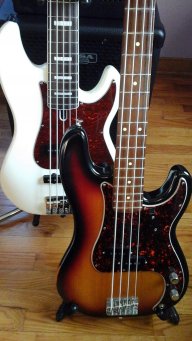
My sire PJ has a strong b string,the fender precision p5,not so much.
 

Attachments

  • 20191208_130224.jpg
    20191208_130224.jpg
    149.9 KB · Views: 75
Meh. I guess it's the sum of the parts. It's not just the bass sound, it's the whole band's instruments blending together that will do the trick. My wife makes extensive use of low B string with her P in her band and the last thing I would say, and not because she's my wife, is that her low B string gets lost in the mix. When all the instruments fill the "right spots" in the mix and have proper EQ settings (and that includes dealing with the venue acoustics, show after show) everything sounds right.
 
When I decided to get a five, I went with a J-bass partly to get the bridge pickup, figuring that the definition would be helpful on a B string. But a good B string tone depends on many factors, like strings, pickups, preamp (if active), and overall construction, so no reason a P5 or P/J 5 can't be fantastic. In particular, I think fives place an extra premium on having a very rigid neck. My G&L fives are excellent in this respect, and IMO better than my old Fender Jazz V partly for this reason. I believe your Yammie has a multi-laminate neck that should be rock solid, so other factors might be involved.

Also on a 4-string, the split-coil pickup naturally cancels hum.
With a 3/2 split-coil there needs to be some compromises to make it hum-cancel as well as a 2/2 split.

Some manufacturers make equal sized coils, with one having pole pieces for only two strings. That seems like the best approach to me, but Fender's P5 pickups don't have equal-sized coils. Nordstrand makes both types:

5 String Precision Bass Pickups
 
  • Like
Reactions: Al Krow
The OP is mixing a few things up.
I agreed that the basic Fender split single coil design doesn't translate well to a 5 string model, which is why they don't really exist. The neck would be horribly chunky, and extending the coil properly is hard to do. One side is going to be longer than the other no matter what. Does one longer coil offset the tone and make the B weaker? It often sounds like it to me.
The Yamaha 1025 is a heck of a bass. I found the PJ setup very useful. The neck was pretty comfortable for me as well.
Where the OP loses me is that they conflate 5 strings with a low B. The vast number of bass players using P style instruments in the doom and stoner subgenres disagree. They tune 4 string Ps anywhere from C to A. They tend to use a pick and a lot of drive, but it can be done. I personally don't care for it and never made it work for me. I don't like soloed bridge pickups either. My sweet spot for low tunings is a double soapbar or J/MM setup, since I mostly play finger, clean-ish, and like a lot of articulation.
 
  • Like
Reactions: anton72

Latest posts