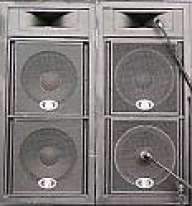
Feedback is putting a ceiling on your practice PA's volume, not the amp section of your powered mixer. Adding a bigger amp will just give you louder feedback.
The advice below is pretty basic, so apologies if you know all this already. I've also simplified in a few spots, to avoid complications it won't likely be useful to consider at this stage.
To control mic feedback in a rehearsal room, start by placing whatever PA speakers you are using as monitors--close to the singers and in the null spot of their vocal mics. Different mics have different sensitivity patterns, but the most common spots are directly behind the capsule or else 45-60% on either side of the rear axis.
Now flatten out the system as best you can with the gear you have (or can afford). A typical cheap rehearsal PA will have peaks and dips in its eq response at almost every stage--the cheap mics will be strongly colored, as will the pre-amps, the eq and built-in effects, and whatever is passing as the monitor wedges. Chances are, some of the components are hyping the same bits of the spectrum. To try to get the system closer to flat, start with eq flat and effects off. Playing recordings through the system gives you a controlled context for making this first pass. If you have huge woofing lows or ice-pick highs, adjust the system eq to tame them. Note that different spots in your room will sound different, and what matters for taming vocal mic feedback is how the system sounds at the spots where the vocal mics are placed.
Make sure your vocal mics are in their rehearsal positions. If possible, make sure that the marks for the singers' mics aren't right by a wall or reflective surface. Ideally, they'd be in a relatively quiet part of the rehearsal space, and in a part of the room not afflicted by huge nodes--but for now, just avoid putting them right in front of a reflective surface or putting your singer's ear right in the drums. Either of those conditions will make it difficult to give the singers enough monitors.
Got recorded music sounding reasonably flat? Great. Now mute playback of your recorded music and work on the mics. Mute all channels except your vocal mics. Bring up your vocal mics, one at a time and still w/o effects or channel eq. Set the channel gain for a hot signal with no clipping, and bring the PA volume up. You might find that one of the mics has a very peaky response curve and/or terrible off-axis rejection. Sometimes, one of the mics has decent gain-before-feedback and the other is a pig. If so, consider replacing the pig.
If your vocal mics are decent and your PA/monitor rig is as flat and clean as you can get it, the maximum vocal mic volume you can get before feedback will dictate the volume level for the room. If the musicians can play under that ceiling, then you're good to go.
If the drummer can only bash or the guitarist(s) insist on swamping the vocals, then you could bring in more/better gear to raise the volume of the vocals before feedback. (Stage-quality mics, monitors with flatter response and tighter dispersion patterns, and better mic pre-amps are first candidates. After that, a graphic eq or feedback suppressor could be useful. (W/o someone in the band who can set that gear though, it's easy to cause more problems than you fix.)
Flattening out your system will help you get more out of it, but there are limits. In the same room, a well tuned system with flat pre-amps and even sounding monitors will get a lot louder before feedback than a peaky or badly tuned system. Still, the best system in the world can get only so loud in a small room before live mics feed back. If you've tuned your rehearsal monitor PA and feedback still keeps the ceiling lower than the musicians can play under, you'll either need to get new musicians (seriously), or learn to live w/o hearing the vocals at rehearsals that become social get-togethers, or go a different route--such as running the vocals through a headphone amp and give closed-ear phones to whoever in the band is actually listening to the vocals.