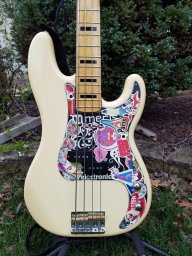
I've hesitated to weigh in on the whole "failure" claim. I guess if one evaluates success or failure through the lens of capitalism only, one can say that these basses did not succeed, as that sort of success can only be determined through analysis of profits and losses. And yes, EBMM is a commercial company existing in a capitalist market, so that can be one valid way of looking at it.
I prefer to look past that to the instruments themselves and their (non-monetary) value to me as an artist. In this sense, these basses are by no means a failure. My Caprice is an amazing bass that surpasses any other fretted bass I've played or owned.
People complain about the large headstock ... EBMM stated that this was to increase sustain. I don't know if that's true, but the bass does sustain better than anything I've played other than my Pedulla Buzz neck-through, which it's about equal with.
People try to say the Caprice is "just another PJ," but the experience I and other owners have had is that the bridge pickup on these basses is very different and balances with the P pickup better than any other basses we've ever tried. Some of us have never had a bridge J pickup that we would use soloed, even on Jazz basses, and we find ourselves using the Caprice bridge pickup soloed. It's that good.
So, sure, maybe these were a commercial failure. I don't care. I'm glad I own one. Van Gogh's paintings were also commercial failures, such that he only sold one in his lifetime. But they are amazing works of art. My Caprice isn't going to hang in the Louvre or sell for millions, I know. I'm not trying to do that sort of direct comparison. But to me, this bass is about as far from a failure as it can get.