As the title says... Is there anything readily available? Turning down the treble on an active bass doesn't sound the same. Likewise, I've not been able to get the same result from EQ pedals.

Enjoy the benefits of a premium membership!
Upgrade Account
-
TalkBass has been independent since 1998. Add your voice.
Create a free account to reply to discussions, view embedded media, and browse with fewer display ads.
Join free Log in
Want zero display ads or expanded classifieds tools? Compare plans.
You are using an out of date browser. It may not display this or other websites correctly.
You should upgrade or use an alternative browser.
You should upgrade or use an alternative browser.
Passive Tone Control in a Pedal
- Thread starter 4StringsEnough
- Start date
More options
Who Replied?
bongomania
Commercial User
Yes, there are a few different ones out there, but I can't remember their makers ATM. As simple as a passive tone control is, it's true that a typical EQ pedal can't model that curve. You'd need something like the Empress Parametric or the Fromel Shape, and they'd be a bit overkill for the job. 

bongomania
Commercial User
Good point about actives! The passive tone control needs a passive connection to the pickups and the cable. With an active bass, you would need to model it with EQ. Or get a Sadowsky onboard preamp with VTC.

In the pedal breeders thread, there's lots of talk about "buffer-busting" pedals, that make active basses play nice with pedals that normally wouldn't sound good with an active bass running through them. Maybe a buffer-buster running into a tone knob would do what the OP wants.Good point about actives! The passive tone control needs a passive connection to the pickups and the cable. With an active bass, you would need to model it with EQ. Or get a Sadowsky onboard preamp with VTC.
Easier would be finding an onboard EQ with active-passive switch and a treble knob that acts as a tone control in passive mode. The Glock 2-band pre in my Dingwall is a perfect example.
bongomania
Commercial User
What the "buffer busters" do is raise the output impedance, which helps with the sound of certain fuzzes. But part of the "magic" of a passive tone pot is how it interacts directly with the pickups and the cable; and a buffer buster doesn't allow that interaction. A buffer isolates the components.
An active/passive switching preamp is a good suggestion.
An active/passive switching preamp is a good suggestion.
Thanks for your suggestions. The problem with an on-board pre is that I'd need to install one on each of my basses. Hence why I'd prefer something outboard. What about the Markbass booster (I forget its name) with VLE (Vintage Loudspeaker Emulator) control. How similar is that?
If nothing exists it seems like a really obvious, simple and cheap void in the market?
If nothing exists it seems like a really obvious, simple and cheap void in the market?
That's kinda what I was thinking... a low pass filter. I used to have an SD800 with that. I'm definitely no expert, but I didn't think low pass filters and passive tone controls were the same. Or are they?
IMO, I would think a low pass filter would get you in the ballpark.
IMO, I would think a low pass filter would get you in the ballpark.
The Mike Pope flexcore also has a tone knob, which I added later and I now use all the time.
A tone knob IS a low pass filter. An un-buffered RC circuit. Pretty simple wiring wise but as others have said the on board pre presents a problem without a buffered circuit
A tone knob IS a low pass filter. An un-buffered RC circuit. Pretty simple wiring wise but as others have said the on board pre presents a problem without a buffered circuit

Some Overdrives have a great tone (treble cut) control. It pretty much does the same thing. On bass, the frequency of the treble control has a profound effect on the over all tone.

+1 for active/passive switching. I dont know how you feel about modding the bass but why emulate a passive tone if you can just have a passive tone circuit
Still available on ebay, I always thought the mid knob on the B.K. Butler Blue Tube pedal was similar to rolling the tone knob on a passive bass. I'm not certain, but that pedal's 3 band seemed like passive baxandall.
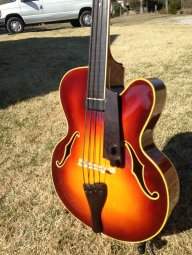
Just get a passive jazz bass..
Yeah, that is friggin' hilarious - let me guess you're pretty young, eh?
The solution to all dilemmas is another piece of technology hehehehehe
Reinvent the wheel much?

Here's some reading on the subject.
Invalid Link Removed
This is a common mis-perception. The tone control in a passive bass is not a basic RC circuit. The RC low pass filter at the link above assumes a perfect voltage source. As bongomania pointed out, the pickups in a bass include reactive components (inductors, capacitors), resistors, and a voltage source.

bongomania
Commercial User
In the LRC filter created by combining pickups, capacitor, and cable, rolling it back does not just roll off highs. It creates a small boost in the lows, and the frequency center of that boost shifts significantly depending on the setting of the tone pot. The LRC filter also changes the slope at which the highs roll off.
This is a common mis-perception. The tone control in a passive bass is not a basic RC circuit. The RC low pass filter at the link above assumes a perfect voltage source. As bongomania pointed out, the pickups in a bass include reactive components (inductors, capacitors), resistors, and a voltage source.
Ok, so you're telling me that a passive wiring harness is not an RC circuit? That doesn't make sense to me... All thats there is a resistor (pot) and a capacitor! Sure there's other variables with the pickups but it seems to me like it would still follow that roll off frequency equation fairly closely.. (f = 2π/RC.. I think)
The passive instrument tone control is an RC network, but it is not an RC low pass filter.
One difference is that the output is taken from the top of a series RC network, not from the cap. The resistive part (the tone pot) is not directly a frequency determining component as it is in an RC filter. It serves more to control the amount of rolloff. The tone pot resistance does affect frequency rolloff at very low settings, but this is mainly because the cap is now a significant part of a resonant circuit, which includes the coil inductance.
I should add that the pot resistance does have an effect similar to the resistor in an RC low pass filter at the node between the resistor and cap; but that is not where the signal is taken from at moderate settings.
-
One difference is that the output is taken from the top of a series RC network, not from the cap. The resistive part (the tone pot) is not directly a frequency determining component as it is in an RC filter. It serves more to control the amount of rolloff. The tone pot resistance does affect frequency rolloff at very low settings, but this is mainly because the cap is now a significant part of a resonant circuit, which includes the coil inductance.
I should add that the pot resistance does have an effect similar to the resistor in an RC low pass filter at the node between the resistor and cap; but that is not where the signal is taken from at moderate settings.
-
Last edited:


