• TalkBass has been independent since 1998. Add your voice.
    Create a free account to reply to discussions, view embedded media, and browse with fewer display ads.
    Join freeLog in
    Want zero display ads or expanded classifieds tools? Compare plans.

Passive Wiring Ideas

Hi,
So, I am using a nice sounding (both somehow incomplete) SR700 as a pilot project to learn as much as I can about bass electronics.

I’ll be starting by wiring the original PUs passive, so that I can listen to how they sound by theirself. Originally I planned a standard VVT configuration which I have on my other basses and works well for me, but since the bass already have 5 holes in it, it would make for one too many ‘producer switch’…

I started reading around in look for inspiration and I fell straight in the tone cap rabbit hole. So I came up with this idea:
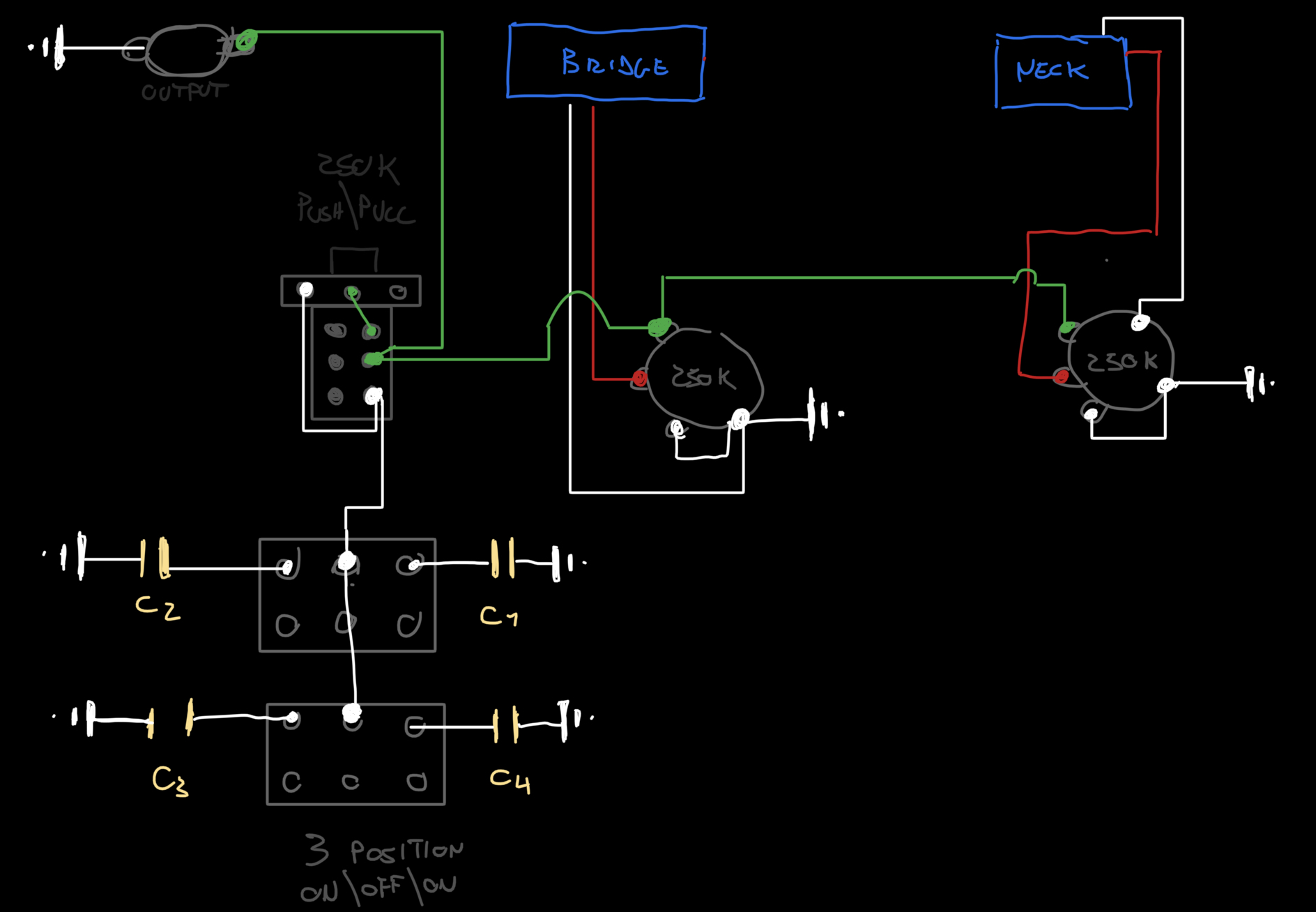
Push-Pull - Tone.png


Basically, two switch (3 position ON/OFF/ON) that would allow me to select 9 different capacitor values (NONE, C1, C2, C3, C4, C1+ C3, C1 + C4, C2 + C3, C2 + C4). The push/pull knob is intended to enable the tone knob or bypass it, sending the parallel signal directly to the capacitor then to ground.

So I guess my questions is:
a) is the push-pull redundant? (i.e. same or similar to rolling of the tone knob completely?)
b) does the schematic look ok (i.e. work as intended), or am I failing to consider something?

In general, I am looking for feedback, inputs, even completely different ideas of what to do with those extra holes that could have at the very least ‘educational value’… Musical value is of course a bonus :)

Cheers
 
Switching in those caps will basically change the range of adjustment the tone pot provides.

The usual way to do switched caps is fixed resistors paired with the caps. So, the bass is wired for several different fixed frequency filters. It is a way to simplify controls, not needing to adjust a knob to chase tone.

A different approach to the bass would be: VVTT and Series/Parallel switch
That would give enough adjustment to spend hours playing with the knobs.
 
Thanks for the feedback.

I guess I want to keep the option to adjust the extent of the cut... According to my (hopefully correct) understanding: different capacitors will determine both the cut frequency AND the frequency at which the resonant peak happen, the variable resistor in series with will determine how much of a cut actually happens, as well as the shape of the resonant peak.

I looked into VVTT configuration, but it looks like more fiddle then I’d like. I doubt that my poor set of hears will be able to discern the (apparently subtle) extra flavours anyway.

I did consider Parallel / Series switching, but a quick search told me is generally a bad idea to put 4 coils in series together. In my case the J pu is hum-cancelling, so it’s likely I’d end up with a lot of mud?

Cheers
 
Just go for it. The switches and caps don't cost much. Mostly, you will be out the time to wire it all up. You might chose to simplify it later. A bare ground wire can save you some time in soldering.

The push/pull should not be necessary. Your cap switches both off should be indiscernible from tapping the pot off. It would only be useful if you want to switch quickly between full tone and your preset tone.
 
  • Like
Reactions: Matt-bb and fig
So, I went on and built the circuit above and wired the stock ibanez pickups to it. Everything works as expected and I gotta say I am very pleased with the result: this bass is my best player, but I was never sold to the sound. After removing the junk electronics those dxp/dxj both sure sound sweet. But this is a story for another time.

About cap values: I used 0.001 and 0.047 on one switch, 0.022 and 0.033 on the other. I can achive 0.069 and 0.08 by using them in parallel.

Here is a picture:
BA59F9A3-0D2C-4B76-9B56-7FFB96076614.jpeg


Here are my first considerations after playing a couple hours at home:
a) 0.001 cap was a sweet surprise. When using it by itself the tone is similar to no cap, but it’s fuller, less harsh and feels like increased output.
b) I like both 0.022 and 0.033, they are pretty similar. I’d say they have the same character with the 0.33 being thicker. 0.047 sounds great especially when soloing either pick up. When I add up to 0.069 and 0.08 everything becomes too muddy and is no use to me (gotta say this particular bass is pretty dark sounding by itself already).
c) push/pull tone knob: when engaged and rolled off I can hear no difference to when it’s bypassed. When engaged and fully open it seems there is a little extra output when bypassing it. In-between-positions seems to bring nothing to the table, at least playing at home by myself. I’ll see if it is useful in a band setting.
d) As midlifeBeginner suggested straight away, it is surely way more complex then it needs to be. I can already see I’d probably better be off with a single switch selecting one of three cap values (0.001, 0.022 or 0.033, 0.047) and no tone knob.

For now this is all, cheers bass people!
 
  • Like
Reactions: XLunacy and fig
When engaged and fully open it seems there is a little extra output when bypassing it

The pot acts as a load in parallel with the pickups - bypassing it with the push/pull will remove that load. It's similar to the "no load tone pot" mod that's somewhat popular, which involves cutting the trace on the pot to achieve the same result when the pot is full on.

If I were in your shoes, I'd probably choose my favorite few caps and put them on one of the switches, then use the other switch for something else. You could do a switched small value cap in series with the pickups for instance.
 
  • Like
Reactions: fig