• TalkBass has been independent since 1998. Add your voice.
    Create a free account to reply to discussions, view embedded media, and browse with fewer display ads.
    Join freeLog in
    Want zero display ads or expanded classifieds tools? Compare plans.

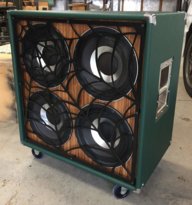
Peavy C-600 Network Speaker Cabinet

Anyone have information?


  • Total voters
    5
  • Poll closed .
Last time I saw those cabs was at a Knights Of Columbus or SPJST Hall in the middle of nowhere Texas in the dark and dank 70's dance hall gigs,
K.C. halls are fairly ubiquitous, but I'm not sure "S.P." halls are found anywhere other than the middle of nowhere Texas. So... well played, sir! :D

Jak se máš?
 
Last edited:
  • Like
Reactions: bassbrad
This reminds me of the cabinet I got for free curbside and which actually does sport a Black Widow 15" that I had to provide myself.
Sounds pretty good but weighs about 100 pounds which is a lot for a single 15" cabinet.
4003f862-808c-4e98-8a74-c4c8cc888586-jpeg.3741914
 
I had to laugh, as well jamming an ice pick in my ear so I could remember what those Peavey horns sounded like. A pawn shop near me have a Behringer 8x10 bass cab on the floor that has several of the 10s replaced with Pyle speakers, which are plainly visible through the grill and not at all neatly arranged. I'm trying to figure out if it might be an improvement or not. I'm not in the market for any more large bass cabs or I'd go unleash the beast and give it a try!
This was the cab mentioned in my post above. I can't believe a pawn shop actually took that in thinking that they would recoup any money on it!

POS.jpg
 
  • Like
Reactions: BasturdBlaster
Yeah no that's just 1974 Peavey. The Crossover is absolutely horrible. I have been redesigning mine for years slowly. On to their 4 cabinets soon. I took out the dual 8-ohm woofers and put in a single 4-ohm woofer. As for the crossover. God they messed it up. A 10uf cap is accidentally put on the horn instead of the tweeter. It does technically work since the horns on mine anyway are 45-ohm about 22.5 in parallel. But still i moved that to the piezo tweeters to block 4000k. I also completely rewired the crossover so the piezos do not share the adjustment knob on the back with the horns. I put a 2-ohm resistor on the piezos to quiet them just a bit. Those super sensitive horns need that big old knob at 22-ohm and 30 watt. Note that the Electro-Voice Paging Horns (PA30-45) which are 45-ohm also came in (PA30) which were 8-ohm! I suspect Peavey used 8-ohm ones originally as it would have matched the impedance perfectly. Mine all have the 45-Ohm ones (they read about ~36 DC resistance). The horn I currently have no cap or coil on because of that delicious 0 degree phase. I want to do a 4th order on them in the future to prevent bass and keep that phase but it will be expensive so currently i am just not. The full range woofer had two 25uf shunt caps in parallel making 50uf and two super extra poopy 2.4-ish mH coils in parallel making 1.2mH. I replaced the caps with 2 22uf caps making 44uf (its what i had close enough and seems to sound just fine). Now after some comparison audibly and using calculators online I replaced the coils with 2 in-line 1.0mH audiophile air core coils making and changing the value to 2.0mH. It really helps pull the full range woofer down out of the horn's range so it doesn't mud it up as much. Such a nightmare design. I had to completely change How the bi-amp system worked, in fact the bi-amp mode completely bypassed the woofer filters and the knob for the horns/tweeters. The second would have been fine but I just rewired it correctly. I will post a picture of my current build, some wiring maps and the original crossover. Cheers hope it helps. This year they are now 50-years old! PS if you're going to put a cap on the horns which i might eventually do i would recommend going more like 12-13uf instead of 10uf. And my crossover points are currently 500hz and 4000hz.
 

Attachments

  • IMG_6083.jpeg
    IMG_6083.jpeg
    2.2 MB · Views: 19
  • IMG_6068.jpg
    IMG_6068.jpg
    1.8 MB · Views: 19
  • IMG_6077.jpg
    IMG_6077.jpg
    2.7 MB · Views: 22
  • IMG_6073.jpg
    IMG_6073.jpg
    2.1 MB · Views: 21
Last edited:
Yeah no that's just 1974 Peavey. The Crossover is absolutely horrible. I have been redesigning mine for years slowly. On to their 4 cabinets soon. I took out the dual 8-ohm woofers and put in a single 4-ohm woofer. As for the crossover. God they messed it up. A 10uf cap is accidentally put on the horn instead of the tweeter. It does technically work since the horns on mine anyway are 45-ohm about 22.5 in parallel. But still i moved that to the piezo tweeters to block 4000k. I also completely rewired the crossover so the piezos do not share the adjustment knob on the back with the horns. I put a 2-ohm resistor on the piezos to quiet them just a bit. Those super sensitive horns need that big old knob at 22-ohm and 30 watt. Note that the Electro-Voice Paging Horns (PA30-45) which are 45-ohm also came in (PA30) which were 8-ohm! I suspect Peavey used 8-ohm ones originally as it would have matched the impedance perfectly. Mine all have the 45-Ohm ones (they read about ~36 DC resistance). The horn I currently have no cap or coil on because of that delicious 0 degree phase. I want to do a 4th order on them in the future to prevent bass and keep that phase but it will be expensive so currently i am just not. The full range woofer had two 25uf shunt caps in parallel making 50uf and two super extra poopy 2.4-ish mH coils in parallel making 1.2mH. I replaced the caps with 2 22uf caps making 44uf (its what i had close enough and seems to sound just fine). Now after some comparison audibly and using calculators online I replaced the coils with 2 in-line 1.0mH audiophile air core coils making and changing the value to 2.0mH. It really helps pull the full range woofer down out of the horn's range so it doesn't mud it up as much. Such a nightmare design. I had to completely change How the bi-amp system worked, in fact the bi-amp mode completely bypassed the woofer filters and the knob for the horns/tweeters. The second would have been fine but I just rewired it correctly. I will post a picture of my current build, some wiring maps and the original crossover. Cheers hope it helps. This year they are now 50-years old! PS if you're going to put a cap on the horns which i might eventually do i would recommend going more like 12-13uf instead of 10uf. And my crossover points are currently 500hz and 4000hz.
Is this a joke post?
 
in fact the bi-amp mode completely bypassed the woofer filters and the knob for the horns/tweeters.

??
Every speaker I’ve ever seen that had an internal crossover, and also had bi-amp capability, bypassed all crossover components and any attenuation for any speakers in the cabinet. This is to allow direct connection to the speakers for use with an external (electronic) crossover and obviously two different amps. Did you put crossover components between the low &/or high input jacks & the speakers?
 
??
Every speaker I’ve ever seen that had an internal crossover, and also had bi-amp capability, bypassed all crossover components and any attenuation for any speakers in the cabinet. This is to allow direct connection to the speakers for use with an external (electronic) crossover and obviously two different amps. Did you put crossover components between the low &/or high input jacks & the speakers?

Well I was thinking that someone might actually blow up speakers by running signal they don't need through them, especially bypassing the resistors. That being said it would be pretty easy to wire it that way. I might change it when I build the new cabinets. I don't plan on bi-amping them since the crossover now actually sounds good. The woofer would be especially easy to isolate off the components but the tweeters and horns would be somewhat an issue because they need different levels of resistance to be level. I suppose it would be fine to have your hi freq amp pushing through different resistors, and you would definitely want to leave the piezo capacitor as well. The biggest problem these speakers had originally was mainly the horns were louder than the piezo tweeters, so everyone turned them up louder to hear the highs making the horn distort the mid's. Really solving that and getting a better coil on the woofer helped clean it up a bunch. I do still have it wired for Bi-amp though it just uses all of the components still. I think that would be kinda problematic but I might test it.
 
Nope, not a joke! you must not know too much about them then! :) Sounds like you're kind of scoffing throughout the whole thread really. Not helpful

I’m VERY familiar with them which is why I’m sure this whole thing is a joke. This is a bass guitar forum in case you missed that.

Actually really nice responsive diaphrams if they were ever dialed in, but they couldn't be at the time. Linkwitz-Riley wasn't really used till the 80's
View attachment 5333120

They were positively awful, phenolic-linen diaphragm with terrible high frequency extension and lots of distortion.

I studied Linkowitz-Riley filters in the 1970’s, they were a specific implementation of the Butterworth alignment built out of the Sallen Key topology. The primary benefit was that when the Fo was specified at -6dB, the low pass and high pass sections combine in a way that the power always sine to one versus frequency. This is called a constant power summing crossover and actually existed before it was called L-R alignment. It was just a pair of underlapped Butterworth filters beforehand.

Since both Linkowitz and Riley both worked at HP, their work was studied as part of my course work since HP recruited heavily from my university. It wasn’t a secret, it was just that they formalized the definition.
 
I’m VERY familiar with them which is why I’m sure this whole thing is a joke. This is a bass guitar forum in case you missed that.


They were positively awful, phenolic-linen diaphragm with terrible high frequency extension and lots of distortion.

I studied Linkowitz-Riley filters in the 1970’s, they were a specific implementation of the Butterworth alignment built out of the Sallen Key topology. The primary benefit was that when the Fo was specified at -6dB, the low pass and high pass sections combine in a way that the power always sine to one versus frequency. This is called a constant power summing crossover and actually existed before it was called L-R alignment. It was just a pair of underlapped Butterworth filters beforehand.

Since both Linkowitz and Riley both worked at HP, their work was studied as part of my course work since HP recruited heavily from my university. It wasn’t a secret, it was just that they formalized the definition.


Huh that sounds interesting. Well the horns are for mid-range not high frequency extension. Sure think what you want but these sound as good if not better than my old jbl's and ess. I used to love them for high volume when i was young and not for quality. But back then in the 90's most PA-horns were WAYY worse. Couldn't hear midrange at all and sounded like you were in a pipe. I think that's my take right there, just still better than typical PA speakers regardless of the material of the diaphram. Anyway that plastic resin I've always preferred, even just plastic dome tweeters if they aren't blown is my preference over the typical silk domes (Excluding whatever the Phasetech tweeters are made of). All my friends would borrow the Peavey's too so they could hear the lead singer. Eventually a couple of horns blew due to that awful crossover design. I painstakingly repaired them which was difficult. This particular pair of speakers was supposedly left over from Fleetwood Mac touring. Probably why I wanted to fix them up instead of leaving them as trash guitar gear.
 
Think what you want. I was there, I worked with and designed around a lot of different components and I can't think of a single worse mid horn-driver actually. Considering it audiophile quality is laughingly absurd.

Fleetwood Mac never used those in their touring days, don't know (or particularly care) where you got this information. The stories that get made up and getting weirder by the day.