I have only purchased one pedal, a Boss EQ. It was ruined when the battery leaked all over the place. So that go's to show how often I used it. I have a Korg tuner that is not a pedal. I just have my bass, amp, cab. That's it.

Enjoy the benefits of a premium membership!
Upgrade Account
-
TalkBass has been independent since 1998. Add your voice.
Create a free account to reply to discussions, view embedded media, and browse with fewer display ads.
Join free Log in
Want zero display ads or expanded classifieds tools? Compare plans.
You are using an out of date browser. It may not display this or other websites correctly.
You should upgrade or use an alternative browser.
You should upgrade or use an alternative browser.
Pedals or No pedals!?
- Thread starter brian579
- Start date
More options
Who Replied?
I use pedals. Gotta pedal board with 10 pedals and another board with two. I can gig without any of them if I wanted to, I just don’t want to.How many fellow bass players don’t use pedals? And how any do use effects? I’m not against them. I just never wanted to rely on anything but my bass, amp, fingers, and occasional pick for tone. If you do used pedals, what pedals can you not gig without?


I played for years without pedals.
About 5 or so years ago I go a zoom multstomp to experiment with and found some eq/preamp setting I liked.
I had always had trouble with boomy notes and found out that a parametric eq could help with that. The one in the zoom was ok but I wound up getting an empress paraeq, which worked great.
Started wanting to fiddle with an HPF, and found the zoom had a preamp with that... Been using it ever since but am planning on getting a stand alone.
Got a keeley bassist to do some mild compression.
I've been looking for some tubish like preamp and at the suggestion of many here on TB I tried the TC SPARK Booster and the Mini. It's getting a nicer sound and using one akways on and the other as a boost.
Am I satisfied? Not yet... I'm still planning on getting a tube preamp, just finances at the moment have delayed that.
I could gig without any of them, I did for a long time. Excluding the zoom pedal from a choice, if I could pick only one pedal the para eq would be it. I can hone in on specific frequencies and cut or boost them.
Pedals mean different things to different people. I mainly use them to tweak a sound better than what my amp can do on it's own. I see pedals as being no different than twisting knobs on a bass or moving eq sliders on an amp... they are simply extensions... and if someone knows how to use them correctly, they really can make a difference. It takes nothing away from the fingers because if one has poor technique, there's not a pedal in the world going to fix that.
About 5 or so years ago I go a zoom multstomp to experiment with and found some eq/preamp setting I liked.
I had always had trouble with boomy notes and found out that a parametric eq could help with that. The one in the zoom was ok but I wound up getting an empress paraeq, which worked great.
Started wanting to fiddle with an HPF, and found the zoom had a preamp with that... Been using it ever since but am planning on getting a stand alone.
Got a keeley bassist to do some mild compression.
I've been looking for some tubish like preamp and at the suggestion of many here on TB I tried the TC SPARK Booster and the Mini. It's getting a nicer sound and using one akways on and the other as a boost.
Am I satisfied? Not yet... I'm still planning on getting a tube preamp, just finances at the moment have delayed that.
I could gig without any of them, I did for a long time. Excluding the zoom pedal from a choice, if I could pick only one pedal the para eq would be it. I can hone in on specific frequencies and cut or boost them.
Pedals mean different things to different people. I mainly use them to tweak a sound better than what my amp can do on it's own. I see pedals as being no different than twisting knobs on a bass or moving eq sliders on an amp... they are simply extensions... and if someone knows how to use them correctly, they really can make a difference. It takes nothing away from the fingers because if one has poor technique, there's not a pedal in the world going to fix that.

For 17 years, I didn't own a single pedal as a bassist. It wasn't until I branched out to other instruments that I built a board. Even now it's all preamps, a compressor and a mini reverb pedal. While I was accumulating pedals I jumped on a good TB deal for a Sadowsky preamp, so I absolutely will be taking my board with me the next time I do find a regular gig as a bassist. But even then I won't spend my night tap dancing.
I could take or leave pedals. But I will say that I didn't realize how uninspiring my amp was until I put some other tone options into the mix. And I don't say that as a tone chaser.
I could take or leave pedals. But I will say that I didn't realize how uninspiring my amp was until I put some other tone options into the mix. And I don't say that as a tone chaser.

Do you mean pedals specifically, or effects in general? I use an overdrive (tube-emulation) for a little bit of crunch, but otherwise rely on my touch for tone.How many fellow bass players don’t use pedals? And how any do use effects? I’m not against them. I just never wanted to rely on anything but my bass, amp, fingers, and occasional pick for tone. If you do used pedals, what pedals can you not gig without?

If we are counting DI floor units as pedals, then yes—mine are essential for stage when going to the FOH or in the studio. Effects pedals are nice but they don’t make a huge difference in my live sound. I like to have some compression available but it’s optional. I have a lovely MXR envelope filter but I mostly just use that for noodling at home. A tuner pedal is a nice accessory, especially when using a headless bass onto which it’s hard to attach a clip-on tuner (although attaching it to the volume knob works okay).
I have not used my DigiTech Trio or my Singular Beat Buddy live or in the studio yet, but they are being woodshedded now.
In short, I would recommend those three: tuner, DI, and compressor.
I have not used my DigiTech Trio or my Singular Beat Buddy live or in the studio yet, but they are being woodshedded now.
In short, I would recommend those three: tuner, DI, and compressor.
It's highly dependent on the needs of the bassist. Some bassists play music where all they do is provide clean low end. Some bassists play music where you cant tell what the bass is doing because the signal is so obscured by effects. I didnt touch a pedal until about 7 years into playing. Then I went crazy, had a monster board and every effect under the sun, and now I've found a happy medium where I have a pedaltrain Jr that gives me every sound I could need on 99% of all gigs. As a working bassist, I want to be able to say "yeah i can do that" whenever asked, and part of that is having extensive effects and signal chain knowledge. A lot of people here are casual or bedroom players just happy to thump along with their favorite songs, with very little interest in nailing all the tones or techniques.

I use this all on all the time along with my GED 2112 . Top comp knobs are usually at two o’clock...

I tried to create a chorus and reverb sound with my fingers once for the part in an artist's original production. Making reverb with one's fingers is really hard. Chorus is also hard if you want the up-and-down modulation (since it's slightly impossible to bend a string to make it flatter than the fretted note).
It's true that plenty of what we do is "good enough" bass to amp, but the idea of pedals is not relying on them like some crutch, but using them as tools to enhance an already good thing. Particularly tone-related ones. Ambient effects and whatnot are clearly a different discussion.
I'm working on setting up a small pedal strip to enhance the sound and headroom of my '60 P's signal going into my rig. Without it, things are fine, I sound good and everyone likes it. But I want HPF, EQ, compression, and a special-effects slot to level up from fine to fantastic, and one little box with one plug to power it all is well worth it to me.
Good post. I'm always intrigued by the clash of opinions here. It's funny to me when folks take the attitude of "they never used em back in the day, so why would I now?" It's like any technology - learn to use it to your advantage. Seat-belts, the internet, social media, etc. Sure, we lived without all of these things, but they all serve a purpose when used correctly.
That's one thing I would not use. All your dynamics and intensity should be done with your fingers. Them lazy boys...
Discussed ad nauseum, but compression and right hand dynamics are not mutually exclusive. You can set a compressor to give a subtle effect or fattening that doesn't squash dynamics or make up for 'lazy' technique. I assure you, they can add things to the sound of your bass that the hands cannot.
For me, I have more effects on my board than I need for 90% of what I do. That said, they are tools and they inspire me. For a current project, tuner, overdrive, distortion, and fuzz are all essential. I have a HPF & LPF under the board, which are utilities more than effects. The phaser is a big plus, but I could squeeze by without. I have two others on the board for fun sounds, but I don't force them into situations where they don't belong.

I assure you, they can add things to the sound of your bass that the hands cannot.
Convince me. What do they add? That you could not do with attention to intensity and dynamics.
Convince me. What do they add? That you could not do with attention to intensity and dynamics.
If you go from fingerstyle playing to slapping and you want a tighter, punchier sounding low end and more snap/crystal highs when popping, you can't achieve what engaging a compressor will with use of your hands alone. Your question is similar to asking what a sound engineer can do with EQ in a studio that you cannot do with your touch/dynamics alone. Likewise, if you use other effects with great dynamic range/peaks, a compressor after those effects can add an evenness to your overall sound that dynamics at the front end of your chain (i.e. your hands) cannot.
I'm not saying you have an incredibly limited range of sounds available from your touch & dynamics. I'm saying that a compressor can alter your sound in ways that dynamic playing cannot. Same with a very squashed compressor set for fast attack and slow release. You won't be able to achieve that same sound just with dynamics. So, it is a tool like other effects - not a sign of laziness. Is every great bass player who uses compression lazy?
Convince me. What do they add? That you could not do with attention to intensity and dynamics.
They allow you to play with multiple techniques without driving the sound person crazy trying to keep your level consistent. Switch between aggressive slap and palm muting in the same song and you'll get why compressors are useful.
Some compressors also impart a tonal quality, that can sound very funky, or bring out the pick attack or bring up ghost notes to an audible level to a live audience. There are many things that compressors can add that would be impossible or impractical for the player to do with dynamic playing and EQ alone.
Is every great bass player who uses compression lazy?
It's well known that musicians are naturally lazy. Just some are lazier than others. You can't beat, clean technique.
I was "no pedals" for 25+ years.
Now I get my freak on. I couldn't do this in, say, a blues band, but a power-pop-with-horns band can always use some fun intro sounds and layers.
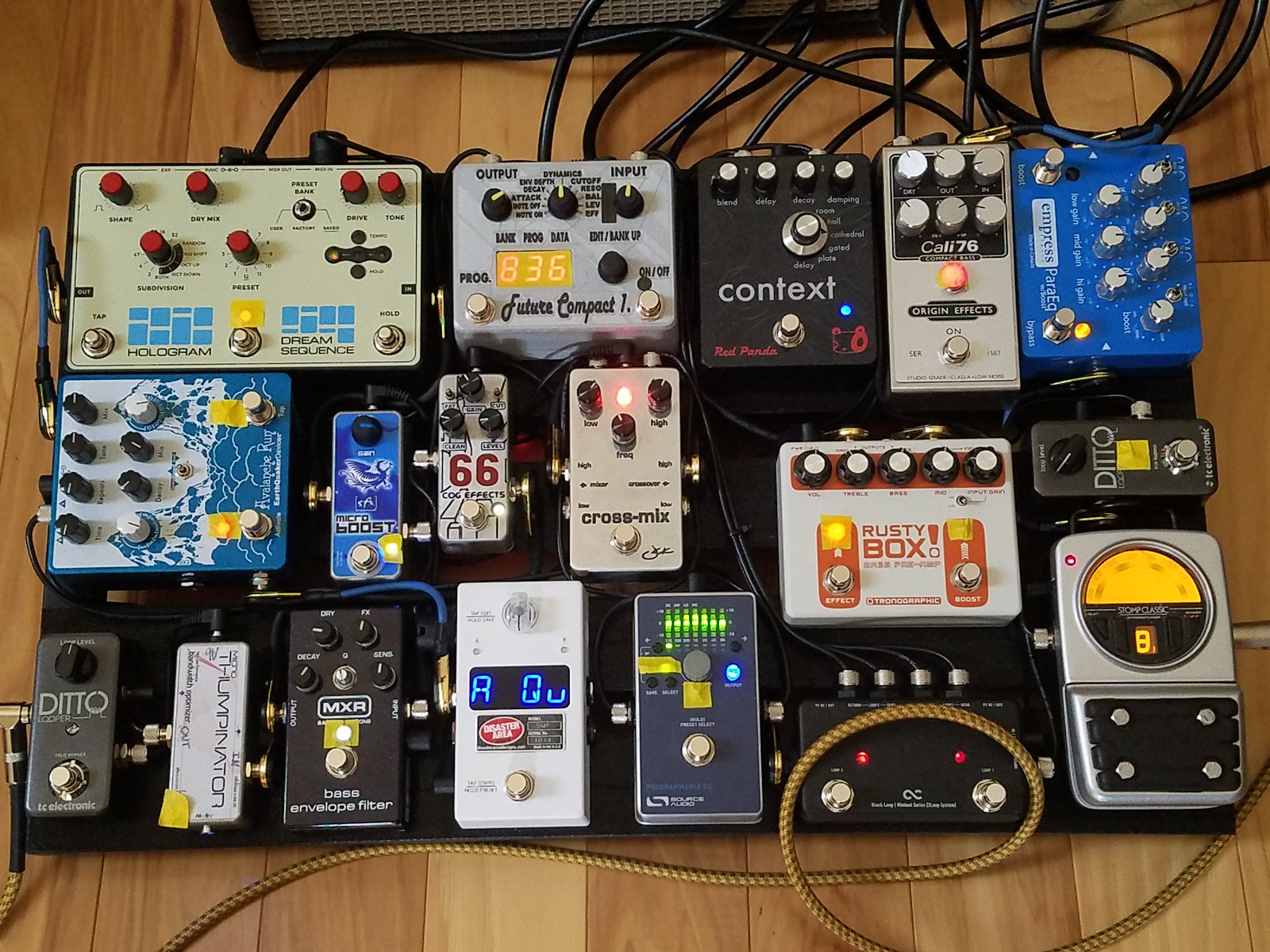
Now I get my freak on. I couldn't do this in, say, a blues band, but a power-pop-with-horns band can always use some fun intro sounds and layers.
Also, just a quick note...everyone is aware that their favorite studio recorded songs have all sorts of EQ, compression and filtering ALL over the tracks, right? More likely than not, anything produced inside a modern DAW has some gentle lining up of tracks and multiple cuts as well, if not straight up quantization.
You can't beat, clean technique.
clean technique is singular....clean techniques are plural....I use one because I play with multiple techniques....My multiple techniques are clean enough each where I mainly use Compression as a Limiter ---- but the percussive nature of slap bass alone, with the sharp thump spike, is enough for me to prefer using one
Convince me. What do they add? That you could not do with attention to intensity and dynamics.
Do you record your band rehearsals?
That was what did it for me. "Damn, that bass sounds great in the mix."


