In isolation I get it it, but as part of an ensemble. Once the pianist is doubling bass lines, or playing melodies high up, they are flat or sharp respectively.

TalkBass has been independent since 1998. Add your voice.
Create a free account to reply to discussions, view embedded media, and browse with fewer display ads.
Join free Log in
Want zero display ads or expanded classifieds tools? Compare plans.

Again, you need to think of each piano key as actually playing a chord made up of multiple tones. Their average, and the overall chord, is much closer to being in tune than they would be if the only the fundamental tone were in perfect tune.
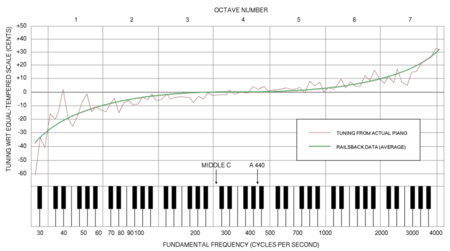
But the fundamentals are tuned flat to sharp. The 2nd and 4th overtone are tuned to it too. A bass string has the same overtone series, but not the range. So if the pianos fundamental is tuned flat, they sure a bass guitar/Upright should too.The railsback chart you posted is showing the tuning of the Fundamental only.
If it were showing the average of the fundamental and overtones, adjusted for their respective amplitudes, it would be a straight line. (if the piano is tuned properly)
Right, at the bass end a piano string isn't really a single "note" any more. The harmonics aren't exact multiples of the fundamental, they're sharper (progressively sharper as they go up). So you've got a tradeoff, you can tune so the fundamental is more in tune, or so the higher harmonics are more in tune. The decision to stretch tune is a decision to prioritize the tuning of the higher harmonics.
Note this is all true of plucked bass guitar strings as well. I wonder which part of the overtone series the typical tuner focuses on.
But the fundamentals are tuned flat to sharp. The 2nd and 4th overtone are tuned to it too. A bass string has the same overtone series, but not the range. So if the pianos fundamental is tuned flat, they sure a bass guitar/Upright should too.
Bass guitar strings are not (typically) struck on harmonic nodes, so mostly only the fundamental is ringing.
There are definitely overtones, but not as apparent as when a sting is ringing from a harmonic.
As the bass player, I try to get the keyboard player to not use his left hand. Seriously, I have been in churches that both the piano and organ were used simultaneously, and the piano tuner did not stretch the tuning as much as a concert piano so it would coordinate better with the pipe organ, which being wind and not strings, with truer overtones, does not suffer from inharmonicity as much as a piano.Cool, so do you know how other instruments deal with being played with a stretched tune piano. Does a bass tune to it and not a pedal tuner, Do higher instruments do the same, flutes, saxes for example?
What happens when you put a synth on top of the piano. does it they just ignore each others tuning?
I don't understand why striking the string somewhere other than a harmonic node would damp the harmonics.
If anything, I'd expect striking at a point to decrease the amplitude of any harmonic with a node at that point.
Pretty certain most of what you actually hear from a bass note is harmonics.
Edit
Piano and bass guitars, and all string, wind, all vibrate harmonically as opposed to en-harmonically (Membranes), so they all have the same harmonic series. Odd and even. But they have different amplitudes and of these harmonics creating the different tones, plus a different attack sound depending on what driving the vibration. If you strike at a node, it amplitude decreases for that harmonic. but with a bass, that strike point varies, depending on if we pluck/pick towards the bridge, or the neck and how long we have made the string by frettng.
This is my understanding of harmonics, Am I amiss so far?
No all strings do not vibrate the same way are not all harmonic.Edit
Piano and bass guitars, and all string, wind, all vibrate harmonically as opposed to en-harmonically (Membranes), so they all have the same harmonic series. Odd and even. But they have different amplitudes and of these harmonics creating the different tones, plus a different attack sound depending on what driving the vibration. If you strike at a node, it amplitude decreases for that harmonic. but with a bass, that strike point varies, depending on if we pluck/pick towards the bridge, or the neck and how long we have made the string by frettng.
This is my understanding of harmonics, Am I amiss so far?
A piano hammer strikes the string at the node.
Where did you hear that? I'm genuinely curious where this idea is coming from.
The harmonic series is infinite, so, sure, any given hammer strikes near the node of *some* partial. But I've never heard that piano makers all place the hammers at the node of some particular partial.
Harold A Conklin Jr: Piano design factors
Perfect 5ths' aren't really perfect, or are they?
On my musical journey I have encountered the terms "Perfect 5th" and "Perfect 4th". I am teaching myself to read music, studying music theory and learning a lot. I understand, describing the 4th and 5th notes of the scale as "Perfect" is because they are the same in the major scale and the minor scale.
I know that, for stringed instruments (especially piano) 4ths and 5ths aren't tuned perfectly. This is because of even temperment. 4ths are tuned narrower than perfect and 5ths are tuned wider. If tuning non-stringed instruments (like a pipe organ) the 4ths and 5ths can be tuned perfectly.
My point/rant? This can be confusing for people learning music theory. Those intervals aren't really perfect, stop calling them that!lol!
Am I wrong? Please educate me.
I learned to tune pianos before I learned music theory. Just the idea that the 5th is called perfect when it's not exactly perfect (ok fretless is) always bothered me. I know its not the same; piano tuning and music theory.
Did the term "perfect" originate when historic temperments were in use and 5ths WERE tuned perfectly?
Yes, you can if you use "Check Intervals", which piano tuners do.Play fretless!
In equal temperament a perfect 5th is 700 cents. That is very, very close to just intonation. I believe no human can hear the difference.
The terminology, as the OP knows perfectly well, has zilch to do with tuning.
They are very drab intervals anyway, suitable only for metal or as reference tones for the spicier intervals such as the #11.
The difference is small. When playing with a piano, and you are listening (and on a fretless) and care, you are probably lowering it a bit without knowing.Regards stretch tuning, why are basses not tuned flat. Or are they when accompanying a stretch tuned keyboard?