Hello all. I am using WinISD to model different combos of mixed speakers and found you CAN get phase plots of mixed speakers to overlay if tuned properly, but not usually. My question is, how much phase offset between drivers is tolerable before it's audible? Particularly in that 40-150Hz region where phase is swinging a lot. 10 degrees? 45 degrees? Anyone done experiments with known speaker boxes or found a thesis on it? I assume the answer is at least as high as the speaker to speaker variability of a multidriver cabinet. Anyone know what that is?

Enjoy the benefits of a premium membership!
Upgrade Account
-
TalkBass has been independent since 1998. Add your voice.
Create a free account to reply to discussions, view embedded media, and browse with fewer display ads.
Join free Log in
Want zero display ads or expanded classifieds tools? Compare plans.
You are using an out of date browser. It may not display this or other websites correctly.
You should upgrade or use an alternative browser.
You should upgrade or use an alternative browser.
Phase offset audibility, particularly with mixed cabs
- Thread starter fast_frank_d
- Start date
More options
Who Replied?

I'll take a wild uneducated guess. In theory 180 degrees would cause the signal to cancel. It will cause some problems but in a room, they won't fully cancel. Beyond 180 degrees you are moving closer to 360 degrees and less phase cancellation of a continuous sine wave (with real music you probably get some cancellation other odd effects). This assumes the two cabs produce the same SPL. So for argument's sake, I'll call 180 worst case. So 18 degrees is 10% of an SPL drop in sine wave theory. So, you might loose up to 10% of your SPL at the cancellation freq., but probably less? I'm guessing. Since your SPL is going to likely be different, you would loose less I think. I'm guessing 5 to 10%, but I could be way off and there my be other effects that I am unaware of as of now. I expect I'm about to learn what those are, and have my theory corrected any moment now. This should be a good thread!

Roll the dice
Or
Maybe you simulate how you plan to stack the cabinets, and what venues you'll use them in
Look around for some Acoustic Simulation software/demoware and there may be freeware
Here's some info,
Invalid Link Removed
Invalid Link Removed
Or
Maybe you simulate how you plan to stack the cabinets, and what venues you'll use them in
Look around for some Acoustic Simulation software/demoware and there may be freeware
Here's some info,
Invalid Link Removed
Invalid Link Removed

- Feb 12, 2006
- 60,958
- 5
- 220,614
- Disclosures
- Development Engineer-Mesa Boogie, Development Engineer-Genzler (pedals), Product Support-Genz Benz
About 30 degrees is a good rule of thumb BUT
You can take 2 cabinets with identical phase responses, then move 1 cabinet 6" or move the measurement mic 6 " and get different responses (generally higher than 200Hz) but it depends on what kinds of boundaries are in the listening space. Boundaries can have a big effect on phase response of a pair of cabinets or a pair of drivers.
You can take 2 cabinets with identical phase responses, then move 1 cabinet 6" or move the measurement mic 6 " and get different responses (generally higher than 200Hz) but it depends on what kinds of boundaries are in the listening space. Boundaries can have a big effect on phase response of a pair of cabinets or a pair of drivers.
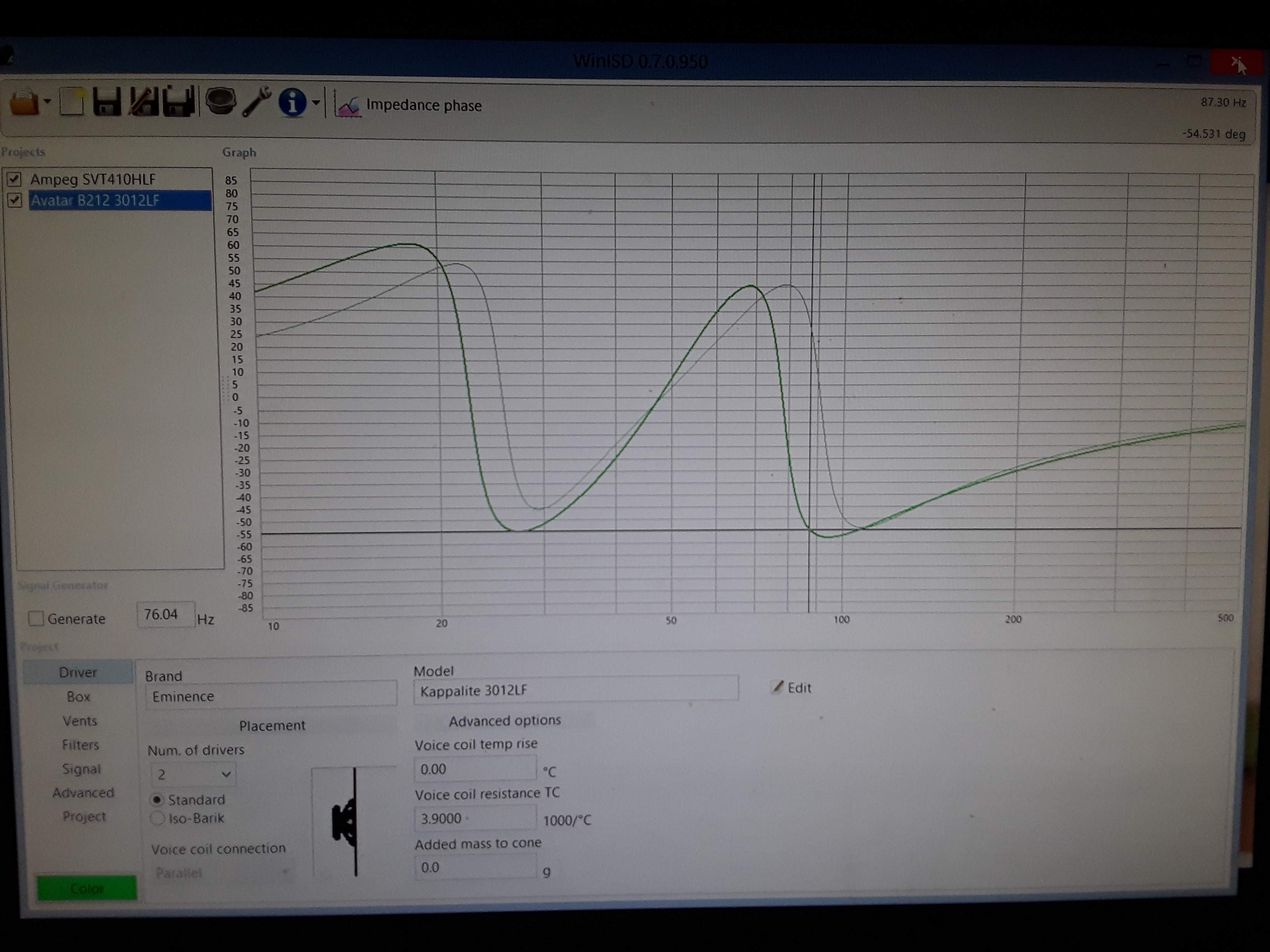
30 degrees gives me hope, thanks. The worst situation is when the drivers/cabs are so different that the 2 lines are criss crossing each other due to different slopes rather than lead/lag, so moving the cabs wont be that helpful, in which case I am hoping it's just not audible under XX degrees offset. Of course, even moving the cabs to account for lead/lag will have best results at 1 frequency and inferior results everywhere else, but its something! See pic of example of criss crossing I am trying to describe..

I've done some reading on the subject of arrays of speakers.
My general understanding - what people who build line arrays and bessel arrays keep saying - is that there will be interference, but that at low frequencies the interference tends to have an additive effect. And in high frequencies, the effect tends to be destructive.
hornresp is another tool you can use to simulate and visualize this stuff. Extremely venerable program, can trace it's source code all the way back to punch cards. the current windows UI is not the most intuitive but i wouldn't call it hard and there are tutorials online.
My general understanding - what people who build line arrays and bessel arrays keep saying - is that there will be interference, but that at low frequencies the interference tends to have an additive effect. And in high frequencies, the effect tends to be destructive.
hornresp is another tool you can use to simulate and visualize this stuff. Extremely venerable program, can trace it's source code all the way back to punch cards. the current windows UI is not the most intuitive but i wouldn't call it hard and there are tutorials online.
- Feb 12, 2006
- 60,958
- 5
- 220,614
- Disclosures
- Development Engineer-Mesa Boogie, Development Engineer-Genzler (pedals), Product Support-Genz Benz
My comment about moving speakers is that the results will vary... some parts better and some parts worse but it's nothing more than a moving target of compromises.
I have designed medium and several large format line array systems (products for touring market only), and there are 2 distinct schools of thought... each has its merits, benefits and challenges.
Referring to mid through high frequencies, the first school of thought is to define the vertical pattern as tightly as possible and accept small areas of significant lobing due to the irregularity that typically occurs at the edges of the vertical pattern. The second school of thought is to allow for quite a bit of overlapping in the vertical domain but design the edges of the pattern that overlap to be as smooth and uniform as possible, resulting in larger areas of lobing but much less significant lobe impact. I prefer the second approach in general (though there are some applications where the first is better) because it tends to be a little more forgiving with varying splay angles, the overall character of the coverage appears to the listener to be more uniform with varying splay angles. This is especially true where the array breaks apart for more near field coverage, the tight patterned arrays tend to show their lobes more "in your face" unless the near field fills are a looser vertical pattern (some manufacturers do this to avoid exaggerating the lobes as the array widens vertically).
This is an expensive area to play in, I built proof of concept systems that cost #30-$40k... essentially prototypes!
I have designed medium and several large format line array systems (products for touring market only), and there are 2 distinct schools of thought... each has its merits, benefits and challenges.
Referring to mid through high frequencies, the first school of thought is to define the vertical pattern as tightly as possible and accept small areas of significant lobing due to the irregularity that typically occurs at the edges of the vertical pattern. The second school of thought is to allow for quite a bit of overlapping in the vertical domain but design the edges of the pattern that overlap to be as smooth and uniform as possible, resulting in larger areas of lobing but much less significant lobe impact. I prefer the second approach in general (though there are some applications where the first is better) because it tends to be a little more forgiving with varying splay angles, the overall character of the coverage appears to the listener to be more uniform with varying splay angles. This is especially true where the array breaks apart for more near field coverage, the tight patterned arrays tend to show their lobes more "in your face" unless the near field fills are a looser vertical pattern (some manufacturers do this to avoid exaggerating the lobes as the array widens vertically).
This is an expensive area to play in, I built proof of concept systems that cost #30-$40k... essentially prototypes!
Just giving a little bump to see if any other of our resident experts had something to add or subtract. Greenboy or Fitz or others?

- Nov 24, 2008
- 4,343
- 7,163
- Disclosures
- Owner & designer, AudioKinesis; Auth. mfg, Big E (Home Audio only)
My question is, how much phase offset between drivers is tolerable before it's audible? Particularly in that 40-150Hz region where phase is swinging a lot.
As ballpark rule of thumb, I find it useful to be aware that two equal-loudness sources will sum to +6 dB when in-phase and to +3 dB if their phase angles are 90 degrees apart ("phase quadrature"). I would guesstimate that 30 degrees apart sums to about +5 dB.
As to where audibility sets in, and at what point we transition from "audible" to "objectionable", I couldn't say. When we combine two identical cabs, typically they sum to about +6 dB down low, transitioning to about +3 db up high, where the wavelengths are too short relative to the spacing between the cabs for their outputs to combine in-phase at most angles, so in effect we get approximately semi-random phase energy at the top end, hence +3 dB rather than +6 dB. Now if our two cabs are different enough that their relative phase was 90 degrees apart at some point in the low end, giving us +3 db down there instead of +6 dB, would that be "objectionable"? I don't know. My guess is that it might still sound pretty good, assuming we started out with two cabs that otherwise sound pretty good.
- Feb 12, 2006
- 60,958
- 5
- 220,614
- Disclosures
- Development Engineer-Mesa Boogie, Development Engineer-Genzler (pedals), Product Support-Genz Benz
30 degrees of phase shift between 2 sources is pretty hard to hear but where you average 30 degrees there are bound to be areas greater than this. If the worst case was 90 degrees, this might very well be totally acceptable depending on the uniformity versus frequency.
Thanks for additional info, that's interesting. I ran the setup in post #6 (phase chart) and it sounded pretty horrible, so I figured 90 degrees was too much. Talking about muddiness, not SPL, and assumed that this was a good example of why folks are discouraged from mixing cabs, so trying to nail down a phase target for folks interested in working up their own cab combinations.
- Feb 12, 2006
- 60,958
- 5
- 220,614
- Disclosures
- Development Engineer-Mesa Boogie, Development Engineer-Genzler (pedals), Product Support-Genz Benz
This applies to combinations of identical drivers that have different acoustic centers from the measurement point as well. There are lots of ways that phase response can be altered, even 2 identical drivers, one new and one driven to the point of damage will have a different phase response.
The phase chart you posted in #6 shows the speaker impedance phase which is not identical to the phase response of the cabinet.Thanks for additional info, that's interesting. I ran the setup in post #6 (phase chart) and it sounded pretty horrible, so I figured 90 degrees was too much. Talking about muddiness, not SPL, and assumed that this was a good example of why folks are discouraged from mixing cabs, so trying to nail down a phase target for folks interested in working up their own cab combinations.
Speaker impedance phase can't excceed bigger numbers than +/- 90 degree while cabinet phase respone can reach phase shift numbers that equal 360 degree (that's very natural for 4th order filters). Cabinets can be (mathematical) described with science of (electrical) filter theory. Any ported cab can be (mathematical) discribed with a 4th order filter alignment.
I think Andy and Duke have brilliantly explained that phase shift on its own between to different cabinets can't be a proper solution approach just to explain muddy sound issues.
Let me begin with a simple "practical" example WHY phase shift between to signals does not cause a muddy sound. With many preamps there are parallel effect send/retuns and a blend pot to balance the dry signal with the wet signal. The preamp may send the "wet" signal path to a couple of pedal boards which (more or less) may cause phase shift to the "wet" signal. Every EQ adjustment and any internal filter will cause phase shift to the wet signal path.
The wet signal path is feed back to the preamp return jack, the player blends the wet (but phase shifted) siganl with the dry (orignal) signal but, with the exception of some "coloring" to the total sound there will be no noticeable mudd on the total sound.
Ported cabinets can be designed in different ways but every design can be described with a distinct 4th order filter alignment.
In sicience we have got a couple of (common) filter alignments like Butterworth and Tschebyscheff alignment.
The Butterworth alignment is characterized by a smooth roll off and good damping characteristic by less group delay. The Tschebyscheff alignment is characterized by a roll off that looks like as fall off a rock, rather poor damping and highish group delay.
The next "interesting" part in this context is the amplifiers working mode. Most of all (mordern) amplifiers have got kinda "sense" line connected to the speaker which "monitors" the speakers behavior (vernacular words, the global feedback loop). The speaker sends information back to the amplifier IF the speaker tries to reverberate, and the amplifier "hits" back with (oppositely directed) energy just to force the speaker into the amplifiers' intended speaker movement.
(Actually the amplifer sucks energy back which is caused by "unintended" driver movement)
Different cab designs can result in different filter alignments with different damping characteristic. Some cabs demand for more of "control" by the amplifier than others. As long as the amplifier drives only "one" distinct cab characteristic within a seperated frequency bandwidth its no issue for the amplifier to "control" respectively "damp" the drivers intention of reverberation. Of course the amplifier has to be designed with sufficiant damping factor just to do the job.
Try to imagine you have got cabinet A) that is designed close to a Tschbyscheff alignment with a rather poor (basic) damping characeristic, and at the other side you have got cabinet B) that shows a Butterworth characteristic.
Cabinet A) asks for more of amplifier control than cabinet B).
Each cabinet may provide a "good" sound as long as if played alone.
Both cabs in combination (both cabs parallel connected to the amplifier) run the amplifier in embarrassment cause the amplifier doe not know which cabinet he shall give a preference.
Cabinet A) still asks for "control" while cabinet B) already tries to tell to the amplifier "I'm finished".
The total "information" coming from the cabs and send to the amplifier will be nothing but an mishmash average of both cabinets "information" and (consequently) cabinet A) gets not enough control just to be properly controlled while cabinet B) will be overdamped.
Unfortunatelly there is some equalization current between the cabs which makes the scenario even
worse.
Car analogies are nice to read, and I know these are of way more interest than difficult comprehensive science stuff.
In Germany we have got driving school cars with accelerator and break pedal on both the left and right side at front seats.
Person A) sits on the left side, person B) on the right side. Person A) tries to accelerate while person B) tries to slow down. Person A) claims there was a better match if person B) would just do the same as he does himself while person B) claims exactly the same demand.
Thanks for the thorough response, lots of good info in there. My understanding is that the WinISD phase response does include the effect of the cabinet because I am modeling the speaker and cabinet together. When I change the cabinet tuning or volume, the phase chart moves accordingly. The dry/wet signal is not relevant to my setup, but the modern amps having a "sensing feedback loop" is very interesting. I was not aware of any such technology, so that is a very interesting wrinkle in the "mixing cabs" debate.
So now my question would be this. Let's assume that the WinISD modeling is accurate, and that both the speaker and cabinet phase impacts are included in the phase response chart. Let's also assume that I can get 2 very different cabinets to overlay phase chart through tuning the box volumes and tuning frequencies in WinISD (which I can, see post #2 as example). Question: If the phase charts overlay, does that mean the amplifier will see that same feedback reverberations from these 2 cabinets for its "sensing" feature, or is there another technical aspect that needs to be considered when trying to minimize muddiness?
Edit: WinISD must be assuming some cabinet rigidity value and leakage value, I don't think there is an adjustment for this in the software unless someone else knows different?
So now my question would be this. Let's assume that the WinISD modeling is accurate, and that both the speaker and cabinet phase impacts are included in the phase response chart. Let's also assume that I can get 2 very different cabinets to overlay phase chart through tuning the box volumes and tuning frequencies in WinISD (which I can, see post #2 as example). Question: If the phase charts overlay, does that mean the amplifier will see that same feedback reverberations from these 2 cabinets for its "sensing" feature, or is there another technical aspect that needs to be considered when trying to minimize muddiness?
Edit: WinISD must be assuming some cabinet rigidity value and leakage value, I don't think there is an adjustment for this in the software unless someone else knows different?

Most of @ThisBass's post - and, to be frank (...myselfThanks for the thorough response, lots of good info in there. My understanding is that the WinISD phase response does include the effect of the cabinet because I am modeling the speaker and cabinet together. When I change the cabinet tuning or volume, the phase chart moves accordingly. The dry/wet signal is not relevant to my setup, but the modern amps having a "sensing feedback loop" is very interesting. I was not aware of any such technology, so that is a very interesting wrinkle in the "mixing cabs" debate.
So now my question would be this. Let's assume that the WinISD modeling is accurate, and that both the speaker and cabinet phase impacts are included in the phase response chart. Let's also assume that I can get 2 very different cabinets to overlay phase chart through tuning the box volumes and tuning frequencies in WinISD (which I can, see post #2 as example).
 ), most of this forum, is over my head, but I think I can contribute a couple notes to the discussion:
1) all plots do take the box size and tuning (if ported) into account; even the impedance chart shows a curve that, first of all, shows two peaks due to the ported alignment (sealed has only one), and secondly changes if size and/or tuning are modified. This means that the impedance as shown in the chart is that of the whole system, not the driver(s) in free air.;
2) the point made by ThisBass (well, one of them) is, I think, that you should be looking at WinISD's "Transfer function phase" plot, not the "Impedance phase" one.
Thank you for clarification #2, I was missing that somehow, bare with me as I continue learning. I looked at the transfer function phase plots and they are much closer. The 2 Ampeg cabs in post #2 are within 5 degrees phase, while the horrible sounding combo in post#6 is 10-11 degrees from each other, still quite small.....hmm.
What's about the frequency response? Do they show the same "shape" of roll off or is there a noticebale difference like "hard knee" shape versus rather "smooth rool off" shape?Thank you for clarification #2, I was missing that somehow, bare with me as I continue learning. I looked at the transfer function phase plots and they are much closer. The 2 Ampeg cabs in post #2 are within 5 degrees phase, while the horrible sounding combo in post#6 is 10-11 degrees from each other, still quite small.....hmm.
Too much of deviation in roll off shape may run you into damping "characteristic" issues.
You may also have a look to the group delay charts which WinISD does provide. Even a rather small deviation in phase shift can relate into considerable high group delay deviation which may cause issues (as long as there is acoustical coupling present for (narrow aligned) speakers/cabinets.
Many years before (about 30 years in the meanwhile?) we stacked PA cabs on the left and the right behind each other cause we had lack of sufficiant floor area. The total sound at the lows was "muddy" and sounded unusable. Although the subs did still couple acoustically the front sub fired sound just a little bit earlier than the rear sub which then caused mudd cause the subs coupled acoustical each other.
With subs which are stacked side by side (or vertically) yet still "suffer" on some deviation of phase shift these issues are of no concerne cause phase shift works "instantaneous". No way to derive "delay" from pure phase deviations.
I just remember on a forum discussion some time before when I was nearly blamed for strict distinction of (group)-delay versus phase shift
Last edited:
Sorry bro,Most of @ThisBass's post - and, to be frank (...myself
If I had more of ideas for car analogies just to explain with more comprehensibly words, for sure I'd do it


