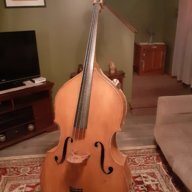
Oh, that is a beautiful Kay. I have two questions: What's with the chunk of wood wedged under the tailpiece?....And more importantly, how the heck did you get the bass to balance there in the middle of the room?

TalkBass has been independent since 1998. Add your voice.
Create a free account to reply to discussions, view embedded media, and browse with fewer display ads.
Join free Log in
Want zero display ads or expanded classifieds tools? Compare plans.
Oh, that is a beautiful Kay. I have two questions: What's with the chunk of wood wedged under the tailpiece?....And more importantly, how the heck did you get the bass to balance there in the middle of the room?

How does the Krivo sound with a bow? I've heard mixed reviews. Also does it pick up fingerboard noise halfway decent when playing slap?
I have a multi effects/modeling pedal, will one of the preamp and eq options on that work with a piezo?

I like the K&K Rockabilky preamps; but I’ve heard good things about the Shadow Preamp as well. Fishman makes one too; all are very good. My HPF is built into the AI Clarus head I run through now and it works very well. For years I cranked an Ampeg SVT wide open to play loud psychobilly with an Underwood pickup and I would sometimes have to deal with feedback issues. Nothing crazy, but annoying nevertheless. With the HPF, K&K rockabilly preamp and the built in HPF in the Clarus I have no problems whatsoever and I hang with a loud drummer and a guitarist who used to like his amps to go to 11.I think that's going to be the direction I am going to go, with maybe a magnetic in the future. Any suggestions for a blendable stereo preamp/buffer/eq?
I’ve played lots of shows with other rockabilly/psychobilly bands throughout the years and several of them taped the f-holes—one even filled up his upright bass with strips of mattress foam just to avoid feedback — can you imagine! I never saw the point in this as I was always able to keep feedback down to a minimum back then by EQ’ing out the problematic frequencies with my built in EQ on my SVT II head through an 810 cabinet; of course this was while using an Underwood pickup with no preamp back then. I used this setup for 20 years; but now with the HPF on my Clarus, Vic’s Model C Pickup and K&K Rockabilly preamp I don’t have those issues anymore. I’m very happy with my rig now and I wish there were shows I could go and play it on now.
I wouldn't normally plug my F-holes either, but there are situations where it makes sense for some players. It really depends on how loud you need to play and how far you are willing to go. If it came down to it, I would rather use custom plugs than gaff tape the F-holes, which is what some people resort too. I have actually seen it first hand with a very loud rock-a-billy band. The bass sounded great and was unbelievably loud.
I have never plugged the F-holes on an upright, but I have worked with sound hole plugs on acoustic guitars and ABGs and it made huge difference for the better. The instrument sounded more like it should with the plugs than without.
A magnetic pickup is not going to sound much like an acoustic bass anyway.
A high pass filter is not going to deal with the same frequency range that plugging the F-Holes will.

Oh yeah - the presence is killer — plus our guarantee went up by $100 as soon as I started playing UB.I imagine stuffing the bass and covering the f-holes compromises the true upright sound. I know a big part of having an upright in some bands, is the aesthetic. Who doesn't love to see someone thumping away on a doghouse?
I guess it's a balance between tone, volume, and convenience.
Your input is much appreciated.
I’ve played lots of shows with other rockabilly/psychobilly bands throughout the years and several of them taped the f-holes—one even filled up his upright bass with strips of mattress foam just to avoid feedback — can you imagine! I never saw the point in this as I was always able to keep feedback down to a minimum back then by EQ’ing out the problematic frequencies with my built in EQ on my SVT II head through an 810 cabinet; of course this was while using an Underwood pickup with no preamp back then. I used this setup for 20 years; but now with the HPF on my Clarus, Vic’s Model C Pickup and K&K Rockabilly preamp I don’t have those issues anymore. I’m very happy with my rig now and I wish there were shows I could go and play it on now.
I’ve never used magnetic pickups as I’ve always played gut strings or synthetics until recently. Some players love them. We opened for Lee Rocker’s Big Blue years ago and he has always used them. He said they never feedback and they amplify well. I didn’t particularly care for his tone slapping those Jargar steel strings he likes, but to each his own. His looked exactly like a P-Bass pickup setup, but he was playing more pizz with Big Blue and that actually sounded pretty good.
I can't imagine it getting any better than it already is! Yes, I am still going to take it in to get a clean bill of health.Oh yeah - the presence is killer — plus our guarantee went up by $100 as soon as I started playing UB.
Setup is key. Get a luthier to examine it and set it up properly with the strings, height and soundpost adjusted to make that Kay really sing. You’ll be very happy with it and they are so road worthy.
I just picked up this 42' Kay S-9,
I have had good luck tuning my bass with either a 31 band graphic or parametric EQ as well. The loudest environment I played in was big band and I never had any problems getting loud enough.
The guy I mentioned playing rock-a-billy was in a relatively small club and playing at a much higher stage volume than I have ever needed. Also the PA had four Cerwin Vega EL36 subs fairly close to the stage. I was actually surprised, if not amazed by how loud and tight the upright was. It was loud enough give you that feeling of chest pump when the bass and kick drum hit.
Taping or plugging the F-Holes:
I believe it does two thing. One it keeps high SPL sound from passing easily into the bass were it can bounce around and excite the bass's body in an unatural way. Keep in mind the basses body has several different resonant modes. For example the front and back plates are typically tuned to different frequency, and also you have the Helmhotz resonance (to name a few).
A hole on an enclosed volume forms a Helmholtz resonator with a specific tuned frequency. The F-holes are designed to reinforce the bass's acoustic response, but the Helmholtz resonance (or any resonance) can cause problems when you use an amp. When exposed to high SPL the bass's natural resonances tend to develop feedback loops with the amp and thus get amplified out of context. In other words the frequency response of the system made up of the bass, pickup, and amplifier change as you increase the gain.
This is where EQ can come in really handy. If a couple of notes become too resonant, you can dip those frequencies to put them back in context. Plugging or taping the F-holes stops or dampens the build up of unnatural resonance in the bass's body, so it's sort of a different way of solving the same problem.
The last upright bass I used professionally was a real cannon acoustically. It was a 7/8s instrument that was very resonant. One of my peers picked it out for the organization. It would have been great in the bass section of some symphony orchestra, but it was not well suited for our needs, because we typically used an amp.
The bass's resonant qualities that made it loud and powerful acoustical really degraded it's ability to work with an amp. Even with all of the EQ tricks I know, I could not get this bass to sound good through an amp. I did not have any trouble getting it loud enough for my needs, but it always had sort of a boxey quality due to resonance in the low mids. The resonance was broadband, so it was impossible to correct with EQ. Dip one frequency and and adjacent frequencies became problematic. Dip the entire frequency range and the sound had no power.
My understanding is the whole idea of Blast Cult upright is to make a bass that is highly reinforced so it doesn't resonate like a normal acoustic upright. This allows it to play at super loud volumes with less feedback problems.
Custom Upright, Electric Basses and Accessories | Blast Cult
Doesn't sound particularly great to me, but I would have to hear it in a loud mix to really judge it fairly.
On that model C, how is the balance between the fingerboard and bridge? Watching some videos (not necessarily that pickup), it seems as though the fingerboard slap is a little overwhelming.Vic's Pickups
^^yes^^
Going high volume, piezos are an easy answer that provides some level of control over feedback. Unfortunately they also have their own voicing, sort of electric sounding compared to what a DB sounds like acoustically, but the pre-amp and/or amp can also help get around that to a point.
I'm using a Vic's model C (bridge and fingerboard) and have been extremely pleased with it for both moderate and high -volume situations. But for lower volume and/or feeding into an FOH, I also have a mounted Sennheiser e604 dynamic mic that produces excellent tone and good mixing potential.
I also use these wirelessly by using wireless transmitters/receivers. I have two sets of these (Getaria 2.4GHz) so I can actually go wireless while using both my piezo system and my mounted mic. It is wonderful not having to worry about cables. Battery life is at least 3 hours; I've never run out of battery power while using them and routinely play for 3+ hours in sets.
Oh, and I don't cover my F-holes. Haven't needed to.
On that model C, how is the balance between the fingerboard and bridge? Watching some videos (not necessarily that pickup), it seems as though the fingerboard slap is a little overwhelming.
My Zoom MS-60B has an input impedance of 1 Mohm. I was thinking of using the Avalon U5 model setting (it has a high pass filter) along with the para or graphic EQ. Should I run the eq before or after the preamp?Check the spec sheet for the input impedance. It needs to be 1 Mohm or higher for most piezos. The primary EQ option to look for is a high pass filter (HPF) which helps a lot with feedback reduction. Other EQ needs are dependent on the freq response of the speakers and to a lesser extent any "baked in" freq response of the amp.