

Enjoy the benefits of a premium membership!
Upgrade Account
-
TalkBass has been independent since 1998. Add your voice.
Create a free account to reply to discussions, view embedded media, and browse with fewer display ads.
Join free Log in
Want zero display ads or expanded classifieds tools? Compare plans.
You are using an out of date browser. It may not display this or other websites correctly.
You should upgrade or use an alternative browser.
You should upgrade or use an alternative browser.
Pin Routers: The Old-School Production Workhorses
- Thread starter Bruce Johnson
- Start date
More options
Who Replied?

Bruce, a bit off topic, but if anyone would know this, it would be you.
Is the Fender headstock shape inspired by the side profile of the scroll bass?
I've been wondering that for a while. It seems obvious, but I've never heard anyone mention it.
View attachment 4269999
Yeah, that's way off the topic of this thread, and I really have no idea. I'm not very knowledgeable on Fender history or details about models. My Fender knowledge is about their truss rods.
Try asking over in the general Basses section.
I didn't want to start a big conversation about it or interrupt the flow of this thread. I thought maybe you'd know because of your experience with scroll basses and experience in general and I saw you were active so blurted it out in here without thinking. Sorry about that.Try asking over in the general Basses section.
More work on the Big Green Pin Router itself:
I mentioned above that, overall, the pin router and fixtures worked very well in that first run of the poplar AMB-2 body. One problem that I had was with the cutting depth not being accurate and consistent enough. It was close, but here and there, it would be off by 1/32" or 1/16". Not good enough for my Scroll Basses!
I looked over the whole depth stop mechanism and ran some tests on scrap. One thing I found is that I made a mistake in the design and machining of that big aluminum depth stop wheel. I machined it so that the 12 steps were flat surfaces. I was thinking that would be the best thing for the flat-bottomed stop to set down onto, right?
Here's how it was with the flat steps:
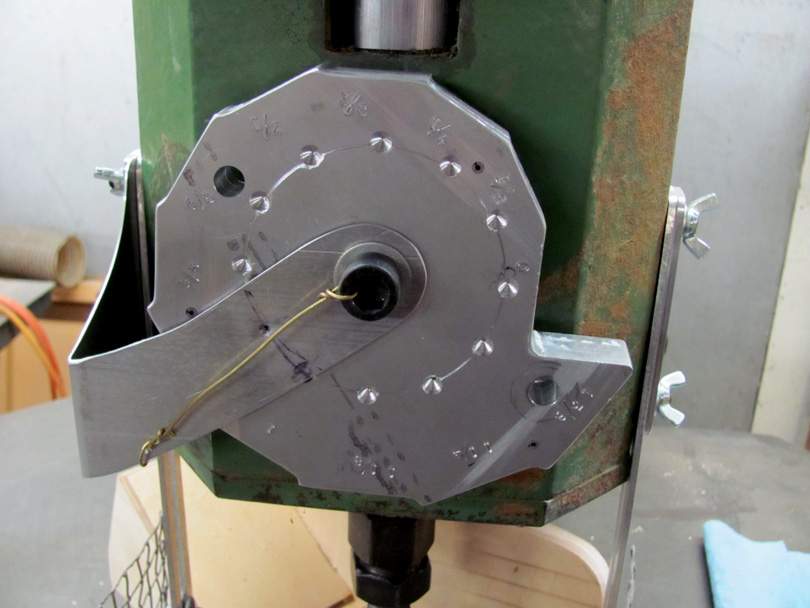
But what I found in using it, is that if the wheel wasn't positioned with the flat step right on horizontal, it would hold the spindle up a little higher, because of the slight angle between the step and the flat end of the stop. If I didn't get the wheel to the exact right position, it was causing errors. To compound the error, I found that the stop's centerline isn't actually lined up with the center axis of the wheel. This is in the fabrication of the machine.
I realized that the solution was to re-machine the wheel so that the steps are not flat, but follow a constant radius around the center pivot. That way, the angular position of the wheel isn't critical at all. The stop will always settle onto the radius of the step, the same radius.
I pulled the wheel off and set it back on the rotary table on the table of my green mill. I re-cut all the steps, this time cranking the rotary table through 30 degrees for each step. Now each step is a constant radius, and each step is 0.125" larger radius than the previous. It didn't take that long to make the change.
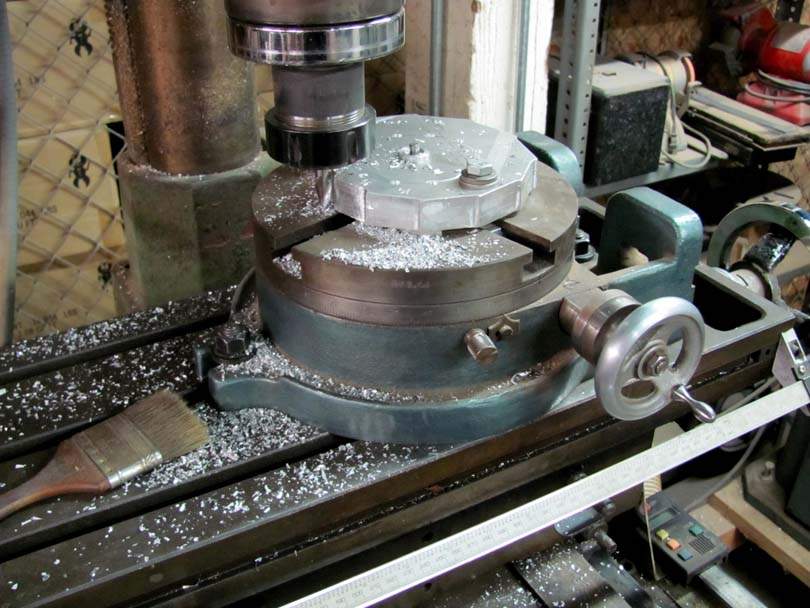
And here's the result. If you look close, you can see that the steps are now curved radiuses. This should be a big improvement in consistency and accuracy.
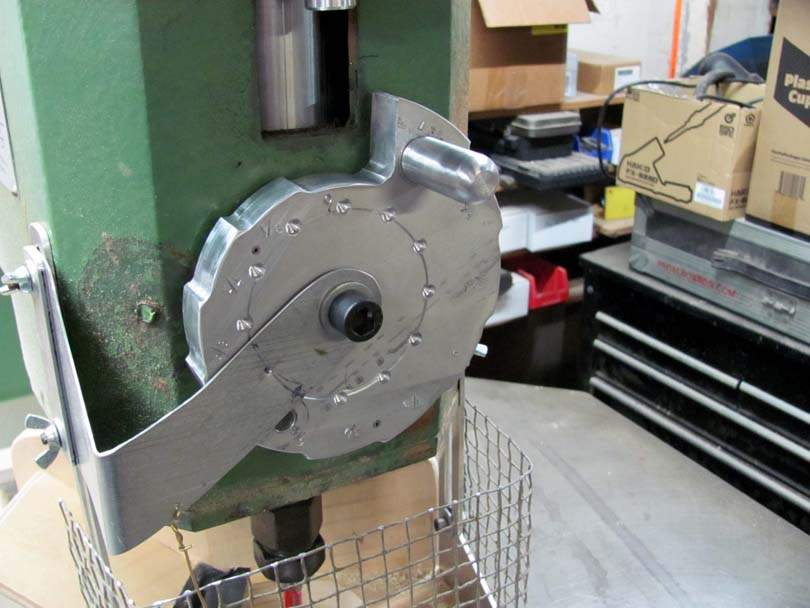
While I was at it, I made two other changes: I added that aluminum crank handle. I noticed when running it before, I was grabbing the whole wheel to turn it. Sooner or later, I was going to end up with a finger on the wrong step when the stop comes down! Ow! That stop comes down with maybe 200 lbs of weight on it! The crank handle keeps my fingers out of there.
I also made up a better center bushing for the wheel, because I noticed there was some deflection/slop when the stop pressed down on the wheel. I'm also going to make up a better detent clicker.
It looks good so far. Coming up, I'll be giving it a workout on a batch of walnut AMB-2M bodies.
I mentioned above that, overall, the pin router and fixtures worked very well in that first run of the poplar AMB-2 body. One problem that I had was with the cutting depth not being accurate and consistent enough. It was close, but here and there, it would be off by 1/32" or 1/16". Not good enough for my Scroll Basses!
I looked over the whole depth stop mechanism and ran some tests on scrap. One thing I found is that I made a mistake in the design and machining of that big aluminum depth stop wheel. I machined it so that the 12 steps were flat surfaces. I was thinking that would be the best thing for the flat-bottomed stop to set down onto, right?
Here's how it was with the flat steps:
But what I found in using it, is that if the wheel wasn't positioned with the flat step right on horizontal, it would hold the spindle up a little higher, because of the slight angle between the step and the flat end of the stop. If I didn't get the wheel to the exact right position, it was causing errors. To compound the error, I found that the stop's centerline isn't actually lined up with the center axis of the wheel. This is in the fabrication of the machine.
I realized that the solution was to re-machine the wheel so that the steps are not flat, but follow a constant radius around the center pivot. That way, the angular position of the wheel isn't critical at all. The stop will always settle onto the radius of the step, the same radius.
I pulled the wheel off and set it back on the rotary table on the table of my green mill. I re-cut all the steps, this time cranking the rotary table through 30 degrees for each step. Now each step is a constant radius, and each step is 0.125" larger radius than the previous. It didn't take that long to make the change.
And here's the result. If you look close, you can see that the steps are now curved radiuses. This should be a big improvement in consistency and accuracy.
While I was at it, I made two other changes: I added that aluminum crank handle. I noticed when running it before, I was grabbing the whole wheel to turn it. Sooner or later, I was going to end up with a finger on the wrong step when the stop comes down! Ow! That stop comes down with maybe 200 lbs of weight on it! The crank handle keeps my fingers out of there.
I also made up a better center bushing for the wheel, because I noticed there was some deflection/slop when the stop pressed down on the wheel. I'm also going to make up a better detent clicker.
It looks good so far. Coming up, I'll be giving it a workout on a batch of walnut AMB-2M bodies.


Yeah @Bruce Johnson I'm all for keeping fingers clear of big heavy things with lots of force! 
Great job on correcting the issues. I mean, great job on finding the issue too!
Agreed @Matt Liebenau tool gas is a thing! I found myself staring at a used planer all weekend. I don't really need it, but I'd love to have it!
Great job on correcting the issues. I mean, great job on finding the issue too!
Agreed @Matt Liebenau tool gas is a thing! I found myself staring at a used planer all weekend. I don't really need it, but I'd love to have it!
Yes, Tool GAS can be a serious problem because it's self-generating. It's relatively easy to justify why you need a pin router. To build basses faster, obviously! But, then how are you going to make up a depth stop wheel for the pin router, unless you also have a metal lathe, milling machine, and rotary table? About 76.5% of my machines don't actually build bass parts. I have them because I need them to build, modify and repair the machines that build the basses. I often discover ways to use them making bass parts, but the reason I acquired them originally was to build machines. And fixtures and tools.
Large Machine Tool GAS is usually limited by tonnage and square footage. And electrical power service. You've got to recognize your limits. Small Tool GAS is very difficult to keep under control. Warning signs are being unable to remember if you already have one of those, and where it might be in your shop. If that happens, you need to take a break and methodically go through all of your tool boxes and cabinets, looking at every single tool you own to refresh your memory. I do that periodically to keep the Small Tool GAS to a tolerable level.
Large Machine Tool GAS is usually limited by tonnage and square footage. And electrical power service. You've got to recognize your limits. Small Tool GAS is very difficult to keep under control. Warning signs are being unable to remember if you already have one of those, and where it might be in your shop. If that happens, you need to take a break and methodically go through all of your tool boxes and cabinets, looking at every single tool you own to refresh your memory. I do that periodically to keep the Small Tool GAS to a tolerable level.

If you don't have some tool it's like you're without it. There's no task small enough where a specific tool could be justified.

There's an identical Big Green Pin Router to yours Bruce going in my area for a steal right now, under the Cassidie brand name.
I have no way of transporting it, nowhere to install it (it would fill two thirds of my shop), no 3 phase power, and no air system to run it. It's hilariously bigger than any other tool I own, and it would most likely take another few years of developing my own skills before I had a realistic shot of doing useful work on it.
However, somehow, the temptation to buy it lingers...tool GAS is just like that I guess...
I have no way of transporting it, nowhere to install it (it would fill two thirds of my shop), no 3 phase power, and no air system to run it. It's hilariously bigger than any other tool I own, and it would most likely take another few years of developing my own skills before I had a realistic shot of doing useful work on it.
However, somehow, the temptation to buy it lingers...tool GAS is just like that I guess...

The house I sold last year had a ground-level garage/workshop space that was ~1,900 sq. ft. When I bought it in 2009, I had plans to outfit it as a complete guitar-building workshop. Unfortunately (fortunately?), early on I discovered that I have skin and respiratory allergies that prevent me from working around sawdust and solvents in anything more than a very limited capacity. We sold that house late last year and downsized, so it's probably all for the best.

Based on all that, it sounds like it's a must-have item.There's an identical Big Green Pin Router to yours Bruce going in my area for a steal right now, under the Cassidie brand name.
I have no way of transporting it, nowhere to install it (it would fill two thirds of my shop), no 3 phase power, and no air system to run it. It's hilariously bigger than any other tool I own, and it would most likely take another few years of developing my own skills before I had a realistic shot of doing useful work on it.
However, somehow, the temptation to buy it lingers...tool GAS is just like that I guess...

There's an identical Big Green Pin Router to yours Bruce going in my area for a steal right now, under the Cassidie brand name.
I have no way of transporting it, nowhere to install it (it would fill two thirds of my shop), no 3 phase power, and no air system to run it. It's hilariously bigger than any other tool I own, and it would most likely take another few years of developing my own skills before I had a realistic shot of doing useful work on it.
However, somehow, the temptation to buy it lingers...tool GAS is just like that I guess...
Aw, come on, those are weak excuses...
 Solvable problems. You know you need it.
I hadn't heard that Cassidie brand name before. Mine is ITTM brand. I'm pretty sure it was made in Italy, because all of the smaller name plates and internal info plates are in Italian. There are probably many more of them around Europe than there are here in the US.

Yeah a lot of heavy duty woodworking machines over here seem to originate in Italy. Our huge wide belt sander, our 4-sider and our beam saw are all Italian made.
It's a Precious, we needs it...Yeah @Bruce Johnson I'm all for keeping fingers clear of big heavy things with lots of force!
Great job on correcting the issues. I mean, great job on finding the issue too!
Agreed @Matt Liebenau tool gas is a thing! I found myself staring at a used planer all weekend. I don't really need it, but I'd love to have it!
Best way to find a "lost tool?" Buy a replacement. Caveat, said lost tool won't show up until you mung up the replacement.Yes, Tool GAS can be a serious problem because it's self-generating. It's relatively easy to justify why you need a pin router. To build basses faster, obviously! But, then how are you going to make up a depth stop wheel for the pin router, unless you also have a metal lathe, milling machine, and rotary table? About 76.5% of my machines don't actually build bass parts. I have them because I need them to build, modify and repair the machines that build the basses. I often discover ways to use them making bass parts, but the reason I acquired them originally was to build machines. And fixtures and tools.
Large Machine Tool GAS is usually limited by tonnage and square footage. And electrical power service. You've got to recognize your limits. Small Tool GAS is very difficult to keep under control. Warning signs are being unable to remember if you already have one of those, and where it might be in your shop. If that happens, you need to take a break and methodically go through all of your tool boxes and cabinets, looking at every single tool you own to refresh your memory. I do that periodically to keep the Small Tool GAS to a tolerable level.
Ya know why your skills are not up to using a pin router? It's 'cause you don't have one!There's an identical Big Green Pin Router to yours Bruce going in my area for a steal right now, under the Cassidie brand name.
I have no way of transporting it, nowhere to install it (it would fill two thirds of my shop), no 3 phase power, and no air system to run it. It's hilariously bigger than any other tool I own, and it would most likely take another few years of developing my own skills before I had a realistic shot of doing useful work on it.
However, somehow, the temptation to buy it lingers...tool GAS is just like that I guess...
Yeah, that's true. My whole point with this thread is to show you guys my own experience with learning how to use pin routers. Prior to 2019, I didn't know much about pin routers. I had been doing maintenance and repairs on the Big Green Machine when Mike owned it, so I was basically familiar with the machine. But I had hardly ever run it. It was, honestly, intimidating. And I hadn't spent any time figuring out the tooling to make it work for my needs. I had watched Mike run it, but I wasn't really sure how much value it would be to me, to my Scroll bass production.
Then Mike died, and suddenly the Big Green Machine was mine. Or maybe I now belong to it? So, I made the conscious decision to learn how to use it. To figure out what it can do, and how to put it to work helping me build Scroll Basses. Efficiently and safely.
And that's what I'm doing. I'm getting more comfortable running it. And I'm seeing that, with good tooling and setup, this beast can really crank out wood parts. Soon, I'll be wondering how I ever built basses all those years without a pin router.
I remember years ago, visiting Rick Turner's shop. He had a huge pin router back in a separate room, and some poor guy running it most of the day. You could hear the thing running from Rick's office. I remember him telling me that the sound of that machine was his overall gauge of how his guitar factory was running. When he could hear it running, that meant that the factory was running smoothly. Parts were flowing in and out of the pin router, and guitars were being built. When it went quiet, it meant that there was a hangup in production that had to be fixed.
Historical note: For a long time, the poor guy running Rick's pin router was....Rob Allen.
Then Mike died, and suddenly the Big Green Machine was mine. Or maybe I now belong to it? So, I made the conscious decision to learn how to use it. To figure out what it can do, and how to put it to work helping me build Scroll Basses. Efficiently and safely.
And that's what I'm doing. I'm getting more comfortable running it. And I'm seeing that, with good tooling and setup, this beast can really crank out wood parts. Soon, I'll be wondering how I ever built basses all those years without a pin router.
I remember years ago, visiting Rick Turner's shop. He had a huge pin router back in a separate room, and some poor guy running it most of the day. You could hear the thing running from Rick's office. I remember him telling me that the sound of that machine was his overall gauge of how his guitar factory was running. When he could hear it running, that meant that the factory was running smoothly. Parts were flowing in and out of the pin router, and guitars were being built. When it went quiet, it meant that there was a hangup in production that had to be fixed.
Historical note: For a long time, the poor guy running Rick's pin router was....Rob Allen.
I watch a lot of videos from Texas Toast Guitars, partly because Matt makes me laugh, partly because there's a bit of usable info there. It's YouTube, most of it is geared to generate clicks, you have to keep that in mind. But you can pick up some nuggets along the way. My point was.....Matt uses a big pin router for all of his big bulk stuff with body cavities, neck pocket and so on. He's also spent a lot of time creating templates and jigs to do all that, but it really shows off what can be done with them.
Some more refinements to the depth stop mechanism on the Big Green Machine:
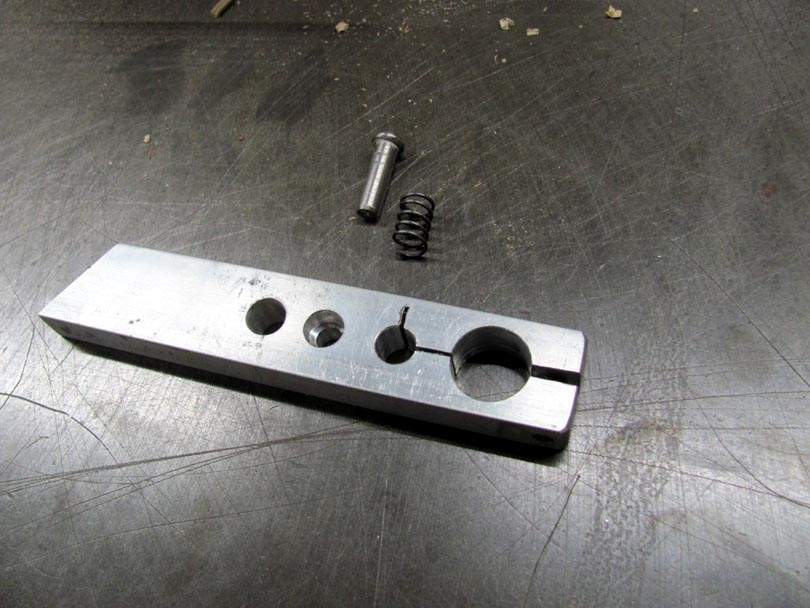
The previous detent clicker for the depth stop wheel sorta worked, but not very well. So I made a new one, much better and more positive. I machined up a little button head on a shaft from stainless to be the detent that clicks into the holes in the front face of the wheel. A spring goes behind it, in an aluminum arm that clamps onto the head of the center bolt of the wheel. There's a 10-32 socket head screw to tighten the clamping.
And a simple aluminum bracket to support the bar up at at an angle. The reason I positioned it up at that angle is so that it doesn't block access to that grease fitting.
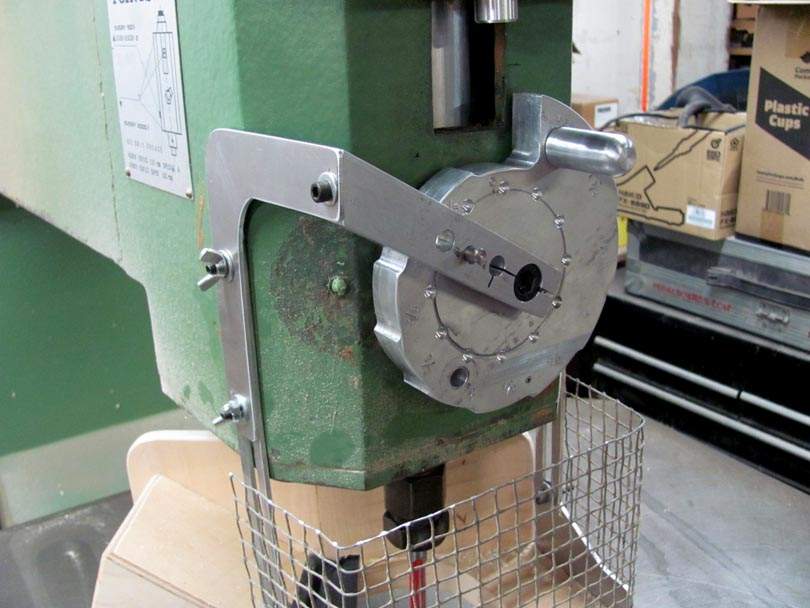
Okay, that looks neater, and now it clicks solidly from one position to the next, and stays in place. Ready for testing on the upcoming run of walnut AMB-2M bodies!
The previous detent clicker for the depth stop wheel sorta worked, but not very well. So I made a new one, much better and more positive. I machined up a little button head on a shaft from stainless to be the detent that clicks into the holes in the front face of the wheel. A spring goes behind it, in an aluminum arm that clamps onto the head of the center bolt of the wheel. There's a 10-32 socket head screw to tighten the clamping.
And a simple aluminum bracket to support the bar up at at an angle. The reason I positioned it up at that angle is so that it doesn't block access to that grease fitting.
Okay, that looks neater, and now it clicks solidly from one position to the next, and stays in place. Ready for testing on the upcoming run of walnut AMB-2M bodies!


