HI to all i have a PJ bass /and lost on how to wire a missing broken switch /it has 1 vol/ then the bypass switch then i think a pot what blends both pickups then a treble pot/ the bass i think is a early yamaha / put some photos on/ they are mini pots/ and don't know what the switch did i don't mind just having 2 vol pots/ and a balance pot and the treble but don't know how to wire this setup tried lots of sites but no luck any help out there the input jack is on the edge of the bass

Enjoy the benefits of a premium membership!
Upgrade Account
-
TalkBass has been independent since 1998. Add your voice.
Create a free account to reply to discussions, view embedded media, and browse with fewer display ads.
Join free Log in
Want zero display ads or expanded classifieds tools? Compare plans.
You are using an out of date browser. It may not display this or other websites correctly.
You should upgrade or use an alternative browser.
You should upgrade or use an alternative browser.
PJ bass guitar wiring
- Thread starter just paul
- Start date
More options
Who Replied?


The switch was a pickup selector switch, but the switch you have pictured won't work for that purpose.
I suggest a balance (pickup selector), master volume, master tone setup.
Wiring Diagrams
I suggest a balance (pickup selector), master volume, master tone setup.
Wiring Diagrams
hi that's the switch what was in the bass but it had been bypassed would like to upgrade but not sure how to wire it what switch could i put back thanks for the replyThe switch was a pickup selector switch, but the switch you have pictured won't work for that purpose.
I suggest a balance (pickup selector), master volume, master tone setup.
Wiring Diagrams

You may or may not be able to drop in full size 25mm pots without a little cavity work, not a big deal if so, there is plenty of room.
What I did on my P/J:
500K linear taper Volume, 250K Balance (M/N taper, ungrounded), 500K audio taper tone with .047uF cap. My tone control has a DPDT push/pull to configure the P pickup in either series or parallel. Series gives you the strong, traditional P tone, parallel gives a brighter J tone to the pickup. Makes a P/J more versatile.
Here's the main diagram,

Then wire the P pickup to the new switch like this (if possible)
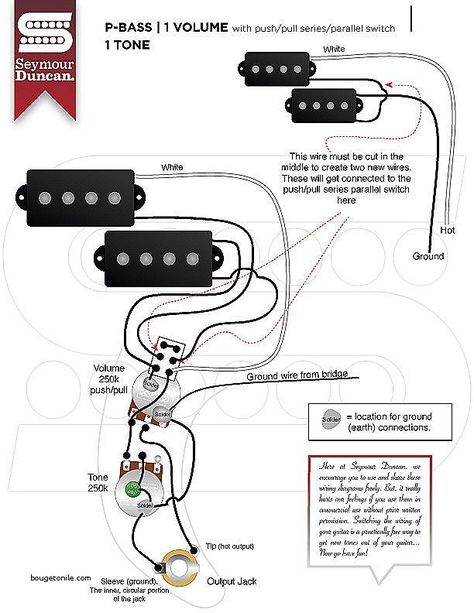
You could also just wire it V-V-T- series/parallel switch.
TBH, there is not a whole lot of solid reasons to have dual volumes (or volume and balance) and a pickup switch on basses, unless your playing and tonal style requires it. Seems most players prefer a blendable vs switchable format for bass tones.
I like active electronics and would be tempted to wire this bass Vol-PU Switch (or Blend knob)-Bass-Treble.
What I did on my P/J:
500K linear taper Volume, 250K Balance (M/N taper, ungrounded), 500K audio taper tone with .047uF cap. My tone control has a DPDT push/pull to configure the P pickup in either series or parallel. Series gives you the strong, traditional P tone, parallel gives a brighter J tone to the pickup. Makes a P/J more versatile.
Here's the main diagram,
Then wire the P pickup to the new switch like this (if possible)
You could also just wire it V-V-T- series/parallel switch.
TBH, there is not a whole lot of solid reasons to have dual volumes (or volume and balance) and a pickup switch on basses, unless your playing and tonal style requires it. Seems most players prefer a blendable vs switchable format for bass tones.
I like active electronics and would be tempted to wire this bass Vol-PU Switch (or Blend knob)-Bass-Treble.
This is for electric guitar, but basses are wired the same. I recommend 250 k Ohm audio taper pots for volume, and one 250 k Ohm linear taper pot for tone. The pickup switch is a short Les-Paul type switch, you'll have to buy that from a music store or a place that sells guitar & bass electronics.
Wiring Diagrams
Wiring Diagrams
The opposite works better for bass.I recommend 250 k Ohm audio taper pots for volume, and one 250 k Ohm linear taper pot for tone.
Wiring Diagrams
Linear/B taper tone controls focus pretty much all of the usable tone sweep in the bottom 2 numbers of the control. It almost works like an on/off switch--pretty much no change in tone until you get around 3 and it starts to darken, then it goes to full on resonant bump and out at 1-2.
Audio/A taper pots give a wider and finer range of use for tone controls-it starts to slowly roll off around 8, gets darker around 4 and gets the resonant bump around 2.
The opposite is true with volume pots. Linear volumes have a wider and finer range of use. This is especially useful in a Vol-Vol set up and precise blending is the goal. With audio taper pots on a two pickup bass, with one pickup on 10, the other pot is pretty much out of the blend around 7-8 on the knob. Linear pots extend that usable range down to around 4-5.
Fender traditionally used all audio tapers in both positions and many hold that to be gospel. I feel that is more a result of trying to keep less parts on hand (you order one vs two types of pots) to simplify production. In my (and many other's) experiences, linear taper volumes are great, especially if you play clean to lightly gritty-which is mostly where the bass lives. Audio taper is nice for cleaning up really dirty tones with the volume control, which is more common with the guitar. .


I'm going to go against what the original arrangement was and suggest that regardless of what you do with the rest of the options, have two volumes. Especially with different pickups like in a P/J the ability to run one pickup full on and have the full range of the other pickup available to flavor to taste is very useful. A sweep knob limits you to one line of ratios, where as two tones gives you far more flexibility.
Thus, a V/V/T would be my suggestion for the first three holes. For the last hole, it's up to you, a second tone (one for each pickup), pickup selector switch, Series/parallel switch or even a kill swtich, would be fine options.
Thus, a V/V/T would be my suggestion for the first three holes. For the last hole, it's up to you, a second tone (one for each pickup), pickup selector switch, Series/parallel switch or even a kill swtich, would be fine options.

- Apr 18, 2008
- 16,024
- 1
- 31,754
- Disclosures
- I'm highly opinionated and extremely self-assured
I'm going to go against what the original arrangement was and suggest that regardless of what you do with the rest of the options, have two volumes. Especially with different pickups like in a P/J the ability to run one pickup full on and have the full range of the other pickup available to flavor to taste is very useful. A sweep knob limits you to one line of ratios, where as two tones gives you far more flexibility.
I'm not sure what you mean, but if you mean what I think you mean, then you're only correct if using an A/C taper blend. An M/N taper blend does indeed let you have "one pickup full on and have the full range of the other pickup".

that sounds good a pickup selector switch that's what might have been there as you can see on second hole but i need simple drawing of the wiring / i am a novice and had lots of nice people trying to help except one guy going on about my spelling sad ?/ well it would be 2 vol / 1 pickup selector/ 1 tone / what pickup selector do i need is it a short 3 way toggle switch and if anyone can give me a simple drawing of all the connections that would be great and don't forget i am not a tec guy i would like to than everyone for there help
right guys
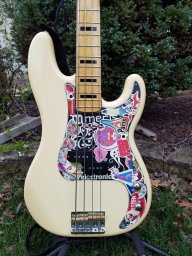
just had another look at the controls on the bass/ the first is a vol/ the hole was were that switch was/ the 3rd seems to leave the p pickups on/ when turned to the off position / when that pot is turned up it brings the jazz pick up into play blending it with p pickup but you can not turn the p pickup of / so maybe the switch turned the p pickup /of does anyone know how to bring a new switch back into play it was by passed looks like 2 wires have been joined together so how do mi wire a new switch in place put photo of old switch on
just had another look at the controls on the bass/ the first is a vol/ the hole was were that switch was/ the 3rd seems to leave the p pickups on/ when turned to the off position / when that pot is turned up it brings the jazz pick up into play blending it with p pickup but you can not turn the p pickup of / so maybe the switch turned the p pickup /of does anyone know how to bring a new switch back into play it was by passed looks like 2 wires have been joined together so how do mi wire a new switch in place put photo of old switch on
Attachments


FWIW those Seymour duncan diagrams are about as simple as it gets for a non schematic drawing. If you're uncomfortable with a soldering iron, just bring it to a tech and tell them what you want. Shouldn't be that expensive and It'll save you many hours of frustration when you have hum, or something doesn't work, etc. as well as all the pots you might burn in the process lol.
Ah yes, but then you're still locked into one limited curve.I'm not sure what you mean, but if you mean what I think you mean, then you're only correct if using an A/C taper blend. An M/N taper blend does indeed let you have "one pickup full on and have the full range of the other pickup".
What if you find one pickup works best slightly dimmed but you want full range of possibility from the other? Sorry, not going to happen with a blend knob.
Let me be clear that a blend knob usually works good enough and it is easy to use. However it will ALWAYS limit you to a small fraction of the possible pickup level combinations compared to two volumes.
Last edited:

^^^ This ^^I'd just forget about how it used to be wired and figure out how YOU want the controls to work, then ask about how to wire it like that...
Especially as it seems like it's a lot of just guessing at "how it used to be" at this point..
T$
Trying again. Two pickups, two volumes, pickup selector switch, master tone control:
It's an Adobe Acrobat file, you need to have Adobe reader installed to see it.
https://docs.google.com/gview?embedded=true&url=https://www.seymourduncan.com/wp-content/uploads/2016/05/2H_3G_2V_1T.pdf
It's an Adobe Acrobat file, you need to have Adobe reader installed to see it.
https://docs.google.com/gview?embedded=true&url=https://www.seymourduncan.com/wp-content/uploads/2016/05/2H_3G_2V_1T.pdf


