
Enjoy the benefits of a premium membership!
Upgrade Account
-
TalkBass has been independent since 1998. Add your voice.
Create a free account to reply to discussions, view embedded media, and browse with fewer display ads.
Join free Log in
Want zero display ads or expanded classifieds tools? Compare plans.
You are using an out of date browser. It may not display this or other websites correctly.
You should upgrade or use an alternative browser.
You should upgrade or use an alternative browser.
PJ basses. Are they wired in series or parallel?
- Thread starter ics1974
- Start date
More options
Who Replied?



You’re talking about 2 different parts of the system. The 2 halves of the P pickup are wired in series, typically. On most basses the P and the J pickup are wired in parallel with each other.

- Apr 18, 2008
- 16,016
- 1
- 31,730
- Disclosures
- I'm highly opinionated and extremely self-assured
You’re talking about 2 different parts of the system. The 2 halves of the P pickup are wired in series, typically. On most basses the P and the J pickup are wired in parallel with each other.
Exactly. The two halves of a P pickup are wired in series, forming one complete pickup. There is no second pickup on a normal P bass.
The usual way of wiring two (or more) pickups is to connect them in parallel. This includes PJ basses, which typically connect one series-wired P pickup with one single-coil J pickup in parallel.
These are not hard and fast rules though. You can wire these things any way you like. But the usual circuits are the most popular because they work well for the majority of players.

FullumMusic
Commercial User
- Oct 13, 2022
- 2,010
- 5,688
- Disclosures
- Audio/Music software developer, contracted with a company you've heard of and deving my own stuff.
Restating what was already said, a P pickup is in series with itself: ie: The two halves are wired in series to create one pickup. There's no other pickup for it to be in series with or parallel to.
Jazz basses have two separate single-coil pickups and are usually wired parallel to one another.
Different manufacturers will of course do things different ways, but i'll risk saying most of the time (not all) PJs are wired with the P pickup and J pickup parallel to each other. (Understanding the P part of the circuit is in series with itself so the two halves are acting as a single P pickup.)
This isn't a hard & fast rule. You will find some basses wired from the factory, or customized to have the P and J in series. Some will have a Series/Parallel switch. But in general, most of the time, PJs are parallel.
Jazz basses have two separate single-coil pickups and are usually wired parallel to one another.
Different manufacturers will of course do things different ways, but i'll risk saying most of the time (not all) PJs are wired with the P pickup and J pickup parallel to each other. (Understanding the P part of the circuit is in series with itself so the two halves are acting as a single P pickup.)
This isn't a hard & fast rule. You will find some basses wired from the factory, or customized to have the P and J in series. Some will have a Series/Parallel switch. But in general, most of the time, PJs are parallel.
Last edited:


I read Jazz basses are typically wired in parallel and P basses are typically wired in series. What about a PJ bass. How are they wired?
My MIJ Fender Jazz Bass Special 1984 is a PJ that was wired in series. It had a 3 way switch and on the P+J position, you have to have both pickups' volumes open or there would be no sound. It has to be open even just a tad.
I prefer parallel sound myself. I upgraded to EMG Geezer Butler PJ set and much happier. The Geezer P has a beefier sound by itself and I think it would be overwhelming if they are in series. My Pedulla Buzz is also PJ and wired parallel with Bartolini preamp and pickups. It also has a 3 way switch. The beef is achieve by boosting the bass EQ a bit.

This^ then for passive basses the entire bass is V-V-T, with the P-pickup on one volume, the J-bridge pickup on the other volume, and a master tone control.You’re talking about 2 different parts of the system. The 2 halves of the P pickup are wired in series, typically. On most basses the P and the J pickup are wired in parallel with each other.

I read Jazz basses are typically wired in parallel and P basses are typically wired in series. What about a PJ bass. How are they wired?
The two halves of a P bass pickup are usually (not always*) wired in series with each other.
The typical PJ has the aforementioned P pickup (where the halves are wired in series with each other) and a J pickup, which are, when both are on, in parallel with each other.
*If you want the absolute quietest P bass in an electrostatic field, parallel wiring the halves (and capacitively loading tje result) is part of getting a bit more signal to noise (and more tonal flexibility) out of a P pickup. That, however takes a bit more time to do (time = money), and for a lot of production P's, any little thing that adds cost is not done.

So, you can blend 2 pickups that are wired in series?My MIJ Fender Jazz Bass Special 1984 is a PJ that was wired in series
(asking for a friend)
So, you can blend 2 pickups that are wired in series?
(asking for a friend)
Honestly I forgot now even though I have owned this bass for over 2 decades. Actually I do - You can't blend them, The J volume is useless until you closed it - it acted as an on-off in the P+J. And those were probably the first fender big pole pickups as well, a lot of output and on top of that they put a TBX tone pot, which boosted treble from past 5 to 10 (not the same as an active treble boost - it was not as refined putting it mildly). I like how it is setup know with EMG GZR PJ + their passive controls.
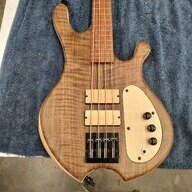

One can wire the pickups however they like. Usually the J basses have two single coils in parallel. The P pickup is a split coil one wired in series, and the J on a PJ is usually a single coil. The P and the J of a PJ is usually wired in parallel.

The Godin Classic Shifter 4 allowed you to set the two pickups in series or in parallel.
Godin Shifter Classic 4 Bass Review
Godin Shifter Classic 4 Bass Review

JeezyMcNuggles
Inactive
- Feb 23, 2018
- 14,723
- 20,970
- Disclosures
- I suck, but nobody really notices
P basses only have one pickup.I read Jazz basses are typically wired in parallel and P basses are typically wired in series. What about a PJ bass. How are they wired?
Pj basses, along with every other two pickup bass, are wired in parallel.
JeezyMcNuggles
Inactive
- Feb 23, 2018
- 14,723
- 20,970
- Disclosures
- I suck, but nobody really notices
It makes it quiet and frailThe two halves of a P bass pickup are usually (not always*) wired in series with each other.
The typical PJ has the aforementioned P pickup (where the halves are wired in series with each other) and a J pickup, which are, when both are on, in parallel with each other.
*If you want the absolute quietest P bass in an electrostatic field, parallel wiring the halves (and capacitively loading tje result) is part of getting a bit more signal to noise (and more tonal flexibility) out of a P pickup. That, however takes a bit more time to do (time = money), and for a lot of production P's, any little thing that adds cost is not done.
It makes it quiet and frail
If you don’t do anything more than wire it in parallel, and you don’t understand capacitive loading, yes, you might come to that conclusion. If you understand a bit more, though, there is a spectrum of possibilities opened up by parallel wiring- every sound you can get with series wiring, and a bunch that you can’t.

Apart from (at least) Danelectros, which are wired in series.P basses only have one pickup.
Pj basses, along with every other two pickup bass, are wired in parallel.
I have one almost like this, exactly the same color, black burst but with « rosewood » neck.The Godin Classic Shifter 4 allowed you to set the two pickups in series or in parallel.
Godin Shifter Classic 4 Bass Review
Last edited:


