• TalkBass has been independent since 1998. Add your voice.
    Create a free account to reply to discussions, view embedded media, and browse with fewer display ads.
    Join freeLog in
    Want zero display ads or expanded classifieds tools? Compare plans.

Plans/Schematics on building bass cabinets.

There are a lot of DIY bass cabinet threads and after looking through them, I have learned a lot of really interesting things about voicings, tones, sealed, ported etc.. about cabinets. I would really like to make some various-size bass cabinets with my son for their woodshop project but would like to see if anyone has plans for a build. Looking at all different sizes from 2x10, 4x10, 2x15, 4x15, 6x10, 1x5/4x10, etc...(any and all variations) Do you have plans that you're willing to share or know where to access plans that would help to get us started?

Thank You!
The Thiele-Small parameters of the driver (with some of Martin King's math, if you can handle it) will determine the theoretical optimum size/dimensions of the cab. After that materials, bracing, lining, stuffing, etc. are a matter of experience, trial and error, and taste.

IOW to make a really great sounding cab gets complicated.
 
There are a lot of DIY bass cabinet threads and after looking through them, I have learned a lot of really interesting things about voicings, tones, sealed, ported etc.. about cabinets. I would really like to make some various-size bass cabinets with my son for their woodshop project but would like to see if anyone has plans for a build. Looking at all different sizes from 2x10, 4x10, 2x15, 4x15, 6x10, 1x5/4x10, etc...(any and all variations) Do you have plans that you're willing to share or know where to access plans that would help to get us started?

Thank You!

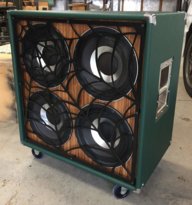
I built my own cabs ... three 2x10s, two 1x15, and one 1x18 ... I looked at a lot of cabs and reverse engineered cabs that would fit in the vehicle I had at the time. If I had to do it now I would make the cabs a few inches deeper.

The cab with the horn actually makes a really good pa speaker (the 1x18 and one of the 2x10s is not shown)


upload_2022-2-19_8-36-27.jpeg
 
  • Like
Reactions: Giraffe
After re-reading the OP, I'll add that I think the first project should NOT be something big like a 410, 610 or 415. I'm considering the initial driver investment, but also thinking that the likelihood of making a construction mistake is higher on the first build and that's a strategy for minimizing the impact of that. Everyone's end goal is different, but I'd build a 210 or two 115s because that's what I'd find more useful for my purposes; obviously YMMV. I'm just suggesting keeping it fairly simple for your first build together...there is something of a learning curve to be experienced. But good luck with it... it sounds like a worthwhile project.
 
Last edited:
The BFM designs tend to favor low end extension, efficiency, and cost at the expense of size. Nothing wrong with that formula as long as it suits the user's purposes. They can be challenging and worthwhile woodworking projects. Here's a Jack 10 in progress.

hMfZcHK.jpg


945ZC8y.jpg


Not a simple box! This cabinet, if I ever finish it, operates as a bass reflex up to about 400 Hz, then as a horn loaded cabinet up to the crossover point (which I will figure out when I get there, by measuring different devices), at which point a line array (this is my contribution to the design) will take it up to a hi-fi response if you want. It is like a study in speaker building and design. It is also a PITA of a build. Did I mention it has to be airtight?!?!

266INWb.jpg


zkCwpHu.jpg


BFM supplies terrific plans that don't just walk you through the build, they explain the theory and reasons for why we are doing it this way. I learned half of what I know about speakers from Bill when he used to participate in this site.

The fEarful design is more mainstream in its approach, favoring a flat response (which means a rock solid bottom with good low and high extension) over cost, in an average sized box with average efficiency. The cab is a simple, lightly braced box, with a simple shelf port that works great for electric bass and other instruments. There is nothing wrong with simple in this case

The woodworking element is basic, maybe to the point of being useless as a project with your son, but the results will be a very well-designed cab that should sound excellent. You do have to wire up the crossover, which is a good learning exercise!

Have fun! It's not hard to have a very successful first DIY cab build!
 
Last edited:
  • Like
Reactions: fuzzer and wcriley
The BFM designs tend to favor low end extension, efficiency, and cost at the expense of size. Nothing wrong with that formula as long as it suits the user's purposes. They can be challenging and worthwhile woodworking projects. Here's a Jack 10 in progress.

View attachment 4591830

View attachment 4591832

Not a simple box! This cabinet, if I ever finish it, operates as a bass reflex up to about 400 Hz, then as a horn loaded cabinet up to the crossover point (which I will figure out when I get there, by measuring different devices), at which point a line array (this is my contribution to the design) will take it up to a hi-fi response if you want. It is like a study in speaker building and design. It is also a PITA of a build. Did I mention it has to be airtight?!?!

View attachment 4591834

View attachment 4591835

BFM supplies terrific plans that don't just walk you through the build, they explain the theory and reasons for why we are doing it this way. I learned half of what I know about speakers from Bill when he used to participate in this site.

The fEarful design is more mainstream in its approach, favoring a flat response (which means a rock solid bottom with good low and high extension) over cost, in an average sized box with average efficiency. The cab is a simple, lightly braced box, with a simple shelf port that works great for electric bass and other instruments. There is nothing wrong with simple in this case

The woodworking element is basic, maybe to the point of being useless as a project with your son, but the results will be a very well-designed cab that should sound excellent. You do have to wire up the crossover, which is a good learning exercise!

Have fun! It's not hard to have a very successful first DIY cab build!
What is keeping you from completing the cabinet?
 
  • Like
Reactions: Giraffe
What is keeping you from completing the cabinet?

That is a reasonable question!

Part of the problem is I have too many projects going at once.

The build reached the stage where I had to complete the line array before proceeding. Since the line array was my idea, I had to select the drivers, design it and figure out how to execute it. This was my first time working with sewer pipe and line arrays, so it took some figuring.

It is moving along. Another month, at the current snail's pace!
 
The number one rule for having any success is to copy one that does what you want it to.
Exactly, I want to build a BBC Tank 1015. I’m a much better woodworker than bass player. I find it difficult to believe that one who is can’t produce a copy at half the cost without scrimping on components.

BTW Wouldn't consider building if I could save the cost of the middleman by buying direct. Just don’t have an ass-pocket full of $. Heck I would gladly pay them for a design for my personal use. They are entitled to profit on their work but don’t feel the same for a retailer.
 
Last edited:
Exactly, I want to build a BBC Tank 1015. I’m a much better woodworker than bass player. I find it difficult to believe that one who is can’t produce a copy at half the cost without scrimping on components...

I find it easy to believe! The woodworking and the wooden box are the least expensive components, so building the box is not going to save you as much as you think.

Those Faital drivers are not cheap, and you may not be able to get the same drivers used in the Tank since many builders use proprietary drivers. I would be very circumspect about knocking that one off, because anyone who even claims to be achieving that much handling capacity and low end extension in a box that small has something unusual going on in there.

The cheapest Faital neo 15" is about $305, and with a 400 watt thermal rating it is probably not the same one in the 700 watt Tank. The cheapest Faital neo 10" is around $240. You still have to build a three-way crossover, buy the tweeter, build the box, and buy the hardware. I'd say an easy $800 plus if those bottom shelf drivers work and you paint the box, more if you wrap it. The 15" is probably not the one you want, so you'll probably be paying more.

Manufacturers benefit from the economy of scale, they are not paying retail for much, if anything. Good components all around are pricey, that's what bumps the cost of the fEarfuls up. You are already at about the cost of a fEarful 15/6/T, which is an outstanding bass cab. Quite a bit bigger than The Tank, though.
 
Last edited:
  • Like
Reactions: agedhorse
Well considered rejoinder. They don't pay retail for parts. Ypu are correct sir. If I do when building, I'm behind the curve. Will abandon woodworking, save my fingers, quarters, and buy something good used. You made my life easier. Thanks.
 
Don't be discouraged, Bham! There are other DIY boxes that will let you use your woodworking skills to good advantage, just maybe not the Tank. That looks like it might have some engineering challenges beyond our reach. The 15" is probably a sub crossed over very low, which means the crossover components will be higher in price than usual. I doubt the manufacturer will provide any info on the drivers so unless you can get one to reverse engineer and they are using a stock consumer driver you are probably not going to get there.

You might consider the BFM designs. He seems to like to keep the costs down low, really low, but he usually offers several driver choices and options so you can control the cost or bump it up if you want. Some of the builds get complicated, which is more satisfying than building a simple box. Build with the cheaper drivers and you can always upgrade later.
 
  • Like
Reactions: BhamGeo
Just sharing my experience. I just built a BMF Omni tall boy 2x12 with the suggested eminence drivers. I wanted to do this project with my elderly dad for that significance mainly and see if I could build something more compact than my Ampeg 8x10 that could hang.

Materials probably into it close to $800. Could have probably done it for under $700 being a bit more savvy in some areas. Probably as low as $500 if you find used drivers.

My dad and I are handy dudes with some trade experience but hardly finished carpenters. There were some challenges but it’s all pretty straight forward. We weren’t in a rush but I’d estimate about 12-16hrs total time working on it.

It’s a very sturdy cab. A bit bigger than I expected. Really puts out some sound. Not quite the headroom of my 8x10, but definitely out punches a typical 2x12. I’d wager performance on par with your high end, boutique builders. It is kinda heavy but something you can pick up and move. I opted against permanent casters (for now) and just have one of the foldable dolly’s that make it easy to move. Main thing is that it fits through doorways with out risking your knuckles or having to shimmy like most cabs. I still have to add my custom badges but it is eye-catching with a custom amp case I made.
IMG_3298.jpeg
 
You could buy a good used 212 with just as high (or higher) performance for significantly less that $800 all day long.
But where is the fun in that? Having designed and built bass cabs in the past I learned SO much that the cost associated with that (both in materials and time) was experience well worth it in understanding how cabs/speakers, etc. work together.

That knowledge also helps when buying commercial cabs (which is all I do now). We live in a time when there are a lot of options now.
 
1) used Schroeder or Baer and the like are not cheap and ya gotta add shipping on top of finding a deal.

2) I wanted to build something that is one of a kind that had my choice of aesthetic… to accompany my next project of a high end bass build.

3) it really was about building something with my dad. He is at the age where there are no guarantees and now I get to have something that combines building memories with my dad and my passion for playing bass. I’m glad I spared no expense. I did the same for my bass build materials… materials cost more than my 78 P and my EBMM. But this will be a truly special thing.
 
3) it really was about building something with my dad. He is at the age where there are no guarantees and now I get to have something that combines building memories with my dad and my passion for playing bass. I’m glad I spared no expense. I did the same for my bass build materials… materials cost more than my 78 P and my EBMM. But this will be a truly special thing.
That's the best reason