Damn, I wish that I had Spidery Fingers.
Welcome to TB, and welcome to the bass!
Lots of great info I this post. Enjoy!
Welcome to TB, and welcome to the bass!
Lots of great info I this post. Enjoy!

TalkBass has been independent since 1998. Add your voice.
Create a free account to reply to discussions, view embedded media, and browse with fewer display ads.
Join free Log in
Want zero display ads or expanded classifieds tools? Compare plans.

Play chromatic scales along each string ... so 1st finger, 1st fret - keep it there while you then go to 2nd finger, 2nd fret (still fingering the 1st fret) - then go to 3rd finger, 3rd fret (while still keeping the previous two fingers on their frets) - then go to 4th finger, 4th fret (while holding down all four fingers on their respective frets). Repeat on the next string. Fingers can't fly if holding down the strings. This trains the muscles to stay close to the fingerboard.
The exercise is easier on guitar, but your fingers look long enough for doing it on bass. I don't have large hands, but I can do it, so I expect many people can. If it's difficult in 1st position, just move up a few frets to where it's comfortable, and do it there. The essential thing is holding all the frets down as you go, whatever position it's in. Do that a little bit every day, it becomes automatic to keep the fingers close to the board. Good luck!
Btw, thumb position looks pretty good already.


I haven't read other comments, because they're quite long....this one may be too, but we'll see.
First, there is no "wrong" or "right" way to play. If what you're doing is causing pain, cramping, or other discomfort... obviously that's your body telling you to find a better way for you to accomplish that task. Some technique ideas that may help, forget about the "one finger per fret" rule, at least for now. You can develope that later as you try to build speed. Start with training your fretting hand about how much pressure you need to fret a note. The easiest way to do this, is remove your thumb from the back of the neck. Either let it float behind the neck...or usually when I do that excercise, I relax my thumb and it ends up riding along the bottom edge of the fingerboard.
Other technique issues to focus on are keeping your wrists straight and relaxed...this is most commonly a symptom of positioning. By that, I mean where and how you hold the bass. I was taught the "body amp" position...I find that's very limiting and requires more work to transition to play in a standing position. I personally prefer classical positioning, but that can pose problems for people with shorter arms. The best advice I can give is...start in a standing position with your bass. When you sit down, your bass should not move (much). The strap you use should be at least 3.5" wide, that will help with fatigue much more than one thinks.
For plucking hand, same wrist straight. And walk your fingers, each step should get you into position to take your next step. Get used to this motion and move closer to the neck, then closer to bridge. Be mindful of how the overall tone changes, but also how the strings change in feel. Also, be mindful of which part of your finger does the plucking and how you can pluck with the soft pad of your fingers and get a soft attack, or pluck with more nail and get a harder (more pronounced) attack.
When you're learning....focus more on ear training vs music theory. No matter what you do or play, there is some rule in music theory that will explain what you did, so that stuff will come naturally. In order to train ears, there are a few shortcuts to find the notes...like focus on learning notes from the nut to the 5th fret on each string....after that everything repeats. Your 5ths are directly above your current note, or down a string and up(towards the body) 2frets...octaves are similar, from a linear approach we are 12 frets up, but we are also, down 2 strings and up 2frets (right below the 5th we were just playing). There are a ton of different patterns around the neck, I would be mindful of them, but not focused on them. It's also a good idea to learn how these notes look on an F clef AND tablature. Learning sheet music is great for visualization and timing.
I want to wrap this up, but there's so much more to explore...I'll leave with addressing the comment about buzzing and choked notes. Hopefully some of the previous tips will help, but bass differs from guitar when it comes to fretting and sounding out the notes. You still want to press the string behind the fret, but instead of using the tip of your finger, you want to use the pad of your finger just below the tip. The softer part of the finger will help mute some of the unwanted overtones from the string vibrating against the fret. Also, this could be a symptom of not your technique, but an instrument that is not setup properly.

I submit that there are many "right" ways to play the bass, just as there are many "wrong" ways.Bad advice from the get go. There is absolutely a right way and a wrong way to play the bass.

Hey,
As the title reads, I’m playing my bass wrong. My fretting hand doesn’t sit right on the neck and my fingers don’t hit the notes right. I get a lot of fret buzz for an action bass and my hands cramp a lot.
I had bass lessons in the middle of the covid surge and my teacher said my hands were “too spidery”.
Don’t mind what I’m playing, the bass isn’t even turned on.
Video for reference.

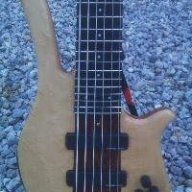


Maybe just try to play less with your pinky until you have a bit more strength?


Hundreds. We should start a thread and build a list. James Jamerson for one... Only used one plucking finger.I wonder how many famous bass players have something "wrong" with their technique?
I think Jack Bruce did also!Hundreds. We should start a thread and build a list. James Jamerson for one... Only used one plucking finger.

An exercise that's helped me much over the years goes as follows:
- fret a note on the lowest string with your first finger
- leave the first finger down, fret the next fret up with the second finger
- leave the first two down, use the third to fret the next
- with all three down, play the fourth note with you pinky
- leave 2-4 down, move the first finger up one string
- now the second
- the third...
- keep going up strings
This can help finger independence big time.
It might be easier to start up the neck, maybe the seventh fret, until you get comfortable lower.
This is an older, but excellent book to build finger independence: https://www.amazon.com/Bass-Fitness-Exercising-Handbook-Including/dp/0793502489
I suggest the old school paper version over the Kindle edition.
Have fun!