• TalkBass has been independent since 1998. Add your voice.
    Create a free account to reply to discussions, view embedded media, and browse with fewer display ads.
    Join freeLog in
    Want zero display ads or expanded classifieds tools? Compare plans.

Double Bass Playing Stand for DB

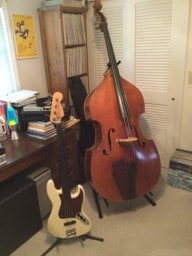
Do any of you folks know of a playing stand for a ¾ double bass? What I am seeking is a stand that supports the DB when at rest but allows freedom of movement when playing it, without gouging it up of course. Most stands I have seen are designed for just parking the bass, stationary, and not for playing it. This would be so cool if I just could grab the bass and play it without any drama. Thanks for the help.


Randy
 
Thank you Mr. Curry. I will check into that. In my experience, teachers can be deeply influenced by their previous educational "programming". And, as an unfortunate result, lack in resiliency and acceptance of new ideas. Just my $.02 on that.


Randy
 
Thank you Mr. Curry. I will check into that. In my experience, teachers can be deeply influenced by their previous educational "programming". And, as an unfortunate result, lack in resiliency and acceptance of new ideas. Just my $.02 on that.


Randy
Or it could have been really bad for his technique as well as having a detrimental effect on his playing so the teacher was right.
 
Last edited:
Casey,
I do appreciate your comments. And I do agree that for good expressive performance freedom is very important for full access to the URB (I play jazz so I do know about that). I have been playing with a modified stand for several years and rather than limiting my ability, it has enhanced what I can do. Really. I may have to design one. I was just hoping someone already made one. Thank you again.

Randy
 
Well, good boy that I am, I obeyed my teacher, and she says I sounded better because of it. That may be.

But here's the question: Freedom of movement? The stand, while impeding freedom of the bass to move, allows more movement by the human being; the bassist moves around the bass rather than moving the bass. It makes playing on the E string easier, especially for us German bowers. Thumb position is different but doable.

Those who sit to play don't seem to require freedom of movement. I see playing the bass on its stand as a hybrid of the the "sitting vs. standing" argument.

It's never going to be approved by conductors or judges, but for someone playing hours-long non-classical gigs, or in spaces too small to lay the bass down, it's a viable approach.

The stand is the K&M 141 or 14100. Here's its page at Gollihur's site:
Portable Folding Stand for Double Bass (K-M model 141)
 
Last edited:
Just looking at the pic A.G. posted and referencing my own stand, I can see all sorts of problems with getting my torso to align properly with the bass's torso, so If I'm going to play it's going to be off the stand. And yes, I have tried playing my bass on the stand.
 
But here's the question: Freedom of movement? The stand, while impeding freedom of the bass to move, allows more movement by the human being; the bassist moves around the bass rather than moving the bass. It makes playing on the E string easier, especially for us German bowers. Thumb position is different but doable.

Those who sit to play don't seem to require freedom of movement. I see playing the bass on its stand as a hybrid of the the "sitting vs. standing" argument.

In my experience, playing seated allows movement on the part of the player, but not of the bass. The seated player always knows exactly where the bass is and will be, and can move their body to do what they need to do. In a standing situation, both the player and the bass moved, which to me feels like the bass is a moving target.
 
I worked at a theater for several years where I did a lot of doubling on different instruments so had the bass on a stand for quick changes. It was never comfortable and was strictly for logistical reasons. I would never want to play that way normally. I could never get my body in the ideal place and was always crouching or bending some weird way in order to compensate. I sat in orchestra for years but that was never really comfortable either. I went back to standing for everything and feel better for it.Standing for an orchestra rehearsal or concert has never been a big strain for me. I know others feel differently. I never wanted to get the"orchestra slouch" that you see in some long-time orchestra bass players.
 
In my experience, playing seated allows movement on the part of the player, but not of the bass. The seated player always knows exactly where the bass is and will be, and can move their body to do what they need to do. In a standing situation, both the player and the bass moved, which to me feels like the bass is a moving target.

I've not played seated enough to argue with you. We all agree that either the player or the bass has to move. The main reason I've avoided playing seated is that I don't want to carry around another piece of gear!
 
I play my bass standing up. I really can't imagine sitting down. And I do not play arco yet, I play pizzicato. And I am a doubler, saxophone is my preferred instrument. I envision a stand that supports the bass in a very flexible way, allowing a great deal of freedom for movement between the instrument and the player. Not a rigid device that you "park" the bass on, like almost all bass stands. I would like a stand that supports the back of the bass but not rigidly, no neck saddle. And has a provision that allows the peg to be located loosely and not locked in place. I actually play this way already and it works much better than a rigid stand. It also is better than no stand as well. You don't have to lay the bass down and pick it up again. It is just there, ready to go. Walk up to it and play it, presto. I don't think anyone makes a stand like this. I might do this.
 
I play my bass standing up. I really can't imagine sitting down. And I do not play arco yet, I play pizzicato. And I am a doubler, saxophone is my preferred instrument. I envision a stand that supports the bass in a very flexible way, allowing a great deal of freedom for movement between the instrument and the player. Not a rigid device that you "park" the bass on, like almost all bass stands. I would like a stand that supports the back of the bass but not rigidly, no neck saddle. And has a provision that allows the peg to be located loosely and not locked in place. I actually play this way already and it works much better than a rigid stand. It also is better than no stand as well. You don't have to lay the bass down and pick it up again. It is just there, ready to go. Walk up to it and play it, presto. I don't think anyone makes a stand like this. I might do this.

You have pretty much described the K&M 141 stand. I don't dare to defend it in the context of technique, but it fits the desires you've expressed.
 
Just ordered a K&M 141 stand from Amazon. I can easily return it if it doesn't work out. My concern is that the "wings" supporting the waist of the bass will interfere with playing the instrument. It needs to move with me. I really use the instrument as an expressive extension of my inspiration. No chair stuff or "proper" technique going on here. To me, that is the soul of music. We shall see.
 
  • Like
Reactions: AGCurry
I have never seen anyone playing with a bass on a stand. For myself I think it would not work, whether standing or seating.

So I ask out of genuine curiosity: what benefit do you expect to get from using a stand for your playing? For example, do you need to swap instantaneously between the bass and some other instrument?
 
Last edited:
There are two kinds of stand:
1. stands that hold the bass vertical resting on the edges of top and back of the under side of the lower bout.
Those stands can be very low and do not need much space around the bass; furthermore they are very stable. However, the vertical position position is not at all suitable for playing the bass.
2. stands that hold the bass inclined backwards, with the bass resting either of the end pin (usually in some kind of cup) or on the lower bout, and on the back. Those stands need to be sufficiently high (at least reaching the upper bout) to ensure the stability of the bass. They also need sufficient space laterally for stability, which would hinder convenient access for playing. Furthermore they usually cannot be adjusted in height or inclination to suit a player's needs as they are not meant for this purpose.

So you would presumably have design and construct your own stand, and ask yourself wether the benefit you expect from such a stand is worth the effort?
upton_bass_cello_stand_floor-1.jpg

HERCULES+DS590B.JPG