Phase is a complicated subject...I'll touch on some ideas to the best of my ability...but let's be clear, I am no expert and I am sort of just scratching the surface.
What you are describing is better called polarity. Flipping the switch essentially inverts the signal.
If you only have one speaker, then it's unlikely you will be able to distinguish between in polarity and out. You may here the switch flipping, but afterwards you are unlikely to be able to tell if the polarity is + or -.
Audible results occur when you have different speakers that are spaced out.
A couple of relevant factors: 1. It takes time for sound to travel a given distance. 2. Wavelength is inversely proportional to frequency. In other words, as the frequency goes down the wavelength gets longer.
The consequence of these factors is two frequencies traveling from a speaker to a listener will arrive at different phase angles.
Imagine you have a speaker producing these two frequencies:
Both waveforms cross the X axis at -3. At -1, the blue waveform has completed a full cycle. At the same place, the red waveform has only complete a bit more than 1/4 wavelength.
Now imagine there are two sets of speakers producing the same waveforms. Assume the second speaker is further away. Depending on the difference in propagation paths, one of the waveforms may sum while the other cancels. Change the location of one of the speakers, and you can reverse which frequency cancels and which sums.
The frequency response contour of a bass can be relevant as well. Perhaps the bass produces a frequency that is summed, or perhaps the bass produces a frequency that is cancelled.
AFAIK...the pickups and speakers will also have some degree of phase variance. I believe with speakers the phase tends to lag as the frequency goes lower. However filters such as tone controls, high pass filters, and low pass filters also introduce variable phase errors.
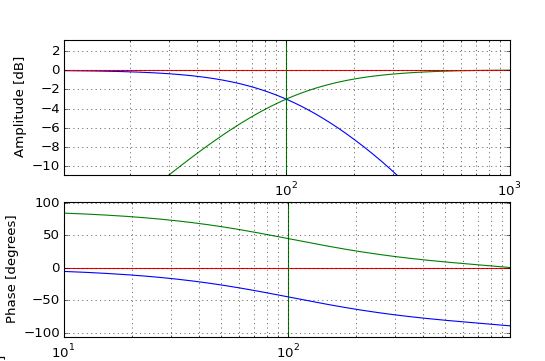
Here is a graphic that shows the phase response of filters in a crossover.
In the top image, green is the high pass and purple is the low pass
Ref:
Time Alignment Part Three: Delays and Crossovers for Tweeters and Mids - Audiofrog
The bottom image shows the phase response of the high pass and low pass. In this image the HPF is leading by 90 degrees and LPF is lagging by 90. Also, notice the phase is rotating throughout the crossover region. Also the phase variance between the signals is 180 degrees, so they are out of phase. This is a characteristic of 12dB/octave BW. With this sort of crossover, you reverse the polarity of one of the drivers; usually the tweeter.