• TalkBass has been independent since 1998. Add your voice.
    Create a free account to reply to discussions, view embedded media, and browse with fewer display ads.
    Join freeLog in
    Want zero display ads or expanded classifieds tools? Compare plans.

Poll: Getting a better DI tone live (without IEMs)

What should I do?

  • Get a preamp, cabsim, and DI, then get a standalone power amp or an amp with preamp bypass

    Votes: 0 0.0%
  • Get a cabsim/DI and split it off before your mesa, call it a day

    Votes: 24 43.6%
  • Somehow filter the signal AFTER the DI out of the mesa

    Votes: 0 0.0%
  • Get a powered more or less flat cabinet

    Votes: 4 7.3%
  • Get a new cab and a mic you like with a clip and ask for two lines

    Votes: 1 1.8%
  • Sell your music stuff, buy land & a tractor, grow food & biodiesel, and prepare for the end times

    Votes: 26 47.3%

  • Total voters
    55
Hey all,

Been struggling with how to move forward with my live sound and wanted to call on the group's advice.

I've been running a mesa d800 into an avatar 212 and it's been a pretty solid setup but during a recent recording session I discovered there's a small amount of buzzing in the cabinet (no worries, I've gotten more than my money's worth out of it). I was all ready to buy a new cab (and had already had a great conversation with Dave at Revsound) when I had a crisis of confidence in whether dropping the bread on a nice new pro cabinet was worth it for me.

Usually when I play live I just get a DI line. Sometimes when I play live the sound engineer mics my cab to compliment the DI. The gigs (we're hoping) to have lined up next year are mostly opening slots for bigger acts where we won't have our own sound person and I probably will be dealing with a different person each night. I REALLY don't want to rely on asking for a lot of attention during soundcheck, or having some complicated setup that takes a lot of explanation. While I play an important sonic role in this group, we're billed as just our singer's name and a great deal of sound check is (and should) be dedicated to getting his vocal sound right.

Someday I hope we'll be on IEMs but that doesn't appear to be in the cards in the short term, and for now me and my bandmates depend on me having a cab onstage making sound.

I run a lot of effects. On maybe half of our songs there's no proper bass in the verses at all and I do a variety of pad effects and then drop the bass in the chorus. I also use fuzz/overdrive on a few songs. The pad sounds especially have gotten pretty complicated and I very much need to be hearing my sound live as I'm playing (I'll often bend over a twist a knob on one of my delays as I'm sweeping in a pad with my volume pedal, for instance).

I got the chance to listen back to a couple of gigs that were recorded recently and one high end one I sounded great (and my cab was mic'ed) but the other one I was sterile, not compressed enough (to my ears) and had the swarm of bees issue when I hit fuzz.

The mesa is GREAT product ... across the board sound engineers say the signal out of the DI is strong and easy to work with, but I think the issue it's too dry for what I do. I do like what the preamp and eq on the amp do, but I'm struggling on how to integrate a cabsim with the d800, if that's what I need.

I've been reading about all these cool looking products like the DSM Omnicabsim and Bass Station, Shift Line Olympic, Broughton Messenger and Resonant Filter Equalizer, and various other DI/preamps and compressors, and the problem that I keep running into is that I wouldn't be hearing my actual signal onstage. It seems a lot of these products are marketed with IEMs in mind. Partially the problem is that the Mesa doesn't have a way of bypassing the preamp (so for instance I could only use the thru output of the Shift Line).

I certainly like the idea of going on the journey of figuring out always on preamps, cabsim (or something like it) and compressors at the end of my chain, but I'm wary of showing up with such a complicated and perhaps atypical setup.

What sayest thou talkbass?

Pedalboard included for context. The band in question is modern alt country. Bass is a lakland dj5 w a series push/pull mod strung with flats.
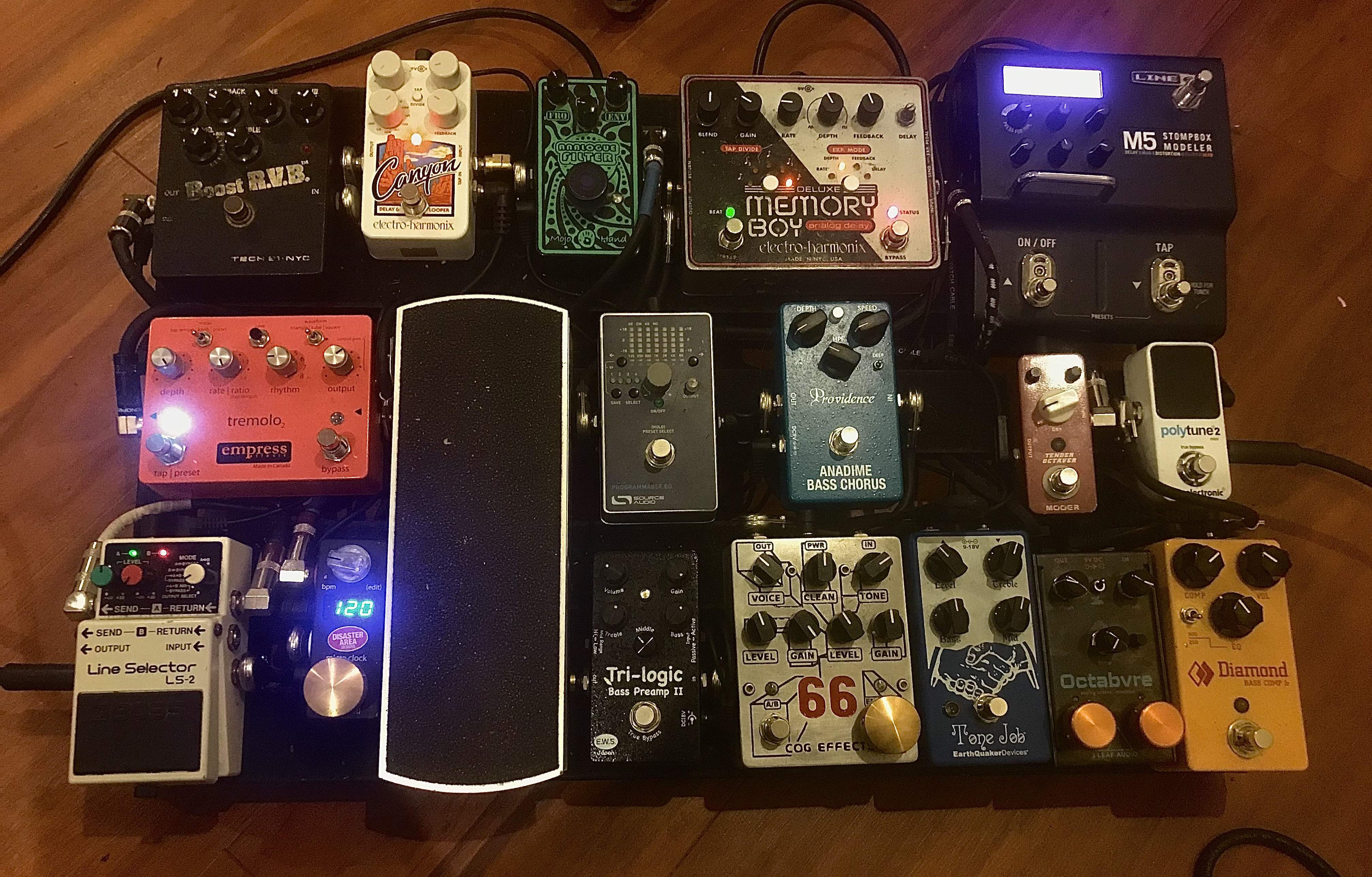
pedalboard dec 2020.jpeg
 
Last edited:
I ended up buying a REDDI and putting Broughton high and low pass filters in front of it, or sometimes a Tech 21 VT Deluxe in front of it, depending on the gig. Then when I got an Ampeg PF-50T I used that with the filters or VTD sometimes as well. I think a major component of me liking my DI sound (and I used to hate DI's) is the tube amp/cab sim aspect, but an HPF and LPF always worked fine for me instead of one of the more deluxe cab sims out there. But I do believe you have to have both.
 
Yeah it’s a tricky problem. So you run the filters into the normal input of the pf-50 and then take the DI out of the head? And then you monitor your signal through your cabinet?

I ended up buying a REDDI and putting Broughton high and low pass filters in front of it, or sometimes a Tech 21 VT Deluxe in front of it, depending on the gig. Then when I got an Ampeg PF-50T I used that with the filters or VTD sometimes as well. I think a major component of me liking my DI sound (and I used to hate DI's) is the tube amp/cab sim aspect, but an HPF and LPF always worked fine for me instead of one of the more deluxe cab sims out there. But I do believe you have to have both.
 
  • Like
Reactions: chiphaleonbass
I ended up buying a REDDI and putting Broughton high and low pass filters in front of it, or sometimes a Tech 21 VT Deluxe in front of it, depending on the gig. Then when I got an Ampeg PF-50T I used that with the filters or VTD sometimes as well. I think a major component of me liking my DI sound (and I used to hate DI's) is the tube amp/cab sim aspect, but an HPF and LPF always worked fine for me instead of one of the more deluxe cab sims out there. But I do believe you have to have both.
Ditto.
I always run my beat to crap old v1 VT bass before DI.
Easy, very effective, techs love the simplicity.

Never had a problem from dive bar to larger venues.
(I use vt bass into j48, the VTDI didn't exist yet. I still use this combo btw.)

Imo, ime, ymmv.....etc.
 
Tech21 Q-Strip is what I use as my DI, and I think it might work for your situation.
  • Built in HPF/LPF should get you close to a "cab-sim" sound, and take care of the swarm of bees sound. They're preset, but can be slightly adjusted.
  • 4 band EQ, with 2 sweepable mids. These work with the HPF/LPF to dial in closer to a cab sim.
  • Parallel out, which would let you run a signal from the Q-Strip to your amp as well as DI to the PA.
Your PA signal wouldn't get the preamp sound of the D800, but the EQ on the Q-Strip is comparable to the amp, from what I can see.

I'm not directly familiar with the product, but otherwise a Two Notes Torpedo CAB Captor between your amp and speaker could get you a DI out with a cab sim, as well as have a line out to your speaker cabinet.
 
Ditto.
I always run my beat to crap old v1 VT bass before DI.
Easy, very effective, techs love the simplicity.

Never had a problem from dive bar to larger venues.
(I use vt bass into j48, the VTDI didn't exist yet. I still use this combo btw.)

Imo, ime, ymmv.....etc.
I did the same with a JDI and VT Bass V2 for a number of years...it's not exotic or super high end, but it always worked and the sound techs were happy.
 
I made my choice in the poll because it was the closest to what I do, which is not one of the choices: I run my active bass through a Behringer passive DI to the board, which actually gives my bass the most neutral and clean low-noise signal. Then our sound man takes care of it with our Beheringer digital board with MIDI personal digital monitor setup. My personal monitor is a Beheringer B205D to get the vocals and keys and a little bit of the treble range of my bass coming back at me to assure the articulation is in the groove with the drummer. No bass amp on stage.
 
Hey all,

Been struggling with how to move forward with my live sound and wanted to call on the group's advice.

I've been running a mesa d800 into an avatar 212 and it's been a pretty solid setup but during a recent recording session I discovered there's a small amount of buzzing in the cabinet (no worries, I've gotten more than my money's worth out of it). I was all ready to buy a new cab (and had already had a great conversation with Dave at Revsound) when I had a crisis of confidence in whether dropping the bread on a nice new pro cabinet was worth it for me.

Usually when I play live I just get a DI line. Sometimes when I play live the sound engineer mics my cab to compliment the DI. The gigs (we're hoping) to have lined up next year are mostly opening slots for bigger acts where we won't have our own sound person and I probably will be dealing with a different person each night. I REALLY don't want to rely on asking for a lot of attention during soundcheck, or having some complicated setup that takes a lot of explanation. While I play an important sonic role in this group, we're billed as just our singer's name and a great deal of sound check is (and should) be dedicated to getting his vocal sound right.

Someday I hope we'll be on IEMs but that doesn't appear to be in the cards in the short term, and for now me and my bandmates depend on me having a cab onstage making sound.

I run a lot of effects. On maybe half of our songs there's no proper bass in the verses at all and I do a variety of pad effects and then drop the bass in the chorus. I also use fuzz/overdrive on a few songs. The pad sounds especially have gotten pretty complicated and I very much need to be hearing my sound live as I'm playing (I'll often bend over a twist a knob on one of my delays as I'm sweeping in a pad with my volume pedal, for instance).

I got the chance to listen back to a couple of gigs that were recorded recently and one high end one I sounded great (and my cab was mic'ed) but the other one I was sterile, not compressed enough (to my ears) and had the swarm of bees issue when I hit fuzz.

The mesa is GREAT product ... across the board sound engineers say the signal out of the DI is strong and easy to work with, but I think the issue it's too dry for what I do. I do like what the preamp and eq on the amp do, but I'm struggling on how to integrate a cabsim with the d800, if that's what I need.

I've been reading about all these cool looking products like the DSM Omnicabsim and Bass Station, Shift Line Olympic, Broughton Messenger and Resonant Filter Equalizer, and various other DI/preamps and compressors, and the problem that I keep running into is that I wouldn't be hearing my actual signal onstage. It seems a lot of these products are marketed with IEMs in mind. Partially the problem is that the Mesa doesn't have a way of bypassing the preamp (so for instance I could only use the thru output of the Shift Line).

I certainly like the idea of going on the journey of figuring out always on preamps, cabsim (or something like it) and compressors at the end of my chain, but I'm wary of showing up with such a complicated and perhaps atypical setup.

What sayest thou talkbass?

Pedalboard included for context. The band in question is modern alt country. Bass is a lakland dj5 w a series push/pull mod strung with flats.

View attachment 4076700

The solution is soundcheck IMHO. If soundcheck is not possible or insufficient, you get what you get!

My impression is people seem to think this is relatively easy to pull off, but it's actually fairly complicated. A lot of work is required before sound check, and you need the ability to be able to tweak your effects super fast during sound check. Unfortunately the situation you are describing is not really conducive to giving you the type of sound check that is really necessary to pull this off perfectly...it takes time!

Some ideas:
-You can and should dial in all of your effects before soundcheck, but in my experience this only gets you in the ballpark. If you change your volume significantly or the the acoustics in the room are drastically different, it's likely that you will need to tweak levels and EQ of each and every effect...you should develop an intuitive feel for it over time.

-Signals should be processed for location and intended purpose. My believe is for optimal results you need different processing for onstage monitoring than the audio tech needs for building the main mix.
A consequence of this: If the effects are perfect for you on stage, they are probably not going to be perfect for the audio tech's needs. This is where sound check comes in. Essentially you go through each of your patches and make sure they sound decent, and the balance from effect to effect falls where you expect it to fall. If things aren't right you make adjustments and/or work out a compromise on the spot.
-How to dial in your effects:
Part of the problem may be that the effects need to be optimized for either an instrument amp or the PA. They can't be optimize for both because the frequency response is generally very different. If you plan to stop using your amp, that sort of resolves part of the problem as I think you should be able to dial your effects in so they sound decent through a PA without needing a speaker SIM or HPF. This is is providing you have a FRFR system of some type than you can use to tweak your effects.

If you dial the effects in using a traditional amp, it may be a good idea to use some sort of processing to take a bit of the edge off the top end. The problem is there is quite a bit of variation in the way different PAs are tuned. Ideally you should be able to rely on the audio tech to get it right, but under the circumstances that is not always possible.
-Speaker SIMs and/or LPFs
I have mixed ideas on these as I think a decent audio tech should be able to dial in the sound without needing a SIM. IMHO the closest you're probably going to get to your stage sound is to put a mic on your cab, but that is not going be exact. The mic is very close to the speaker and your ears are far enough that the sound develops and changes. Also, mics don't hear exactly the same way our ears do.

The issue with speaker SIMs is they are often generic, so they are not even an attempt to approximate your stage sound. Of course if you have the ability to do an Impulse Response (IR) of your actual rig, that would be ideal. I know the Two Notes C.A.B. M+ uses IR technology, but I don't think it allows you to do an actual IR of your rig.

-Post EQ DI:
Normally this is my least preferred option as it tends to be noisier the Pre EQ. Also, if you use a traditional tweeterless cab, the Post DI sound can be really bright and ganky. However, if you are running without an amp and just relying on the monitors to hear, I would suggest using a preamp and sending a Post EQ signal so you have some basic tone shaping abilities for your sound in the monitors.

Often the monitors are setup Pre EQ on the mixing console. This allows the audio tech to adjust your sound for the house without impacting how your instrument sound in the monitors. So your sound in the monitors may be flat or perhaps an LPF may be applied. If you do send a Post EQ DI, my advice is get your sound dialed in early and then try to lock it it. Any tweaks you make during the show will throw off all of the mixes derived from you signal. This can be very frustrating for the audio tech, because it's not easy to get the bass dialed in.

FYI, The Tow Notes C.A.B. M+ works as Instrument, Line, or Speaker level and the OMNICabSIM works at Instrument and Line level.
 
A few months ago I went through a similar thing when I thought I was going IEM. Here are some thoughts in no order at all.

  1. I use a Mesa Subway D800+, meaning we have the world's best and possibly most expensive pre's to do what we're doing. :D
  2. Going IEM is not cheap if done properly. Get good earphones and stay away from anything on Amazon, especially if it looks Chinese.
  3. I tried several cabsims in pedals, multi FX - digital and analog - software, ipad, you name it. The absolute best was a Boss graphic eq on my board with 10k turned down. I also have a Broughton LPF and that works great too. This should fix your buzzy fuzz. The so-called cabsims did nothing but introduce tonal artifacts that took away from my sound, which I was trying to replicate. They then created sonic problems if their own. IMO cabsim pedals are less than worthless.
  4. In consideration of the above, the simplest solution is the best.
  5. In the end I gave up on IEMs completely to return to my Mesa 15 cabs and am utterly happy for it. The band likes it too.
  6. There have been times when I turned down my onstage volume and asked for monitor support so I could keep an ear on my sound. I don't do it always, just if I'm concerned for whatever reason. Which is almost never, but that option exists.
  7. If I do a gig with backline, I assume it's going to be an svt and have a game plan for that. I use my amp and pedalboard and that gets me pretty close.
  8. My board is set up for contingencies, I specifically wanted it to be able to deal with such issues as mandatory backline and unknown amps. And questionable sound men. It's why I have both a graphic eq and LPF/HPF on my board or in my bag.
  9. Be nice to the sound guys and tell them about your buzzy distortion. They probably have better tools than you to deal with it.
  10. Get your cab fixed or buy a new one. An incessant buzz in a cab is just, well, you know. Bad.
Good luck and I hope I could help.
 
I'm going to do something I usually don't, ie suggest something the OP didn't ask for. From what you describe, the obvious answer for me would be to ditch everything and get a high-end modeler, like the Helix. It seems to be perfect for your use case, as it's highly capable for pads and you can get any cab sim you want and lots of routing options. For amplification, I would go for a FRFR powered cab. So I chose the last option which is the closest one.
 
Last edited:
  • Like
Reactions: FatBoutedGirls
Another Q/Strip user. The HPF/LPF has been a revelation for me. Extremely useful as part of my DI signal. The HPF is set at 45Hz and the LPF is set at 3kHz, attenuated at 12dB per octave. The LPF gives me a lot more control over high notes and frequencies for clean tones, and dirt tones sound a lot more natural via DI. I also cut the treble as well if I've got new strings on. I wondering how a seperate DI box would sound. Would love to try out a REDDI, or maybe a JDI.
 
Hey all,

Been struggling with how to move forward with my live sound and wanted to call on the group's advice.

I've been running a mesa d800 into an avatar 212 and it's been a pretty solid setup but during a recent recording session I discovered there's a small amount of buzzing in the cabinet (no worries, I've gotten more than my money's worth out of it). I was all ready to buy a new cab (and had already had a great conversation with Dave at Revsound) when I had a crisis of confidence in whether dropping the bread on a nice new pro cabinet was worth it for me.

Usually when I play live I just get a DI line. Sometimes when I play live the sound engineer mics my cab to compliment the DI. The gigs (we're hoping) to have lined up next year are mostly opening slots for bigger acts where we won't have our own sound person and I probably will be dealing with a different person each night. I REALLY don't want to rely on asking for a lot of attention during soundcheck, or having some complicated setup that takes a lot of explanation. While I play an important sonic role in this group, we're billed as just our singer's name and a great deal of sound check is (and should) be dedicated to getting his vocal sound right.

Someday I hope we'll be on IEMs but that doesn't appear to be in the cards in the short term, and for now me and my bandmates depend on me having a cab onstage making sound.

I run a lot of effects. On maybe half of our songs there's no proper bass in the verses at all and I do a variety of pad effects and then drop the bass in the chorus. I also use fuzz/overdrive on a few songs. The pad sounds especially have gotten pretty complicated and I very much need to be hearing my sound live as I'm playing (I'll often bend over a twist a knob on one of my delays as I'm sweeping in a pad with my volume pedal, for instance).

I got the chance to listen back to a couple of gigs that were recorded recently and one high end one I sounded great (and my cab was mic'ed) but the other one I was sterile, not compressed enough (to my ears) and had the swarm of bees issue when I hit fuzz.

The mesa is GREAT product ... across the board sound engineers say the signal out of the DI is strong and easy to work with, but I think the issue it's too dry for what I do. I do like what the preamp and eq on the amp do, but I'm struggling on how to integrate a cabsim with the d800, if that's what I need.

I've been reading about all these cool looking products like the DSM Omnicabsim and Bass Station, Shift Line Olympic, Broughton Messenger and Resonant Filter Equalizer, and various other DI/preamps and compressors, and the problem that I keep running into is that I wouldn't be hearing my actual signal onstage. It seems a lot of these products are marketed with IEMs in mind. Partially the problem is that the Mesa doesn't have a way of bypassing the preamp (so for instance I could only use the thru output of the Shift Line).

I certainly like the idea of going on the journey of figuring out always on preamps, cabsim (or something like it) and compressors at the end of my chain, but I'm wary of showing up with such a complicated and perhaps atypical setup.

What sayest thou talkbass?

Pedalboard included for context. The band in question is modern alt country. Bass is a lakland dj5 w a series push/pull mod strung with flats.

View attachment 4076700

get something like a Broughton P-15 - send the DI to the board and the effected 1/4” to the effects loop return of your Mesa. Now you have a better preamp and a better DI signal
 
I have to second/third and fourth what a lot of other folks have said. If you really are particular about the sound that FOH is getting you have to control it somehow before they get it. I understand too that openers get minimal time to soundcheck as opposed to headliners, and sometimes you're not even playing out of your own rig because bands don't want that much gear cramping the stage etc..

Cab sims/HPF/LPF will certainly clean up your sound. Ideally sound engineers are doing this anyway (filtering) to make your sound present in a mix; and especially in boomy rooms, providing clarity to your signal. I know this doesn't always happen for groups, especially opening bands, where the first two to three songs can be a wash as FOH can sometimes be mixing on the fly.

Personally I'd recommend the Shift Line Olympic; because it has and amp-like EQ, cab sims and a thru line so that it doesn't color your amp signal unless you want it to; but you can't go wrong with the Q-strip, VTDI or even the Broughton high and low pass filter pedals. I even use the Colourbox V2 from JHS from time to time to dial in my eq as it has a built in HPF as well.

Last thing I'd suggest, because you mentioned compression and I see the mini Diamond Comp on your board, is to try running that last in your signal as opposed to first. That way it's grabbing up everything you're sending it the pads, the fuzz etc... and it's compressing all of that down before hitting FOH. I used to have a Diamond and know that it sounds great, personally I never ran it last in the chain, but I have done this with my Cali76 and it helped tame fuzzes and harsh overdrives. You might find too that the pads pop a little more because they're being compressed after the fact.

Good luck!
 
  • Like
Reactions: bdplaid
I wouldn’t try to complicate things too much. I don’t think any sound guy has ever asked me if I had a cab sim for my DI signal. Just give them your dry or slightly eq’ed signal and they’ll make you sound good if they’re good at their job.

I think the simplest solution would be just putting a DI preamp pedal at the end of your chain. Run the through to your Mesa, give the DI to the house. You’ll hear what you normally hear and they’ll get a juicy sound. I would suggest this and fixing your cab so it could be miked if possible too. Or getting a little 10 inch or 12 speaker that’s just for being loud enough to mike on stage for going with in ears.

I’ve been spoiled by the Kemper for a while now but even with that I’m still usually tied to only one cable to the house. So I blend in a little direct on my own with the amp sims and effects and call it a day. Sound guys seem to really like it.
 
Avalon U5 inserted into your speaker signal path, or mic your cab.

And a word of advice, FOH usually cares very little for bass other than getting a decent level of signal.
Unless you're the headliner, you get what you get. If you expect that up front, life will be easier.

Some FOH will make the decision for you, including bypassing your effects.

Then again this is all dependent on live music being allowed to continue.

Good luck,
Dirk

p.s. and I'm sure solo'd up your cab noise is irritating, but I bet it disappears in the mix.