
Enjoy the benefits of a premium membership!
Upgrade Account
-
TalkBass has been independent since 1998. Add your voice.
Create a free account to reply to discussions, view embedded media, and browse with fewer display ads.
Join free Log in
Want zero display ads or expanded classifieds tools? Compare plans.
You are using an out of date browser. It may not display this or other websites correctly.
You should upgrade or use an alternative browser.
You should upgrade or use an alternative browser.
Poplar as a tone wood
- Thread starter reel big bassist
- Start date
More options
Who Replied?
Originally posted by Luis Fabara
Does just refinishing a MIM P-Bass count?
This one looks pretty normal.
It isnt a single piece body but about 4 pieces but not as a sandwich.
What vintage was it? My '98 Mexi J was solid poplar, but that was only on the sunburst models; everything else from that year was plywood. I'm guessing that they wouldn't have just used plywood for one year.
On the Alembic cosmetic purposes... that could be their reason. But I do hear a difference of a bass with a Maple top or without it. There is a slight tonal change (read: increase) in the high end and low end definition.
Maybe. In a mix, though, that wouldn't really matter. Can you tell the difference between a Les Paul (maple top, mahogany back) and an SG (solid mahogany) over a rock drummer? Probably not.
Another reason for using lots of differing body laminates is to balance out resonances and compress the tone a bit. This makes the sound a bit too smooth, IMO, but to each his own.
Thanks to everyone that replied. I really didn't think
the thread would be this long, but it's cool. By the way my 98 MIM Jazz bass is a sunburst model
I play ska music right now, later i'm looking to venture into the realm of jazz.
Luis, I agree with you my bass does lack definiton in the low end, i wish it was tighter. When I played a Warwick Corvette Standard with a bubinga body, ovangkol neck, and wenge fingerboard, it had excellent low end definiton. Acutally it had great defenition all around. Yea i'm gonna take some time to read up on the woods, it's interesting.
Thanks go out to analogkid9, ebozzz, Luis Fabara, cruise4, Player, barroso, AndersK2, embellisher, Marty Forrer, Thrillkiller,
and JazznFunk. I'd also like to thank anyone that's going to respond to this thread after I post this message.
Sincerely,
Greg P
the thread would be this long, but it's cool. By the way my 98 MIM Jazz bass is a sunburst model
I play ska music right now, later i'm looking to venture into the realm of jazz.
Luis, I agree with you my bass does lack definiton in the low end, i wish it was tighter. When I played a Warwick Corvette Standard with a bubinga body, ovangkol neck, and wenge fingerboard, it had excellent low end definiton. Acutally it had great defenition all around. Yea i'm gonna take some time to read up on the woods, it's interesting.
Thanks go out to analogkid9, ebozzz, Luis Fabara, cruise4, Player, barroso, AndersK2, embellisher, Marty Forrer, Thrillkiller,
and JazznFunk. I'd also like to thank anyone that's going to respond to this thread after I post this message.
Sincerely,
Greg P

- Aug 13, 2000
- 2,016
- 19
- 46
- Disclosures
- Audio Pro - Ecuador
Well, this is a picture of the P-Bass I worked on.
I believe it is Pre-96 MIM P-Bass
It has a solid poplar body that I stained with Yellow dyes and finally tung-oiled it.
I also defretted it and covered the fretboard with Varathane.
Here it is:
Link Removed
It looks a little darker here.
I believe it is Pre-96 MIM P-Bass
It has a solid poplar body that I stained with Yellow dyes and finally tung-oiled it.
I also defretted it and covered the fretboard with Varathane.
Here it is:
Link Removed
It looks a little darker here.

reel. what i think is that you can't compare two basses such different as a MIM fender jazz and a Warwick Corvette Standard with a bubinga body thinking that the only factor of the better low end of the warwick is the material. these are two completely different basses, with different body shapes, design, necks, pickups and electronics. if you really want to understand how a wood affects the tonal spectrum of a bass you need to compare two basses that are at least the same model. in this way you'll agree with me that the differences are not so big. and if you have two of the same kind of basses with the same wood for the body and you change the pickup or the elctronics of one of the two, you'll agree that the differences in sound are bigger that changing tha wood.
i forgot: Luis. really nice bass!! if i were you i'd change the pots to the chrome ones, but you did a really good job on that bass. i'd consider a u retro preamp for that bass. it works well for fretless in my opinion

analogkid9,
my Jazz looks like it´s made of solid polar with alder top and back pieces. A sunburst.
my Jazz looks like it´s made of solid polar with alder top and back pieces. A sunburst.
- Aug 13, 2000
- 2,016
- 19
- 46
- Disclosures
- Audio Pro - Ecuador
Well, it has some flaws.
Also, it looks like that because I dyed the wood first.
The Natural Poplar color was awful.
I will try posting some other pictures so you can see all the details.
About the Preamp and stuff... Well Its not mine, and the Owner doesnt even change the strings periodically... (Sometimes I give him some new or semi-used strings for his bass)
So adding more stuff to it, I believe its a little out of the question.
But thanks on the suggestions.
Also, it looks like that because I dyed the wood first.
The Natural Poplar color was awful.
I will try posting some other pictures so you can see all the details.
About the Preamp and stuff... Well Its not mine, and the Owner doesnt even change the strings periodically... (Sometimes I give him some new or semi-used strings for his bass)
So adding more stuff to it, I believe its a little out of the question.
But thanks on the suggestions.
Well I emailed Mike about the use of Tullipwood (Poplar) in the MTD basses. I told him I avoided it because of the structural instability and asked if he knew something that I didn't. He said he just thought it sounded good.
Which brings up the question: Given the subtlety of the tonal differences created by the wood itself (ignoring all other factors), what should be the major consideration in wood choice? (Talking about a solid body electric, obviously an acoustic instrument would have different considerations.)
IMO a structurally sound instrument is very important, followed by weight, look, ease of working, acceptance of finish and finally tone. (although, the factors that we don't like to consider, cost and availability, tend to be premier in the final decision.) Considering that all of these factors can be altered by mixing (laminating) different woods or adding other materials (graphite, steel, etc) a solid Poplar bass body just doesn't make sence to me. There are so many woods that are superior in all considerations (except price, availability and maybe ease of working) that the only way I could justify using it is if I were making the least expensive and easiest to work (cut, rout, sand, etc) body. (and actually then I might go with basswood [a bit more stable and a little tighter grain]). I did quite a bit of studying before I built my first guitar and I don't recall any author (luthier) even mentioning Poplar as an option.
In a production instrument it makes sence in-so-far as it's abundant and a manufacturer needs to obtain an adequate supply to meet production needs which is, I believe, why we are seeing more poplar and basswood instruments (again, cost and availabilty take precedence.) Alder and swamp ash just aren't as available as they used to be. My latest instrument is 2- 3/4" pieces of primavera with a 1/4" of walnut sandwiched in between. Primavera (sometimes called white mahogany) is a stable hardwood that is surprisingly light. It works fairly easily (similar to ash) and it sands and accepts finishes nicely. It's a mexican wood that's fairly abundant and can be had for $10 a bd/ft or less.
Which brings up the question: Given the subtlety of the tonal differences created by the wood itself (ignoring all other factors), what should be the major consideration in wood choice? (Talking about a solid body electric, obviously an acoustic instrument would have different considerations.)
IMO a structurally sound instrument is very important, followed by weight, look, ease of working, acceptance of finish and finally tone. (although, the factors that we don't like to consider, cost and availability, tend to be premier in the final decision.) Considering that all of these factors can be altered by mixing (laminating) different woods or adding other materials (graphite, steel, etc) a solid Poplar bass body just doesn't make sence to me. There are so many woods that are superior in all considerations (except price, availability and maybe ease of working) that the only way I could justify using it is if I were making the least expensive and easiest to work (cut, rout, sand, etc) body. (and actually then I might go with basswood [a bit more stable and a little tighter grain]). I did quite a bit of studying before I built my first guitar and I don't recall any author (luthier) even mentioning Poplar as an option.
In a production instrument it makes sence in-so-far as it's abundant and a manufacturer needs to obtain an adequate supply to meet production needs which is, I believe, why we are seeing more poplar and basswood instruments (again, cost and availabilty take precedence.) Alder and swamp ash just aren't as available as they used to be. My latest instrument is 2- 3/4" pieces of primavera with a 1/4" of walnut sandwiched in between. Primavera (sometimes called white mahogany) is a stable hardwood that is surprisingly light. It works fairly easily (similar to ash) and it sands and accepts finishes nicely. It's a mexican wood that's fairly abundant and can be had for $10 a bd/ft or less.
Originally posted by AndersK2
analogkid9,
my Jazz looks like it´s made of solid polar with alder top and back pieces. A sunburst.
Yep, that's what mine looked like, too.
My understanding is that the sunburst Mims are poplar with a maple front and back.
On a more personal note I have just traded a sunburst Mim Strat for a US 57 ri (which has a two piece alder body). Based on sound only the 57 is slightly 'better'. There were other reasons for buying it
The whole poplar debate amuses me. I have played a number of Musicman 5's and can discern no tonal difference between them. My black one is probably made of poplar. It sounds incredible so who cares what it is made of? I read somewhere that poplar is used because it takes a finish well. Who in their right mind would paint a flame top or swamp ash body?
The Mim Fenders are incredible value for the money. Another thing to note is that the Mia Standards used a spread of woods so dont get superior. Leo Fender swapped from ash to alder because alder was cheaper. Argue away but the only answer is to buy a bass/guitar cos it sounds good regardless if its made of ash, carbon fibre or pallet wood (I jest not Taylor made a guitar from fork truck pallet wood just to make a point).
On a more personal note I have just traded a sunburst Mim Strat for a US 57 ri (which has a two piece alder body). Based on sound only the 57 is slightly 'better'. There were other reasons for buying it
The whole poplar debate amuses me. I have played a number of Musicman 5's and can discern no tonal difference between them. My black one is probably made of poplar. It sounds incredible so who cares what it is made of? I read somewhere that poplar is used because it takes a finish well. Who in their right mind would paint a flame top or swamp ash body?
The Mim Fenders are incredible value for the money. Another thing to note is that the Mia Standards used a spread of woods so dont get superior. Leo Fender swapped from ash to alder because alder was cheaper. Argue away but the only answer is to buy a bass/guitar cos it sounds good regardless if its made of ash, carbon fibre or pallet wood (I jest not Taylor made a guitar from fork truck pallet wood just to make a point).
I am just getting started playing bass but have been a pro woodworker for 25 years. Sounds reasonable that the softer woods would give a mellow tone and a harder wood a more sharper sound. I plan to build a bass in the future and all this talk is interesting about woods. I really never thought the wood in an electronic instrument would have that much of a difference but like I said I am just getting started in the music field. A great wood I have used that is considered a hardwood but really has a semi hard texture is cherry. I also have used an imported cherry knockoff called "lenga". SO just what is the wood of choice? Seems like it depends on the sound you want but can't that be altered with electronics to achieve the richness or harshness you want. It's a package deal I feel and the package is your guitar, pickups, strings, amp, and sound effects that you bring to your gig. Thanks for listening to this music amateur.
You can deffinitely contour the sound with pups, electronics, etc, but you can't produce something that's not there. i.e. sharp attack or sustain.
- Aug 13, 2000
- 2,016
- 19
- 46
- Disclosures
- Audio Pro - Ecuador
Originally posted by cruise4
Check out those Star Wars sheets!
I knew someone was going to notice, when I took the picture.
What can I say?
I still live with my parents (Im 21, work and go to University) but those sheets have been put in my bed since I can remember (Ask my mom).

you are lucky Luis...my Mom used to put me in bed under flower colors sheets. not to mention those with pink tiny bears....
- Neck:Originally posted by Player
...
Which brings up the question: Given the subtlety of the tonal differences created by the wood itself (ignoring all other factors), what should be the major consideration in wood choice? ...
stiffness and weight
possibly hardness for a surface layer
- Fingerboard:
stiffness and hardness
- Body:
soft for mellow and punchy
hard for brittle attack
heavy for sustain
light for wearability
pretty for aesthetics
- Construction:
bolt-on for punch
neck-thru for sustain and less dead spots
......basically.

I've never heard of Cherry being used on a solid body guitar but it sounds like a good idea to me. I have a Seagull acoustic six-string guitar with cherry back and sides and it's very nice.A great wood I have used that is considered a hardwood but really has a semi hard texture is cherry
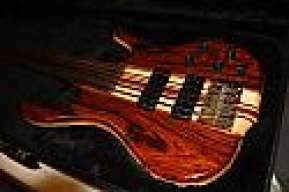
I have been through a TON of high end basses and have had cedar, ash, mahogany, poplar, alder, maple, walnut. lucite and black limba bodies. My favorites are absolutely WALNUT and ASH. This is true across multiple makers and instruments. The tonal distinctions are very subtle but very obvious. Of course, on fretless, a maple body really sings even more. Having said that, I found myself recently with the MTD bug and was just SO surprised at how good the EQ was (on all 3 of my MTDs) and how I could really dial in the natural resonance of the body with the EQ (of course the wenge necks help). And much to my surprise, 2 of the 3 have the growliest POPLAR/TULIPWOOD bodies. It is certainly a different animal than my Smith walnut core Elites or my Ash Roscoes, Elricks and Benavente's but WOW whoda thunk POPLAR could sound so good. I feel like a bit of a rehabilitated wood snob with my tail between my legs. Of course, these observations do invite the question: is TULIPWOOD i.e. YELLOW poplar different from the poplar bodies on Musicmans (Steve Morse model) and Fenders? Anyone have any info on that.
For what it is worth. I was a dyed in the wool MAPLE body freak (Pedullas) for a very long time. MAPLE is very DIRECT and FOCUSED. Then I got an ASH body bass and while there was a little less focus (which at first sounded like a volume drop) there was a warmth and a distinct separation in frequencies ranges that bloomed out of the ASH. CEDAR disappointed me and was too midrangey and sucked out the LOW tones, MAHAGONY felt the same way to me - too tight and midrangey ALDER was fairly close to the ASH and LIMBA was quite delightful.
I also learned that when playing Single Cuts terminating on the 12th fret there is added low and mid lows that can become overbearing with certain types of woods (mahogany and cedar for example) whereas the same model with an ASH body (even alder) just breathed like a fine violin.
What do I know except more than I thought I knew yesterday?! All I know is these POPLAR (tulipwood) MTDs just kill and like ASH the articulation is superb expanding the range and character of my tone more than I could get with straight maple body. (Still LOVE that all maple for fretless though = 110 focused fundamental).
Take it from an elitist wood snob - give POPLAR a good listen. If the build is first rate, and the top is HARD, it just might be sonic magic.
For what it is worth. I was a dyed in the wool MAPLE body freak (Pedullas) for a very long time. MAPLE is very DIRECT and FOCUSED. Then I got an ASH body bass and while there was a little less focus (which at first sounded like a volume drop) there was a warmth and a distinct separation in frequencies ranges that bloomed out of the ASH. CEDAR disappointed me and was too midrangey and sucked out the LOW tones, MAHAGONY felt the same way to me - too tight and midrangey ALDER was fairly close to the ASH and LIMBA was quite delightful.
I also learned that when playing Single Cuts terminating on the 12th fret there is added low and mid lows that can become overbearing with certain types of woods (mahogany and cedar for example) whereas the same model with an ASH body (even alder) just breathed like a fine violin.
What do I know except more than I thought I knew yesterday?! All I know is these POPLAR (tulipwood) MTDs just kill and like ASH the articulation is superb expanding the range and character of my tone more than I could get with straight maple body. (Still LOVE that all maple for fretless though = 110 focused fundamental).
Take it from an elitist wood snob - give POPLAR a good listen. If the build is first rate, and the top is HARD, it just might be sonic magic.


