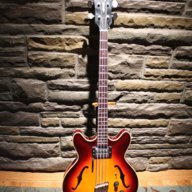
I would really love to get an explanation in non technical terms of how a electric bass guitar works. From the pluck of the string to the input of a bass amp. Any takers?

Enjoy the benefits of a premium membership!
Upgrade Account
-
TalkBass has been independent since 1998. Add your voice.
Create a free account to reply to discussions, view embedded media, and browse with fewer display ads.
Join free Log in
Want zero display ads or expanded classifieds tools? Compare plans.
You are using an out of date browser. It may not display this or other websites correctly.
You should upgrade or use an alternative browser.
You should upgrade or use an alternative browser.
Possible to explain to a dolt?
- Thread starter wold
- Start date
More options
Who Replied?

Pluck strings. Strings vibrate. Vibrating strings contain iron. Pickups have magnets wrapped in wire. Iron in vibrating strings in magnetic field induces electric current flow in wires around magnets. Wires connected to amp. Amp makes signal louder and sends to speakers. Speakers using wires wrapped around magnets attached to speaker cones convert electrical signal to sound.
Pluck strings. Strings vibrate. Vibrating strings contain iron. Pickups have magnets wrapped in wire. Iron in vibrating strings in magnetic field induces electric current flow in wires around magnets. Wires connected to amp. Amp makes signal louder and sends to speakers. Speakers using wires wrapped around magnets attached to speaker cones convert electrical signal to sound.
Terrific!
But how about between pup and the female output......Pots and caps?
Ok, the volume pot(s) is easy - it's a variable resistor connected to ground - turned one way, it puts lots of resistance between the signal and ground - turned the other way, the resistance goes to zero, and the signal gets bled off to the ground wire leaving no sound. The tone pot is a little more complicated but not by much - stick a capacitor of the correct value in between the pot and the ground - low frequencies don't go through capacitors well and stay on the signal, but high enough frequencies go right by the capacitor and are drained to ground, so it acts as a simple RC filter taking away high frequencies when you turn the pot that way. With the tone pot maxed the full resistance is in between the signal and the capacitor, so it doesn't really "see" the cap and the highs don't get drained away. (There are a couple of ways to do a tone knob, actually, but that's the most basic version.)
Add an on-board preamp and things get a lot more complicated, but it's all basically the same ideas - make all or part of the signal louder or softer, the parts of the signal you "tune out" get drained to ground before going out the jack.
Add an on-board preamp and things get a lot more complicated, but it's all basically the same ideas - make all or part of the signal louder or softer, the parts of the signal you "tune out" get drained to ground before going out the jack.

Even I get this. Explanations of things boiled down are hard to find for the most part. And, even harder for me to find. I've read these last two posts about four time and viola! Now maybe on to compression and equalization?Ok, the volume pot(s) is easy - it's a variable resistor connected to ground - turned one way, it puts lots of resistance between the signal and ground - turned the other way, the resistance goes to zero, and the signal gets bled off to the ground wire leaving no sound. The tone pot is a little more complicated but not by much - stick a capacitor of the correct value in between the pot and the ground - low frequencies don't go through capacitors well and stay on the signal, but high enough frequencies go right by the capacitor and are drained to ground, so it acts as a simple RC filter taking away high frequencies when you turn the pot that way. With the tone pot maxed the full resistance is in between the signal and the capacitor, so it doesn't really "see" the cap and the highs don't get drained away. (There are a couple of ways to do a tone knob, actually, but that's the most basic version.)
Add an on-board preamp and things get a lot more complicated, but it's all basically the same ideas - make all or part of the signal louder or softer, the parts of the signal you "tune out" get drained to ground before going out the jack.
EQ is easy enough - lets you boost some frequency ranges and cut others - sometimes to adjust for taste, sometimes to "tune" to the sound of the room, or to avoid feedback. How it's implemented is lots of fancy filters, beyond my grasp.
Compression is a bit trickier - the idea is to squish out some of the loud/soft dynamics - soften the strong attack phase of the note, and even out the sustaining part of the sound so that the volume stays constant longer - not supposed to affect frequencies ideally, but usually does to some extent - so basically squashes the loud parts and amplifies the soft parts and tries to make it all more even in volume.
That's about as far as I can go without studying up, someone who knows more will have to pick it up from here...
Compression is a bit trickier - the idea is to squish out some of the loud/soft dynamics - soften the strong attack phase of the note, and even out the sustaining part of the sound so that the volume stays constant longer - not supposed to affect frequencies ideally, but usually does to some extent - so basically squashes the loud parts and amplifies the soft parts and tries to make it all more even in volume.
That's about as far as I can go without studying up, someone who knows more will have to pick it up from here...
EQ is easy enough - lets you boost some frequency ranges and cut others - sometimes to adjust for taste, sometimes to "tune" to the sound of the room, or to avoid feedback. How it's implemented is lots of fancy filters, beyond my grasp.
Compression is a bit trickier - the idea is to squish out some of the loud/soft dynamics - soften the strong attack phase of the note, and even out the sustaining part of the sound so that the volume stays constant longer - not supposed to affect frequencies ideally, but usually does to some extent - so basically squashes the loud parts and amplifies the soft parts and tries to make it all more even in volume.
That's about as far as I can go without studying up, someone who knows more will have to pick it up from here...
Thanks beholder. This dolt needs all the help he can get!
Jeepers! That's a lot. Guess I know what I might do in my retirement years.
Your other option is to take a course in basic electricity/electronics at your local community college.
After that you should be able to figure out what each component is doing.
After that you should be able to figure out what each component is doing.
Your other option is to take a course in basic electricity/electronics at your local community college.
After that you should be able to figure out what each component is doing.
Over the years I have done a plethora of electrical types of work. Everything from design/build residential and commercial AC/DC wiring DDC,PE,EP HVAC Environmental control,security and on and on. But, remarkably nothing much to do with magnetic s aside from the coil type activated solenoid. If it's on a schematic I can usually follow it. But practical and theory are on different sides of the universe to me.

I know what they would say if I walked in...hey grandpa..the wicker chair making class is down the hall in the other classroom.Your other option is to take a course in basic electricity/electronics at your local community college.
After that you should be able to figure out what each component is doing.
Speaking of old guys in community college:
Once I was sitting next to a teenage classmate & logged into the shared computer. He was blown away that I had over 10K unread messages on gMail.
I explained that I've had gMail since it was a thing.
you should be able to read this then:

They mistakenly label it "tone" pot, but we both know it cuts more than one tone from the treble frequencies of the timbre.
Once I was sitting next to a teenage classmate & logged into the shared computer. He was blown away that I had over 10K unread messages on gMail.
I explained that I've had gMail since it was a thing.
Over the years I have done a plethora of electrical types of work.
you should be able to read this then:
They mistakenly label it "tone" pot, but we both know it cuts more than one tone from the treble frequencies of the timbre.
I have over 111K right now. But I don't delete much...I had over 10K unread messages on gMail.
Coincidentally, one of those tabs fills up with messages from the community college, where I haven't attended for years.
The other tabs get little attention, Social especially. It's filled with Twitter & FB updates that I don't care about.
The Primary tab is largely read.
BTW, that S.D. course on guitar electronics seems pretty thorough!
The other tabs get little attention, Social especially. It's filled with Twitter & FB updates that I don't care about.
The Primary tab is largely read.
BTW, that S.D. course on guitar electronics seems pretty thorough!
you should be able to read this then:
View attachment 2960238
They mistakenly label it "tone" pot, but we both know it cuts more than one tone from the treble frequencies of the timbre.[/QUOTE]
OK I get that......I guess I'm just hung up on the magnetic effect on electrical flow or vice versa for that matter. Obviously my brain is just a knot. Cept when I'm jamming.
View attachment 2960238
They mistakenly label it "tone" pot, but we both know it cuts more than one tone from the treble frequencies of the timbre.[/QUOTE]
OK I get that......I guess I'm just hung up on the magnetic effect on electrical flow or vice versa for that matter. Obviously my brain is just a knot. Cept when I'm jamming.
Think of the pickup as a generator, because it basically is.
It's using the same principles as the speaker is to produce the sound, only backwards.
It takes a motor to generate electricity or electricity from the generator to run a motor, LOL!
and the strings (wire) vibration is the thing that induces the voltage into the pickups
It's using the same principles as the speaker is to produce the sound, only backwards.
It takes a motor to generate electricity or electricity from the generator to run a motor, LOL!
and the strings (wire) vibration is the thing that induces the voltage into the pickups


