• TalkBass has been independent since 1998. Add your voice.
    Create a free account to reply to discussions, view embedded media, and browse with fewer display ads.
    Join freeLog in
    Want zero display ads or expanded classifieds tools? Compare plans.

Potentially silly power amp questions

I'm looking into getting a power amp for my cabinet, and have a few questions

If it says stereo 4 ohms at 500 watts, does that mean I take two separate feeds off of the power amp, one into 1 4ohm cab, 1 into another 4 ohm cab? Does that drop the cabs to 2ohms, or is it still 4ohm because the cabs are not connected to each other?

If the power amp is 1000 watts at 2ohms, and I connected it like poweramp, cab1, cab2 - would it see 2ohms that way? Would 1000watts at 2ohms be the same volume as the above example, where two cabs are both seeing 500watts each? Is that how it's calculated, 500+500, or is the 2ohm option going to be much louder?

And I've seen some talk about this on here, but just want to make sure - if I have 1000 watts going into a 500 watt cab, have it at half volume, compression, peak limiter, etc - is that all ok, as long as I'm not going too crazy?

Just some theoreticals, as that's more wattage than I would ever need, but I just wanted to check.

Thank you!
 
Depends on design for some things.

Generally with power amps, yes, the marketed specs are for each totally independent channel.

Ohms; impedance actually, that is measured in ohms, is provided to the equation by you, the user. This is determined by what and how many cabs are connected.

Bridge mode will differ per amp, designer and manufacturer but is typically the combined power into double the minimum impedance.
 
500 watts per channel would be each channel delivering rated power (500 watts) into separate speakers at the load specified in the power rating of the amp.

The load that the speaker provides to the amp is unrelated to the amp itself. An amp can drive a minimum specified load and the speaker needs to be greater than or equal to the amp's minimum rated load.

Bridged operation is entirely different, you need to understand and respect the amp's requirements when operating bridged.

I generally recommend matching the RMS power of the amp to the RMS power handling of the speaker. Beware of things like peak power or program power, etc, they are mostly a marketing department thing. The volume or input level controls on an amp do NOT limit the power, which is why I make the recommendation above.
 
I kinda didn't really answer many questions there....

Ok, so each channel operates its own amp. Yes one 4 ohm cab per side should make 500 watts available in your example, and correct the load each channel is presented with is 4 ohm. Never use a stereo amp with opposite channels combined to one cab, or cabs sharing both outputs.


And Mr. Horse tidied my mess up there while I was typing ;)
 
And please, don't use the amp in bridged mode. Totally unnecessary with the amount of power available in stereo/parallel mode.
Some of these numbers I'm seeing are absolutely insane. I was thinking of maybe getting a lower wattage amp and running bridged just to get a reasonable number into my 810, but I really think getting a more powerful amp and running it normally is the way to go
 
  • Like
Reactions: DWBass and ashtray
Well, if you particularly liked your 4 ohm cab and wanted to run 2 of them stacked then this is an option that many amps can't offer. You would need an amp that can operate at 2 ohms,m or separate amps. A power amp is the latter.

What is the end goal? Do you need two amp channels? Is all of your tone on a pedal board, just need power? I ask because there's a lot of power options a lot smaller than 19" wide.
 
  • Like
Reactions: S-Bigbottom
Thank you all! It's all starting to make sense. So in this case, would there be a point to running two separate 4 ohm cabs if they are both getting 500 watts? Would that just be to have two cabs on two sides of the stage or something while keeping the volume the same?

I think you nailed it although I wouldn't place (2) bass enclosures on opposite sides of the stage. I use the same: (2) 4 ohm enclosures paired with an older Crown XLS 1500 (see chart below) which does ~500 watts per side / 4 ohms...one enclosure per amp channel. Sometimes I use only one enclosure and one channel. For the big woop-de-do's, I may use both enclosures and both amp channels. While bridged mode is an option, I think it best be left alone for the time being.

XLS_DriveCore_original.png
 
  • Like
Reactions: dbase
Agree. My old Carvin BX1500 worked like this. I typically ran each channel into its own 8 ohm cab. Each got 300 watts with that load. Sure, I could run them both off the same channel and get 450 watts with that 4 ohm load, but I usually didn't. And I never bridged them together 900 at 8 and 1500 at 4 ohms. That seemed almost suicidal. But the real attraction for me was this: it was reassuring to me that I could, if I wanted to, run two different cabs of entirely different power handling capabilities and be totally fine. I could, if the fancy struck me, run an 800 watt 4 ohm 410 on one side and a 150 watt 8 ohm 112 on the other. All I need to do is dial them each in with their own separate volume knobs and I'm golden. No, I never actually did this, but I loved the fact that I could.
 
Last edited:
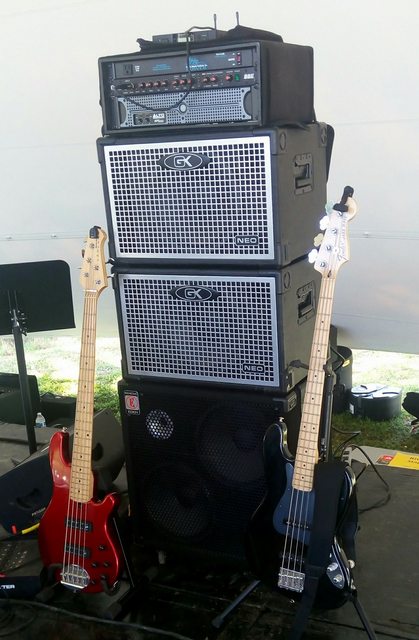
This is my big rig setup. I use parallel mode. The 2 8ohm GK's get 500w from one side of the amp. The 4ohm Eden on the bottom gets 500w from the other side of the amp. I rarely use this setup but when I do, I can get pretty loud. To some of y'all, 1000 total watts doesn't seem like a lot but trust me, it's plenty.
2APEBR1l.jpg
 
Last edited:
Would that just be to have two cabs on two sides of the stage or something while keeping the volume the same?

Don't separate the cabs like that for Bass frequencies
You may be standing close to one speaker and think it sounds fine, but the bass sound going to the audience could be disintegrated.
Read this: The “Power Alley” - Discussion & Solutions To The Troubling Interaction Of Subwoofers - ProSoundWeb
Read the article to find out why it's OK for mid/high frequencies to widely separate cabs.
 
This is my big rig setup. I use parallel mode. The 2 8ohm GK's get 500w from one side of the amp. The 4ohm Eden on the bottom gets 500w from the other side of the amp. I rarely use this setup but when I do, I can get pretty loud. To some of y'all, 1000 total watts doesn't seem like a lot but trust me, it's plenty.
2APEBR1l.jpg
1000W for those speakers is plenty of SPL IMO. I am driving Crown XLS 1002 bridged 1100W at 4 ohm to 810 and 700W at 8 ohm to 410 and would not ask for more. I choose lower power model because of very low price 285€ compared to other models. It would give total 700W in stereo to dual 4 ohm setup like yours being plenty loud, but could not run 2 ohm load in bridged mode for those.

Nice setup you have. PA power amp offers extreme flexibility to cabinet combinations.
 
hey somewhat of a new post i recently got a carvin bx1500 and really like especialy being able to biamp ive used it with my peavey 215 and 1810 as a stack or the 1810 with the high and low split but im currently having issues output 1 works great and so does the biamp output work but output 2 does not have any signal unless i really crank it then it work but cut out here and there what would cause this or how could i fix it or should i begin looking for a new head